

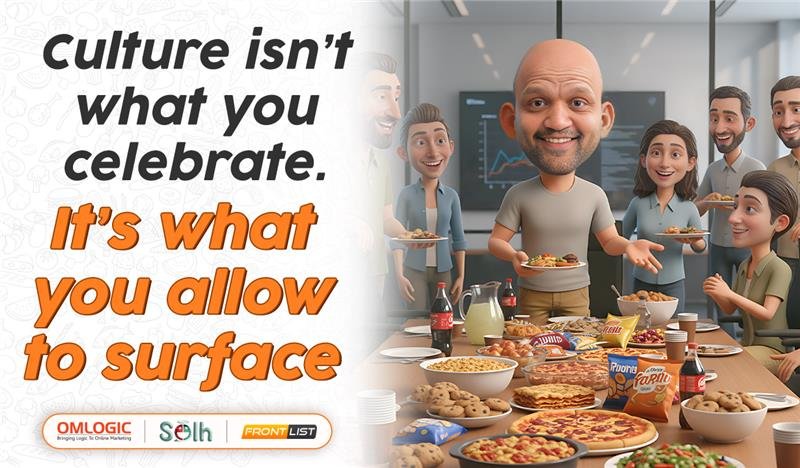
Potluck. Not the Food One. The Honest One.

Between Christmas and New Year, when most companies are pretending to work or aggressively “recharging”, we do something far more uncomfortable.
We talk.
At OMLogic, every team sits down for a potluck.
Not food.
Ideas.
One team.
One table.
One brutally honest conversation about workplace culture as it actually exists—not how it’s presented.
What worked.
What failed.
What broke.
What we should never repeat.
What we absolutely must do next year.
No decks.
No speeches.
No “positive energy only” nonsense.
Just people who actually worked together, telling the truth.
Why We Call It Potluck
Because everyone brings something.
- A mistake they made
- A system that slowed everyone down
- A client moment that changed how they think
- An idea they never found space to voice
- A hard truth they avoided all year
Silence is not participation.
Comfort is not the goal.
This isn’t therapy.
This isn’t bonding.
This is organizational culture in practice—specifically, a system for honest feedback at work.
If you don’t close the year honestly, the next year opens with friction.
What People Reveal (And This Is the Real Magic)
Here’s the part no culture consultant will tell you.
These conversations expose real workplace culture problems far faster than surveys or town halls.
Potlucks reveal intent.
Some people show up ready for more.
They speak sharper.
Think bigger.
Take ownership beyond their role.
You can see it clearly.
Some high flyers… don’t.
They coast.
Deflect.
Avoid accountability.
You realise they peaked earlier than you thought—often a silent sign of deeper company culture problems.
And then there are others.
Some people use the potluck to say:
“I want to be a solid part of this team.”
Not flashy.
Not loud.
But dependable.
And some use it to quietly wear off.
They disengage.
Emotionally exit before formally doing it.
This quiet disengagement is exactly how top talent quits without being noticed in most organisations.
The signals are all there.
And here’s the part most leaders struggle with.
I love both outcomes.
Because clarity is kindness.
And pretending is expensive—especially in leadership and workplace culture.
The Good. The Bad. The Ugly. On the Table.
The structure stays simple.
The Good
What genuinely moved the needle.
Not vanity wins. Real impact.
The Bad
Decisions that sounded smart and aged badly—classic workplace culture issues hiding inside good intentions.
The Ugly
Friction. Ego. Missed handovers. Avoided conversations.
The roots of toxic workplace culture if left untouched.
Then we define Do’s and Don’ts for the next year.
Not aspirational.
Executable.
This is how workplace culture improvement actually happens—without drama.
Innovation Without the Theater
No one says “innovation”.
They just suggest:
- Kill this process
- Automate that workflow
- Change how we brief
- Stop doing this entirely
- Try this quietly for 30 days
Some of OMLogic’s strongest systems, client models, and internal frameworks have come directly from these conversations—not workshops about building workplace culture, but honest team-level problem solving.
Not from offsites.
Not from consultants.
Not from “culture initiatives”.
From people who were allowed to speak honestly without punishment.
That’s how team culture evolves when leadership gets out of the way.
Culture Isn’t an Offsite. It’s a Filter.
Potlucks do something most companies avoid.
They filter.
Not aggressively.
Not cruelly.
Naturally.
People self-select.
- Some step up
- Some stabilise
- Some step out
And all three outcomes are healthy.
Because improving workplace culture isn’t about keeping everyone.
It’s about knowing who’s actually in.
From OMLogic to Solh. Same DNA. Same Results.
This system didn’t stay inside OMLogic.
It carried straight into Solh.
Different domain.
Higher emotional stakes.
Same rule.
Close the year honestly.
Enter the new one clean.
The impact was immediate:
- Faster alignment
- Less internal noise
- Sharper product thinking
- Clearer ownership
- Fewer “this was never discussed” moments
When mental health and stress are your business,
internal pretending becomes an unhealthy workplace culture risk.
This is why stress becomes the invisible metric killing companies long before performance numbers dip.
Solh didn’t need a new culture.
It inherited a working one—rooted in employee feedback culture, not performance theater.
No Fluff. No Moral Lectures. Just Respect for Reality.
We don’t do culture for LinkedIn.
We do it so January doesn’t feel like denial.
Potlucks aren’t cute.
They’re necessary.
Because teams that avoid truth in December
end up managing exits, resentment, and workplace culture conflict by March.
My Passport Can Take Me to 60 Countries. It Just Can’t Prove Which One I’m From.