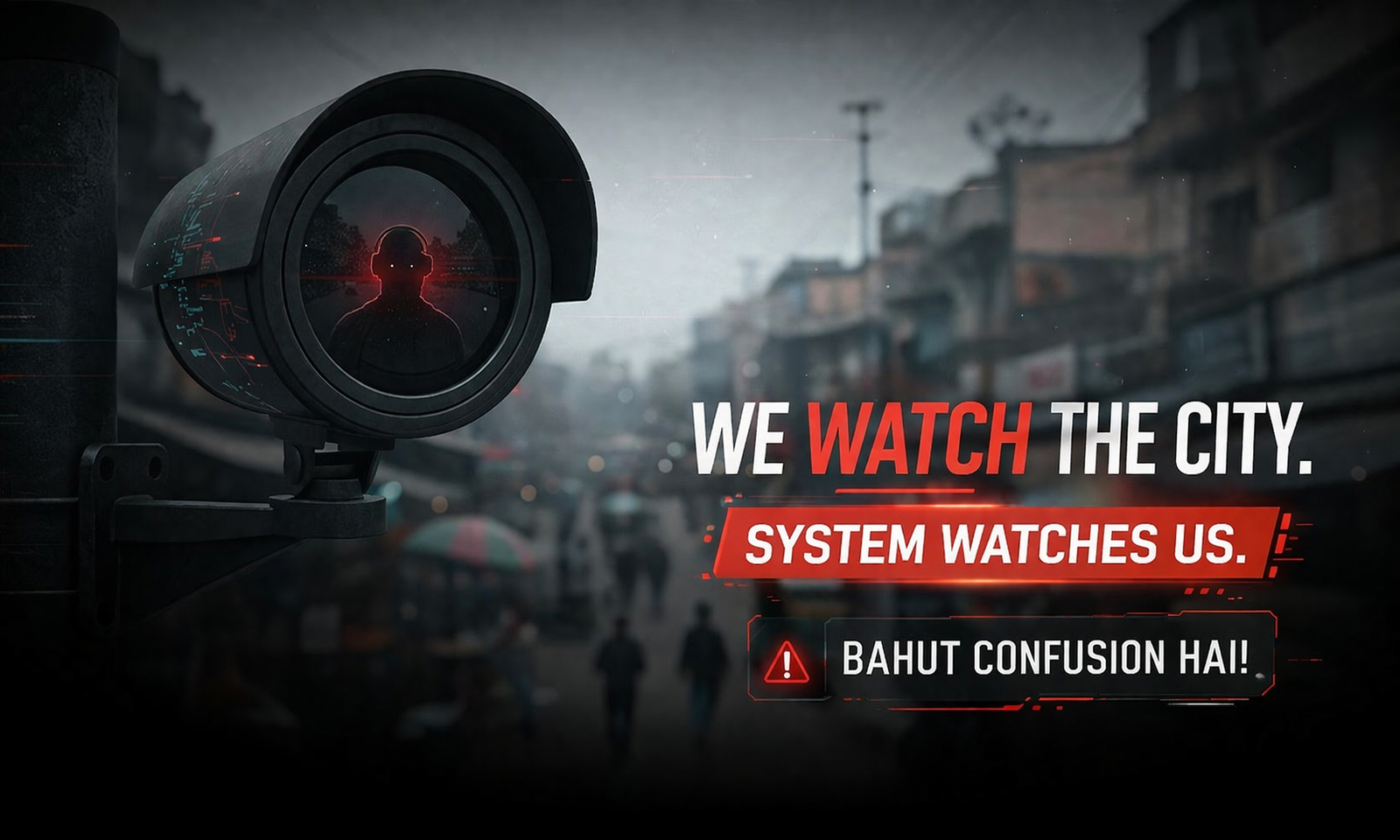
DELHI’S CCTV U-TURN: WERE WE PROTECTING CITIZENS… OR EXPOSING A CITY?

Delhi Installed 2.7 Lakh Cameras to Feel Safe. Now It’s Removing Them to Actually Be Safe.
(Delhi CCTV cameras removed — and why it matters)
Let that sink in.
For years, Delhi sold its CCTV network as a symbol of safety.
“World’s most surveilled city.”
“Every street covered.”
“Women safer than ever.”
And now?
We’re quietly dismantling over 1.4 lakh cameras as part of a larger Delhi government CCTV removal move.
Half the system.
Because the same infrastructure that promised security…
may have compromised it.
This Isn’t a Fix. This Is an Admission.
You don’t rip out 250,000+ cameras unless something is fundamentally broken—especially in a city already facing a growing Delhi surveillance system issue.
This is not:
“system upgrade”
This is:
“we trusted the wrong system.”
The Political Noise (Convenient, but Incomplete)
Of course, the blame game has started:
- Installed under AAP
• Questioned and dismantled under BJP ecosystem
And like clockwork:
- One side screams “national security”
• The other screams “selective outrage”
But here’s the uncomfortable truth:
👉 Even if this is political… it doesn’t make it incorrect.
Sometimes politics exposes problems.
It doesn’t create them.
The Real Issue: You Didn’t Install Cameras. You Installed Computers.
Most of these cameras are from Chinese manufacturers like Hikvision—at the center of the ongoing Hikvision cameras India controversy.
Globally:
- Restricted in the US
• Scrutinized across Europe
• Flagged in multiple cybersecurity audits
Why?
Because these aren’t dumb cameras.
They are:
- Internet-connected
• Firmware-driven
• Data-processing devices
In simple terms:
👉 They are surveillance machines that can be surveilled—raising serious concerns about Chinese CCTV cameras security risk.
The Fear Nobody Wants to Admit
Is there proof that China is watching Delhi through these cameras?
No.
Is there a possibility?
Absolutely.
And in cybersecurity:
Possibility is already failure.
Because by the time you have proof,
you don’t have control anymore.
This is exactly why experts are questioning:
👉 is CCTV surveillance safe in India?
Imagine the Scale of Exposure
Now think about this:
- 1.4 lakh connected devices
• Spread across the capital
• Watching roads, homes, movement patterns
• Feeding into centralized systems
If compromised, this is not a leak.
This is:
a live intelligence grid—one of the biggest CCTV security risks India could face.
Can This Be Secured Technically?
In theory:
- Isolate networks
• Block external access
• Audit firmware
• Encrypt everything
In reality?
Across:
- 2.7 lakh cameras
• Multiple vendors
• Multiple integrations
👉 You cannot guarantee absolute control—especially when dealing with large-scale cybersecurity risks in smart cities India.
And national security doesn’t work on “mostly secure.”
The Real Mistake: Speed Over Sovereignty
This is where the failure actually lies.
We optimized for:
- fast rollout
• low cost
• scale
We ignored:
- control
• origin of tech
• long-term risk
We built infrastructure first.
We asked questions later.
This Is Bigger Than Delhi
This isn’t just about the Delhi CCTV cameras removed story.
This is a geopolitical tech problem.
The world is already in a silent war:
- US vs China
• Data vs sovereignty
• Infrastructure vs control
India is just entering that conversation late—especially around the risks of Chinese surveillance technology.
BJP vs AAP? Or China Threat?
Let’s not dilute this.
👉 It is political.
👉 It is also real.
And that’s the dangerous combination.
Because when politics meets real risk:
- truth gets diluted
• urgency gets questioned
• action gets delayed
The Bigger Question Nobody Is Asking
Removing cameras is easy.
Replacing them is the real risk.
- Who are the new vendors?
• Are they secure or just “non-Chinese”?
• Do we even have Indian alternatives at this scale?
Because if the answer is:
“we don’t know”
Then we’ve learnt nothing.
Final Thought
This isn’t about cameras.
This is about:
- who controls visibility
• who owns infrastructure
• who sees what we think is ours
For years, we believed:
more surveillance = more safety
Now we’re realizing:
uncontrolled surveillance = vulnerability
And the scariest part?
We didn’t discover this through a breach.
We discovered it through suspicion.
Which means the system was never trusted to begin with.
FAQ
1. Why is Delhi removing CCTV cameras?
Delhi is removing a large number of CCTV cameras due to cybersecurity and national security concerns, particularly involving Chinese-manufactured devices. Authorities fear that these internet-connected surveillance systems could be vulnerable to external access, making them a potential risk rather than a safety measure.
2. Are Hikvision cameras banned in India?
As of now, Hikvision cameras are not officially banned in India, but they are under scrutiny due to global security concerns. Several countries, including the United States, have restricted their use over fears of data privacy risks and potential foreign surveillance.
3. Are Chinese CCTV cameras a security risk?
Chinese CCTV cameras can pose a security risk because they are internet-enabled devices that rely on firmware and remote access systems. If not properly secured, they may be vulnerable to hacking, unauthorized access, or data transmission to external servers, raising concerns about surveillance and data privacy.
4. Is CCTV surveillance safe in India?
CCTV surveillance in India can improve public safety, but it is not completely risk-free. The safety of such systems depends on factors like device origin, network security, data encryption, and regular audits. Poorly secured systems can become cybersecurity vulnerabilities instead of protective tools.
5. What are the security risks of CCTV cameras?
The main security risks of CCTV cameras include hacking, unauthorized remote access, data leaks, and surveillance misuse. Since modern CCTV systems are connected to the internet, they can be exploited if proper cybersecurity measures are not in place, potentially exposing sensitive information and movement patterns.