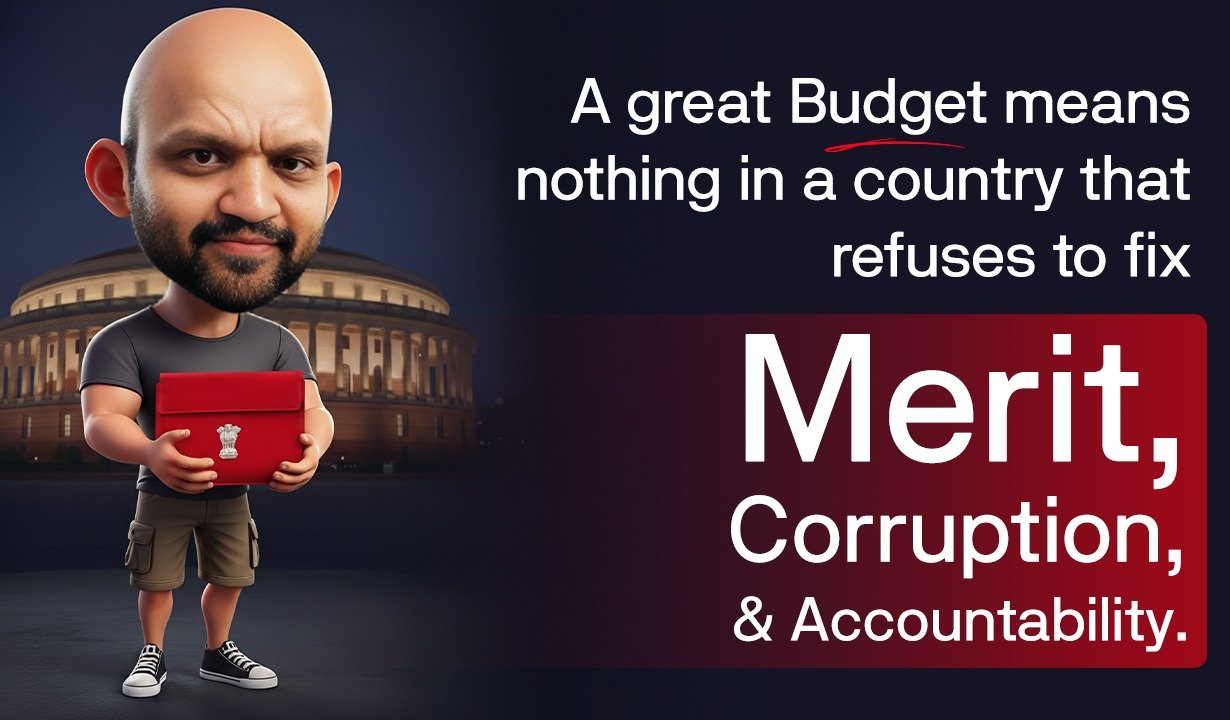
India Budget 2026 Analysis: The Pivot That Works – If We Fix Three Things

India’s Union Budget 2026 reads well. In parts, it reads very well.
A decisive push on infrastructure. A long-awaited FTA with the European Union. A strategic response to US tariff unpredictability. Healthcare graduating from a social obligation to an economic industry. And a quiet confidence that India, along with China, is now contributing 40%+ of global GDP growth — far ahead of ageing Western economies.
On paper, this is a grown-up budget.
(• Economic clarity • Strategic intent • Global alignment)
But paper doesn’t run a country.
All of this only works – truly works – if India confronts three uncomfortable, structural truths.
Before we get there, let’s understand what this India Budget 2026 analysis is really revealing.
The EU FTA: A Structural Shift, Not a Headline
The India–EU Free Trade Agreement is not another photo-op deal. It fundamentally changes India’s trade geometry and stands out as one of the most consequential Union Budget 2026 highlights.
- Zero or near-zero duties for Indian textiles, leather, jewellery, engineering goods, MSME exports
• Easier access to a 27-nation market contributing ~25% of global GDP
• Inflow of European technology, machinery, medical devices, aerospace inputs
For the budget, this means two things:
- Export-led job creation becomes realistic, not rhetorical
- India reduces over-dependence on the US and China for demand
This is long-cycle thinking.
(→ Market diversification → Jobs → Industrial depth)
US Tariffs: Why the Budget Had to Go Industrial
US tariffs and trade unpredictability forced India’s hand.
The response in Budget 2026 is clear: build domestically, scale globally – a core theme running through any serious Union Budget 2026 analysis.
- Higher capital expenditure
• Strong manufacturing incentives
• A decisive push in pharma, biopharma, electronics, and semiconductors
This is not protectionism. This is insurance.
Healthcare: From Welfare Line Item to Economic Engine
The most under-discussed shift in Budget 2026 – and a major India Budget 2026 economic impact story — is healthcare.
Healthcare has officially moved:
- From charity → capability
- From social sector → industrial sector
Duty waivers on cancer and rare-disease drugs. Investments in biopharma. Medical tourism. Workforce expansion. Mental health infrastructure.
This is healthcare as GDP, exports, jobs, and resilience – not just expense.
(• Productivity • Scale • Economic security)
The Macro Reality: India + China = The Growth Engine
While the US and Germany manage slow growth, India and China together are driving over 40% of incremental global GDP growth. Global power shifts shaping India’s economic future
Budget 2026 leans into this reality instead of apologising for it – a perspective often missing from surface-level India Budget 2026 explained coverage.
India is no longer a supporting actor in the global economy. It’s writing plotlines.
Now The Hard Part: Three Things That Can Still Break This Story
Everything above works if and only if India fixes three chronic diseases –structural weaknesses in India’s economic governance.
- Reservations and the Absence of Meritocracy
No economy scales on compromised competence.
You cannot talk about manufacturing excellence, healthcare leadership, or global competitiveness while systematically diluting merit.
Corrective action was meant to be temporary. It has become generational entitlement.
School education should be the great equaliser. After that, support must be economic, not identity-based. Beyond schooling, merit must rule.
(→ Competence → Efficiency → Global credibility)
Without this, the best budget becomes an average execution – regardless of how positive the India Budget 2026 impact on economy appears on paper.
2. Corruption at the Basic, Everyday Level
Big-ticket corruption makes headlines.
Small-ticket corruption cripples nations.
Licences. Permissions. Inspections. Local offices. Municipal bodies. Police stations.
Budget allocations mean nothing if execution leaks at the bottom. Corruption is not a moral problem anymore – it’s an economic tax on growth.
(− Productivity − Trust − Speed)
3. Apathy and Zero Accountability in Government Supervision
India does not lack policies.
India lacks supervisors who are answerable.
Files move slowly because no one pays a price for delay. Outcomes are optional because consequences are absent.
Without accountability, even well-designed budgets turn into annual rituals – one of the biggest India Budget 2026 pros and cons rarely acknowledged.
Impact on the Common Man
If executed well:
- Better healthcare access and affordability
- More manufacturing and export-linked jobs
- Stable taxes with no shock therapy
- Lower long-term costs through scale
If the three issues remain untouched:
- Same frustration
- Same inefficiencies
- Same promise, different year
Final Take
Budget 2026 is directionally right.
But nations don’t fail because of bad plans. They fail because of weak execution.
Fix meritocracy. Crush everyday corruption. Enforce accountability.
Do that — and this budget becomes a turning point. Ignore it – and it becomes another well-written PDF.
India deserves better than PDFs.
FAQs: India Budget 2026 Analysis
1. What is the budget of India for 2026?
India’s Union Budget 2026 focuses on higher capital expenditure, manufacturing-led growth, healthcare expansion, and export competitiveness. While exact allocation numbers vary across ministries, the budget prioritises infrastructure spending, industrial incentives, and long-term economic resilience over short-term populism. This reflects a strategic shift toward sustainable growth rather than consumption-driven stimulus.
2. What is expected in Budget 2026 in India?
Budget 2026 is expected to emphasise industrial scaling, trade diversification, healthcare as an economic sector, and export-led job creation. Key expectations include stronger manufacturing incentives, reduced trade dependence on the US and China, deeper global integration through FTAs, and continued focus on capital investment rather than welfare-heavy spending.
3. What is in the new budget for 2026?
The new budget for 2026 includes a decisive push for infrastructure, manufacturing, healthcare, and global trade integration. Notable inclusions are support for pharmaceuticals, biopharma, electronics, and semiconductors, duty waivers on critical healthcare drugs, and policy alignment to leverage the India–EU Free Trade Agreement for exports and jobs.
4. What are the highlights of the Budget 2026?
Key highlights of the Union Budget 2026 include:
- A strong focus on export-led growth and manufacturing
- Strategic use of the India–EU FTA to expand market access
- Healthcare repositioned as an economic and industrial engine
- Higher capital expenditure to counter global trade uncertainty
- A long-term growth outlook aligned with India’s rising role in global GDP growth