India EU FTA Impact on Indian Economy – A Tariff-Lighter World Takes Shape

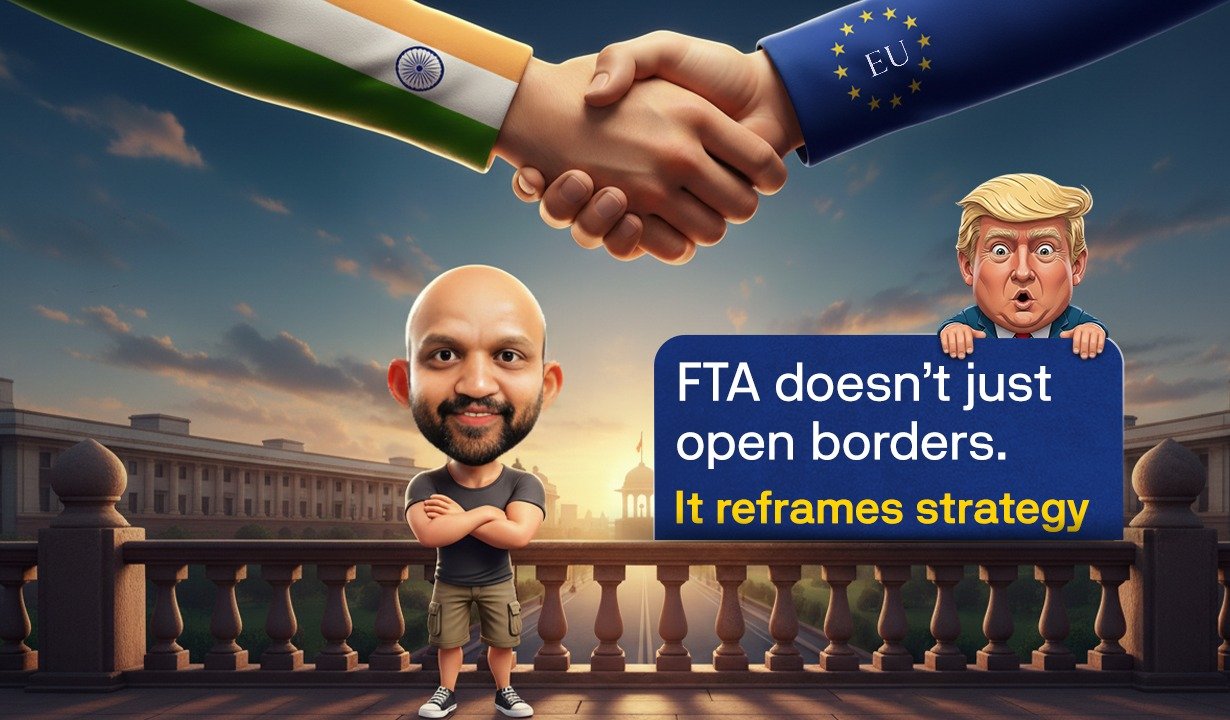
This is historic — not because it’s perfect, but because it proves India is finally playing big-league global economics, not just defensive bilateral skirmishes. And if you read both headlines and history with honest eyes, what’s happening here is a clue about the world I’ve been writing about in India Vision and later in KGism — a world where tariffs fade and trade reflects real comparative advantage.
The India EU FTA impact on Indian economy goes far beyond a single trade announcement. It signals how India is repositioning itself in global trade corridors.
Let’s unpack what this deal means — fast and hard.
A World Without Tariffs — The KG Vision
Here’s a truth no politician says out loud: tariffs are nothing but economic blindfolds. They pretend to protect, but mostly they distort. If I had my way — and one day I suspect this will be the global norm — people would import and export goods based on:
✔ What they do best
✔ Where nature and human expertise give them an edge
✔ How efficiently they can participate in global value chains
No tariff walls. No tariff wrestle.
That’s not fantasy. That’s real economic equality — not the mushy, dependent, lifelong quota sort.
The India EU free trade agreement is a step in that direction: a world where goods and ideas move closer to where they’re most productive, not where they’re most shielded. This is exactly how the impact of India EU trade deal should be understood — structural, not sensational.
But as always, here’s the twist.
Sector Roundup — Winners, Realities, and Misplaced Hype
✔ Textiles & Leather — A Massive Opportunity
India’s apparel, garments, leather, and footwear industries have spent decades competing with Bangladesh and Vietnam under EU duty disadvantages. With tariff elimination, the India EU FTA textile industry impact suddenly becomes tangible — access and competitiveness, not just headlines.
This is one of the clearest India EU FTA benefits for manufacturing-led exports.
✔ Spices & Agro Exports — Aroma Meets Access
Zero-duty access means spice hubs like Gujarat could see a major export surge — a real rural-to-global link. The India EU FTA agriculture impact fits neatly with how KGism views grassroots productivity feeding global markets.
✔ Engineering & MSMEs — Supply Chain Upgrade
Engineering exports could jump to USD 25 billion in two years as tariff barriers dissolve. The India EU FTA MSME impact is not anecdotal; it’s trajectory-driven and supply-chain led.
This is where tariff reduction under India EU FTA quietly does the heavy lifting.
✔ Pharma & MedTech — Real Global Integration
Healthcare, medical devices, and pharmaceuticals gain cheaper European entry and stronger export footing. The India EU FTA pharma sector stands to benefit from deeper integration, job creation, and innovation spillovers — a textbook case of free trade agreement impact on India done right.
✔ Services & Mobility — Skilled Indians Gain
The deal also opens services and “Mode 4 mobility” pathways so Indian professionals can move more fluidly. The India EU services trade and mobility framework turns trade into brain circulation — and India is a net winner here.
AUTO SECTOR – The Elephant in the Room (But Not the Idol)
Now here’s where logic has to beat enthusiasm.
The India EU FTA automobile sector does see tariff reductions on fully imported cars — from over 100% to roughly 30–40% initially, with quotas and phased cuts.
But real talk:
→ Most cars Indians buy today are made or assembled in India
→ Local assembly already attracts lower duties — and that doesn’t change meaningfully
So the headline “cars will get cheaper!” misunderstands the India EU trade agreement analysis. Only premium and luxury segments feel meaningful relief. The mass market remains structurally untouched.
Worse, if the tariff gap collapses too fast, European manufacturers may prefer imports over production. That weakens localisation incentives — a risk policymakers must watch closely.
This is why not every India EU FTA benefit is automatic.
How This FTA Helps India Play on the World Stage vs the U.S.
Amid tariff wars, U.S. protectionism, and unstable trade rules, the India EU trade relations framework gives India strategic breathing room.
It allows India to:
✔ Diversify export destinations
✔ Avoid single-bloc dependence
✔ Balance global trade partnerships
This puts India not in a defensive posture, but in the driver’s seat of multiple global trade corridors. Read this in the context of India’s broader foreign trade strategy.
It’s not India vs the U.S. — it’s India between the U.S., EU, and emerging markets, pulling benefits from all sides.
This positions India not defensively, but assertively — shaping its global trade strategy instead of reacting to shocks.
The Pro-India Growth Narrative
Here’s the punchline:
India doesn’t want charity. It wants markets.
It doesn’t want fences. It wants bridges.
The India EU FTA impact on Indian economy lies in selective dismantling of barriers where it matters most:
— Open goods markets
— Boost exports
— Deepen supply chains
— Expand services and mobility
All while protecting sensitive sectors and allowing gradual adjustment.
This is strategic opening — not ideological surrender.
FAQ
- What is in the India–EU FTA?
The India–EU Free Trade Agreement includes tariff reductions on goods, improved market access for Indian exports, cooperation on services and professional mobility, investment protection, intellectual property norms, and regulatory alignment to ease cross-border trade between India and the European Union. - What is the FTA in the EU?
An FTA in the EU refers to a free trade agreement between the European Union and another country or region that reduces or eliminates tariffs, simplifies trade rules, and improves access to EU markets while maintaining common EU trade standards. - What does the EU import from India?
The EU imports textiles and garments, pharmaceuticals, engineering goods, chemicals, leather products, agricultural items like spices, and IT-enabled services from India, making the EU one of India’s largest export destinations. - What is the FTA agreement?
An FTA agreement is a trade pact between two or more countries that lowers or removes tariffs, reduces trade barriers, and establishes rules to promote smoother exchange of goods, services, and investments.
5. What are the benefits of the EU free trade zone?
The EU free trade zone benefits member states by enabling tariff-free movement of goods, creating a large unified market, lowering costs for consumers, improving supply-chain efficiency, and increasing global competitiveness through scale and regulatory consistency.