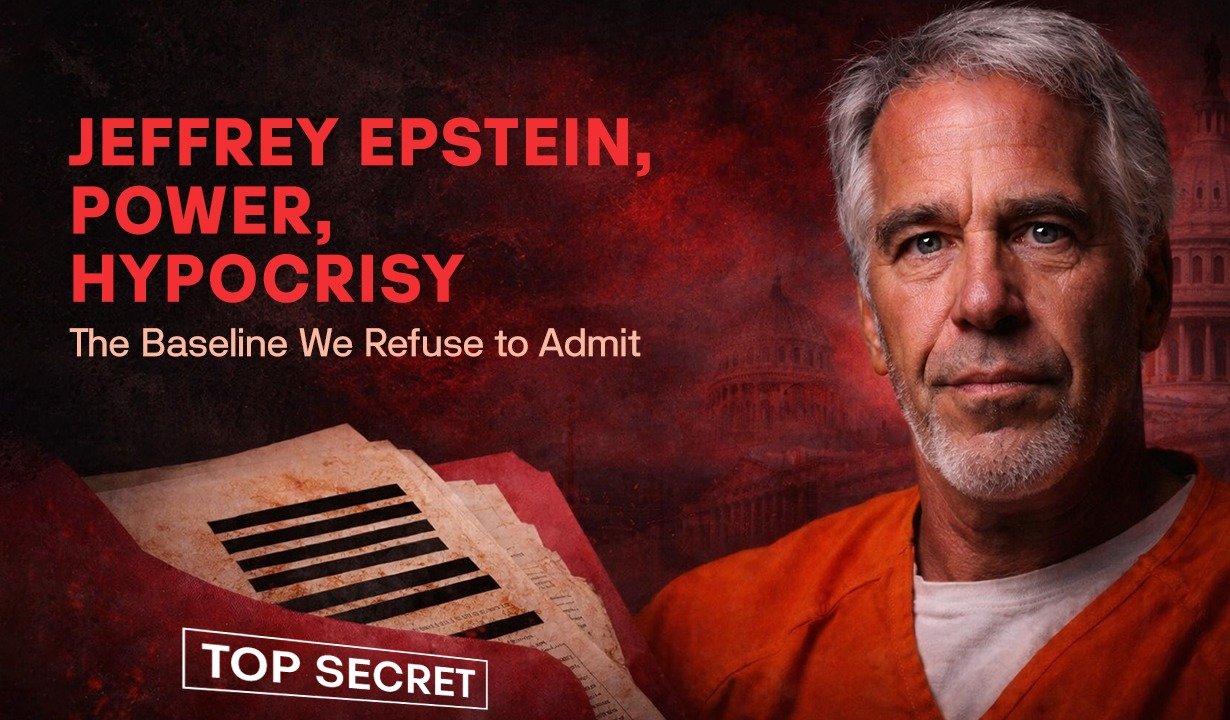
Jeffrey Epstein, Power, Hypocrisy & the Baseline We Refuse to Admit

Jeffrey Epstein, India, and the Art of Missing the Point
The world is once again pretending to be shocked.
Jeffrey Epstein is back in the news, and with him, the ritualistic pointing of fingers at anyone who ever shook his hand, boarded a plane, or attended a party where bad decisions were served with champagne. What follows is less justice and more media hysteria around Epstein, driven by implication rather than evidence.
India’s response has been quietly sensible: Indian stories in the Epstein files are pointless.
Not because abuse should be ignored. But because noise is being confused for truth in the larger Jeffrey Epstein controversy analysis.
Epstein was four things simultaneously:
• A political fixer
• A rich, party-loving social connector
• A convicted sex offender
• A man who owned an island and access
He knew everyone. Everyone knew him. That alone is not a crime, even in the context of Jeffrey Epstein power and influence.
Let’s be painfully honest. Prostitution, drugs, and moral stupidity are normal human behaviour at scale. Not admirable. Not condonable. But common. Pretending otherwise is theatre — a substitution of outrage for an evidence-based justice system.
The line is simple and non-negotiable.
Anyone who interacted with Epstein after he was formally labelled a sex offender, and sought or exchanged political, legal, or institutional favours, is complicit and deserves investigation. That is the only defensible Jeffrey Epstein case legal perspective.
Everything before that is context, not conviction.
Dragging India into this via vague name drops achieves nothing. There is no evidence trail. No minors. No coercion. No transactional abuse. Just proximity porn for headlines — a textbook case of the proximity vs guilt debate being ignored.
The same applies globally.
Bill Clinton survived an Oval Office scandal because voters separated personal behaviour from governance. Donald Trump’s personal obnoxiousness has never harmed his political success. Royalty, politicians, and billionaires attending parties is not proof of crime, regardless of their Jeffrey Epstein political connections.
The Epstein case matters only in one dimension: power brokerage after conviction.
Who spoke to whom.
Who asked for what.
Who enabled silence.
That is the investigation. Everything else is outrage cosplay — part of an endless Epstein scandal explained loop that produces heat, not outcomes.
India is right to step away from imported moral hysteria. Focus on evidence. Prosecute abuse ruthlessly. Ignore gossip aggressively.
Justice does not need hashtags. It needs clarity.
The Part Everyone Is Pretending Is New
Rich people partying with powerful people is not a scandal. It’s a calendar.
Access, excess, introductions, privacy, no sermons. That’s why people showed up. This dynamic sits at the core of elite hypocrisy in the Epstein case, but hypocrisy alone is not a crime.
Prostitution exists. Drugs exist. Bad decisions exist. 🍸
This is not approval. It’s acknowledgement.
If we criminalised proximity to decadence, half the global elite would need ankle monitors — a reminder that guilt by association in the Jeffrey Epstein narrative is legally incoherent.
Where the Line Actually Is
There is one line. Clear. Non-negotiable.
👉 Underage girls.
That’s it.
Anyone who:
• Participated
• Enabled
• Covered up
• Or knowingly facilitated
with clear, provable evidence should be investigated and punished. No nuance required. Consent and age are the only standards that matter — everything else is moral outrage vs justice posturing.
Prince Andrew wasn’t accused because of vibes. He faced testimony, a civil case, and consequences.
That’s how justice works. ⚖️
The Only Standard That Makes Sense
Here’s the baseline we should have adopted years ago:
Anyone who maintained close association with Epstein after he was publicly identified and convicted as a sex offender deserves scrutiny. This is where real accountability after Epstein’s conviction begins.
Before that?
It’s social proximity. Not guilt.
You don’t retroactively criminalise people for attending the wrong party before the crime was established. That’s not justice. That’s revisionism driven by selective morality in politics.
Clinton, Trump, and the Hypocrisy Olympics
Bill Clinton’s name surfaces and people faint theatrically.
This is the same Bill Clinton who received oral sex in the Oval Office and lied about it. On record. And suddenly we’re shocked that he might attend morally flexible social circles?
Now add Donald Trump to the list.
Trump has always been personally obnoxious. Loud. Excessive. Unapologetic. And none of that has ever hurt his political success. Ever.
That’s the point people keep missing.
Personal vulgarity does not equal criminality. Obnoxious behaviour is not evidence. Political survival is not proof of innocence or guilt.
Unless there is direct evidence of underage abuse, association alone is meaningless. Selective morality is still hypocrisy. 🙃
Why This Saga Is Mostly Overrated
Outside of:
• Identifying real victims
• Prosecuting real crimes
• Preventing future abuse
this entire Epstein obsession is moral entertainment.
It produces:
• Zero reform
• Zero accountability upgrades
• Infinite speculation
Outrage replaces systems work. Lists replace law. Noise replaces outcomes. This is how social outrage culture feeds on the Epstein story without improving justice.
And when the algorithm gets bored, everyone moves on.
A New Baseline We Refuse to Admit
Here’s the uncomfortable truth:
Decadence exists. Power attracts mess. Hypocrisy is bipartisan. Always has. Always will.
The only thing that matters is consent and age. Everything else is noise pretending to be virtue — a failure to prioritise law over public opinion.
If we want justice, we need:
• Evidence over implication
• Law over lynching
• Accountability over performance
Otherwise this is just outrage tourism with better lighting — and another missed opportunity to learn from the Jeffrey Epstein controversy analysis instead of exploiting it.
Perfect. Here are 5 relevant FAQs that align with the blog’s logic-first tone, reinforce your SEO keywords, and don’t dilute the argument.
You can add them as a final section at the end of the blog.
Frequently Asked Questions (FAQs)
1. What is the Jeffrey Epstein controversy really about?
At its core, the Jeffrey Epstein controversy is about underage abuse enabled by power, money, and silence. Everything else — celebrity name drops, party photos, and social proximity — becomes relevant only if it connects to evidence of abuse or post-conviction power brokerage.
2. Does associating with Jeffrey Epstein automatically imply guilt?
No. Association alone is not evidence of criminality. From a legal and ethical standpoint, guilt requires proof of participation, facilitation, or cover-up of abuse. This is why the debate around guilt by association in the Jeffrey Epstein case often generates more outrage than justice.
3. Why is post-conviction association with Epstein more important than earlier links?
Once Epstein was publicly identified and convicted as a sex offender, continued association carried moral and legal consequences. Scrutiny after that point focuses on accountability, influence, and institutional protection, which is central to a serious Jeffrey Epstein case legal perspective.
4. Why are media narratives around Epstein often criticised as moral theatre?
Because much of the coverage prioritises implication over evidence and outrage over outcomes. Endless speculation produces visibility, not reform. This is why critics describe the discourse as media hysteria around Epstein rather than a focused pursuit of justice.
5. What is the only non-negotiable standard in the Epstein case?
The standard is simple: underage abuse and lack of consent. Anyone who participated in, enabled, or concealed such acts should face investigation and punishment based on evidence. Everything else — decadence, hypocrisy, or personal vulgarity — is secondary to justice.
6. Why do references to India in the Epstein files lack legal relevance?
Mentions of India in the Epstein files are largely contextual name drops without an evidence trail. There are no verified allegations involving minors, no transactional abuse, and no documented coercion linked to India. Without victims, testimony, or proof of facilitation—especially post-conviction—such references amount to proximity-based speculation, not grounds for investigation. Legal scrutiny requires evidence, not implication.