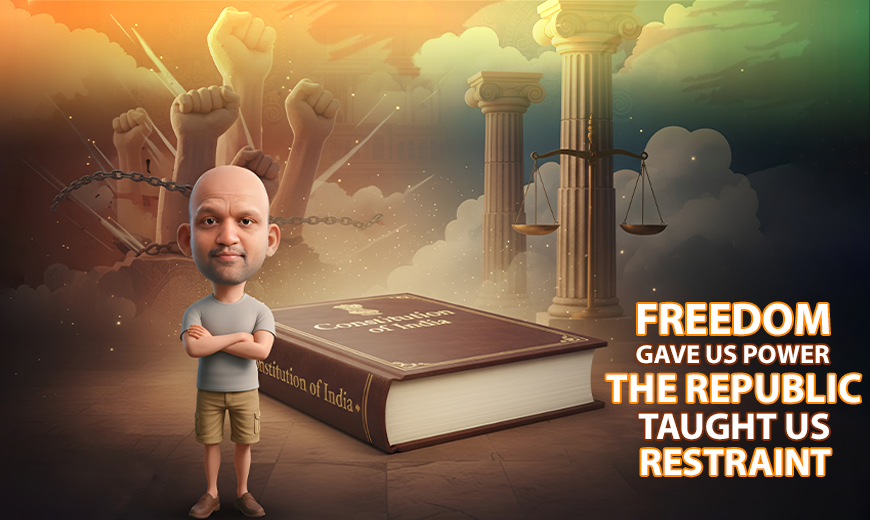
26th January: When India Chose Ram Over Parshuram

In India Vision, I wrote something uncomfortable years ago:
India will not collapse because of lack of freedom.
It will collapse if freedom is not restrained by structure.
That sentence explains the Republic Day significance in India better than any parade ever could — a reminder of the truth of freedom.
Republic Day is exactly that idea, formalized.
If 15th August is Parshuram, 26th January is Ram.
And if that analogy makes some people uneasy, good.
Republics are not meant to be comfortable. They are meant to be stable.
Parshuram Gave Us Power. Ram Gave Us Restraint.
To understand why Republic Day is important in India, one must first understand what independence actually gave us—and what it did not.
Independence Day is about breaking away.
Republic Day is about not breaking society.
On 15th August 1947, India received the tools of freedom:
- Self-determination
- Political agency
- Raw power to decide its future
That was Parshuram.
Vishnu’s sixth avatar. Necessary. Violent. Decisive.
But power without restraint becomes entitlement.
So on 26 January, when we reflect on the 26 January Republic Day significance, India did something far more intelligent than emotional.
It chose discipline over drama.
That was Ram.
Maryada. Balance. Righteous limitation.
In India Vision, this is the difference between a nation that reacts and a nation that endures—a distinction central to the difference between Independence Day and Republic Day.
A Republic Is Not a Feeling. It Is a Book.
A republic is boring.
And that is its greatest strength.
The Republic Day meaning is not found in slogans or sentiment. Republic Day celebrates a document, not a moment.
The Indian Constitution does something radical:
- It limits the majority
- It restrains the state
- It protects the individual from popular anger
Democracy says numbers matter.
The Constitution says numbers can be wrong — which is why logic over empathy becomes essential in governance.
That single idea explains the importance of the Indian Constitution and why India still exists as a plural civilization.
Equality, secularism, and liberty are not slogans in India.
They are clauses.
Written. Enforceable. Non-negotiable.
That foresight runs through India Vision. A country of scale cannot survive on sentiment alone—this is the true Indian Constitution significance often missed in ceremonial narratives.
Yes, It Has Colonial DNA. Grow Up.
India’s Constitution carries British legal structures.
Good.
Institutions are not poetry.
They are plumbing.
The founders did not confuse ideological purity with practical survival. They borrowed what worked and Indianized the rest.
That is not weakness.
That is civilizational intelligence—and a core reason the role of Constitution in democracy remains intact in India.
The UK Experiment: When Vibes Replace Frameworks
The UK does not have a written constitution.
Which is why 50.00001% of people could wake up one morning and vote themselves out of the EU.
Brexit was not democracy at work.
It was the absence of constitutional restraint.
India looked at such futures and said:
“We’re writing this down. Carefully.”
That decision sits at the heart of constitutional democracy in India—long before India Vision ever existed.
Why India’s Constitution Is More Advanced Than America’s
The US Constitution was written in the 1700s.
India’s was written in the mid-1900s.
We had the advantage of hindsight:
- Failed democracies
- World wars
- Nationalism run amok
- Colonial collapses
Our Constitution assumes humans will:
- Abuse power
- Follow emotion
- Choose convenience over justice
That is realism. Not cynicism.
In India Vision, this forms the core thesis: strong nations are built on systems, not slogans—an insight central to the importance of Republic Day beyond symbolism, and echoed in modern discussions on systems thinking in structured frameworks.
Republic Day Is Not a Celebration. It Is a Warning.
Independence gave us freedom.
The Republic gave us limits.
Parshuram without Ram is destruction.
Ram without Parshuram is impotence.
India chose both—in sequence. Intentionally.
That choice explains why Republic Day is celebrated after Independence Day, and why India still stands when many louder revolutions did not.
This Republic Day, do not just salute the flag.
Respect the framework that tells power where to stop.
That is not anti-national.
That is nation-building.
Returning to India Vision
And this Republic Day, as part of reflecting on the Republic Day India history, I return to the Preface of my first book (India Vision):
I have grown up reading about power—what it means and what it does to people. Power was sometimes taught as money and sometimes as control. The more I have delved into India, the more I realize how untrue this is.
India is a country run by the mob—or the fear of the mob. It is not run by politicians. It is not run by businessmen. All businessmen try to do is control politicians, and all politicians want is a mechanism to control the mob.
A logical question follows: what is the mob?
The mob is not a group of people. It is a cause or an initiative.
Being a politician essentially means having a mechanism to continuously create causes.
Even liberals in this country are part of a mob—sometimes the more dangerous mob. Those who should remain non-aligned, open to debate and listening, often become the most rigid.
That contradiction is for another book.
For now, this book—and this Republic Day—remains an attempt to understand what pushes India into the right development cycle.
Because India does not survive on emotion.
It survives on restraint.
That is the real Republic Day significance in India.