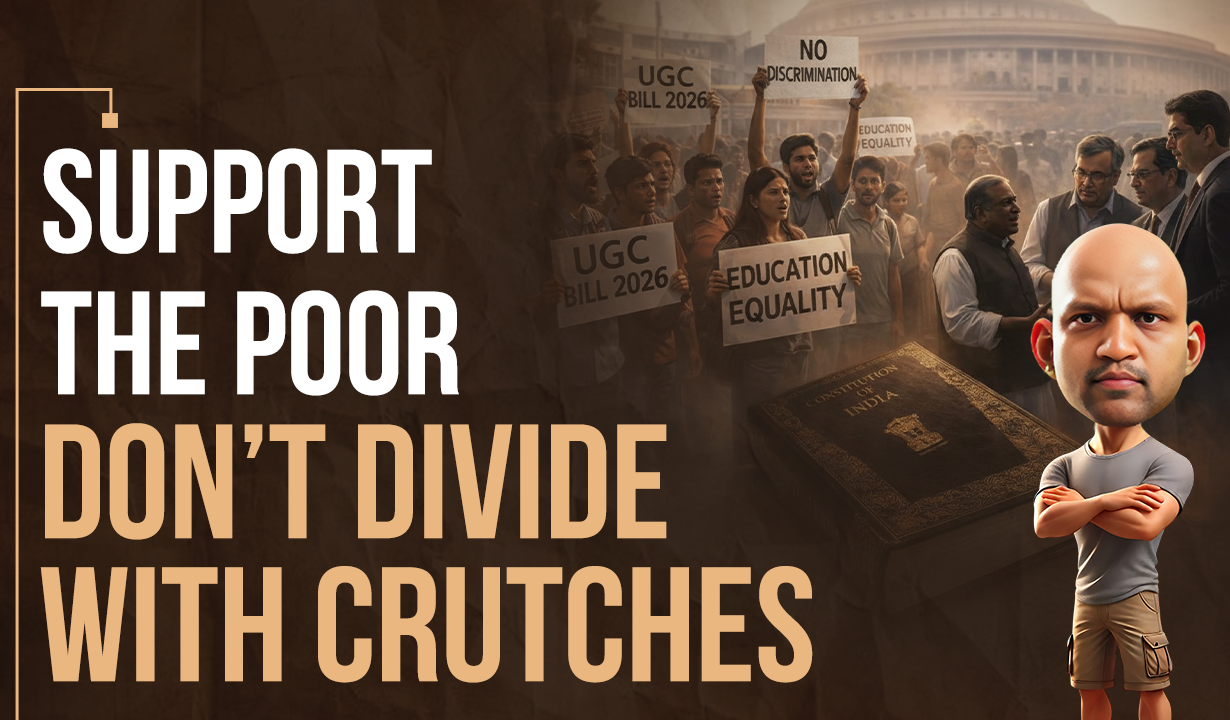
True Equality Is Time-Bound – Not Permanent Crutches

India has hit yet another flashpoint on the UGC Bill 2026 and equity in education. The University Grants Commission’s new Promotion of Equity in Higher Education Institutions Regulations, 2026, aimed at anti-discrimination in higher education, were paused by the Supreme Court, which called them vague and capable of misuse and asked the government to rethink them. Meanwhile, the 2012 UGC anti-discrimination rules stay in force for now.
Let’s be clear: I’ve been writing about this for years — the real issue isn’t caste or quotas in isolation. It’s the constant transformation of corrective policy into permanent entitlement. That’s not equality. That’s institutional dependency.
Equality Was Meant to Correct, Not Perpetuate
In my debut book India Vision, I used a simple hypothetical to show how reservation in higher education, intended as a temporary stimulus, has mutated into a life-cycle entitlement under policies like those debated in the UGC Bill 2026 controversy:
- A boy starts school through reservation
- Gets college and postgraduate seats through reservation-based frameworks
- Secures a government job via reservation
- The cycle repeats with the next generation
That’s not justice — that’s policy prosthesis.
A crutch you never take off.
A stimulus you never stop giving.
The Supreme Court on the UGC Bill 2026 itself expressed concern that the new regulations might divide society and be misused — echoing a deeper structural problem: when policy loses clarity, it invites chaos.
If You Want Real Equality — Fix Schools First
Equality doesn’t start in universities or with new UGC regulations. It starts in:
- Public schools
- Teacher quality
- Rural education infrastructure
- Cognitive development support
School is the great equaliser. By the time someone reaches higher education, inequality has already taken shape — long before debates around the UGC Bill 2026 impact on students begin.
Supporting someone to catch up in school is noble.
Supporting a permanent ladder in college and beyond is merely postponing responsibility.
Meritocracy Is Not Cruel — It Is Honest
As I wrote later in KGism, most people screaming about equality in the UGC Bill 2026 debate really mean:
“Favor my group — not everyone else.”
That’s not equality. That’s group politics in disguise.
This is why logic over empathy in public policy matters more than emotional, group-based decisions.
Real equality is simple:
- Equal opportunity
- Not guaranteed outcomes
A jeweller’s child knows gems better because of exposure.
A doctor’s child understands medicine because of environment.
That isn’t discrimination. That’s life.
Policy debates on equality vs meritocracy in India should aim to give everyone a fair starting line — not engineer outcomes.
After School, Support Should Be Economic — Not Identity-Based
Once school is done, the only legitimate support within Indian education reform should be:
- Economic subsidies
- Fee waivers
- Scholarships
- Educational resources
These help people regardless of ancestry, race, or caste. They don’t create dependencies based on who your grandparents were — a key concern in the meritocracy vs reservation debate.
The Constitution guarantees equality before law (Article 14). When education policy chooses groups instead of individuals, as critics argue in the UGC Bill 2026 latest news, it risks violating that very spirit.
Politics Hijacks Equality — And That’s the Real Problem
Here’s the raw truth:
- Politicians love dependency
- Dependency wins votes
- Votes win elections
So policies mutate from corrective action to permanent favour.
What was once a bridge becomes a dwelling.
That’s not justice — it’s politics holding excellence hostage.
Universities under the UGC’s new higher-education rules should reward preparedness, ability, and grit — not serve as political plantations.
The Supreme Court’s stay signals that even constitutional guardians think something in the UGC Bill 2026 controversy crossed a line.
True Equality Is Brutally Fair — Not Forever Kind
Equality is not a lifetime entitlement under the UGC Bill 2026 framework. It is:
- Equal start
- Equal access
- Equal justice
- Zero permanent crutches
What we need:
- Excellent public schooling
- Economic support for the needy
- Merit as a principle, not a buzzword
- Politics kept out of academic spaces
Anything else is just brand-washed redistribution — and it hurts everyone, including those it claims to help.
Closing Words
Real equality isn’t loud.
Real equality isn’t perpetual.
Real equality doesn’t divide.
Real equality empowers quietly – and then disappears.
That idea connects directly to what freedom truly means in a fair society once equality has done its job.
It doesn’t cling to policy.
It transcends it.
Equality is a start line — not a resting place.
Let’s treat it that way.
FAQs: UGC Bill, UGC Dispute & Protests Explained
- What is the issue with the UGC Bill?
The UGC Bill (Promotion of Equity in Higher Education Institutions Regulations, 2026) introduces new equity and anti‑discrimination rules for colleges and universities in India. The aim is to curb caste‑based discrimination on campuses by setting up Equity Committees, Equal Opportunity Centres and grievance mechanisms. However, critics say the rules are broad, vague, and lack procedural safeguards, making them open to misuse and causing anxiety among students and faculty alike.
- What is the UGC dispute?
The UGC dispute centers on the wide backlash to the newly notified UGC regulations. While the commission and the government say the rules are essential to prevent caste discrimination and create a fair learning environment, opponents argue that the framework could be misinterpreted, misused, or biased, especially since it places strong responsibilities on institutions and equity bodies without clear checks. Some student groups, educators, and legal experts have challenged the rules in court, calling them potentially unconstitutional or unfair.
- Why are people protesting against the UGC Bill?
People — especially students from the general (unreserved) category and some faculty bodies — are protesting because they believe the new rules:
- Could lead to reverse bias or discrimination against general category students.
- Lack safeguards against false or malicious complaints.
- May shift pressure and burden of proof unfairly onto those accused.
- Could create tension and fear on campuses instead of harmony.
These concerns have triggered protests in cities like Delhi, Uttar Pradesh, Rajasthan, and Bihar.
- What is the UGC Bill controversy?
The controversy isn’t just about intentions — many people agree discrimination should be tackled — but about how these rules were framed and notified. Critics claim the definitions used are too broad, equity bodies may lack balanced representation (especially for general category students), and the regulations could be exploited or encourage false grievances. Supporters say the rules are a long‑overdue mechanism to enforce equity on campuses where discrimination has been reported. Both sides have strong views on implementation, clarity, fairness, and constitutional alignment.
- What is the new UGC Bill 2026?
The new UGC Bill 2026 — officially called the University Grants Commission (Promotion of Equity in Higher Education Institutions) Regulations, 2026 — is a set of rules recently notified by the Indian government to tackle discrimination based on caste, religion, gender, place of birth, disability and similar grounds in colleges and universities. It replaces the older 2012 framework with more binding anti‑discrimination measures, requires all higher education institutions to set up Equal Opportunity Centres and Equity Committees, and adds systems like helplines and grievance‑redress mechanisms.