WAR WITHOUT BORDERS: How the US-Iran Conflict Rewrote the Map

The thing about modern conflict is this: it rarely stays contained the way old history books imagine it did. What started as a confrontation deep in the Middle East – strikes, counter-strikes, tit-for-tat aggression — has now flipped into something spilling out like ink on wet paper.
The US Iran conflict global impact is no longer theoretical. It is unfolding in real time.For a detailed breakdown of the US–Iran war 2026 escalation, read our earlier analysis.
In the last 48 hours:
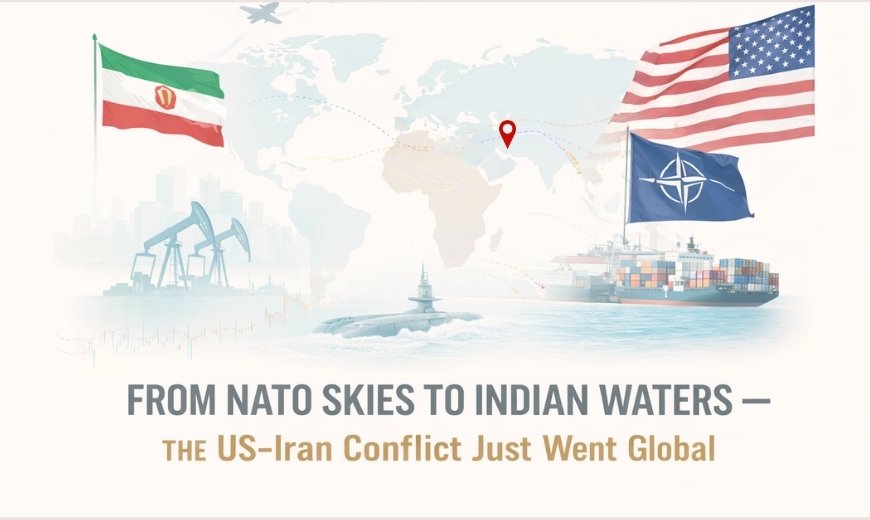
- An Iran-launched ballistic missile headed toward Turkish airspace was shot down by NATO air defence systems over the eastern Mediterranean. Turkey, a NATO member, stressed it won’t tolerate hostile action against its territory. NATO, at least publicly, has not invoked Article 5 – yet -but the intercept itself is a seismic diplomatic moment. This signals rising US NATO Iran tensions and a broader Middle East geopolitical shift 2026 analysts have been warning about.
- A United States submarine torpedoed and sank an Iranian warship – the IRIS Dena -off the coast of Sri Lanka in the Indian Ocean, killing dozens and leaving many more missing. Survivors were rescued by the Sri Lankan navy. It was reportedly the first time a U.S. submarine has sunk an enemy warship since World War II.
This is not a regional flare-up anymore. It’s a geopolitical cascade – and the US Iran conflict 2026 analysis is beginning to reflect that reality.
NATO and the Turkey Flashpoint
Turkey’s denial of casualties means this hasn’t become a full-blown NATO engagement — yet. But missiles crossing sovereign airspace and activated defence systems is the very definition of escalation. NATO doesn’t dismantle missiles out of courtesy; it does so because a member’s security is at stake.
This is how NATO involvement in the Middle East conflict quietly begins.
If just one of these intercepts had caused civilian deaths on Turkish soil, the alliance would be forced into public consultations, not private warnings.
That’s a step beyond deterrence. That’s operational involvement.
The ripple effects extend beyond military posturing. The Iran war global consequences include rising insurance premiums, defence coordination, and strain across alliance systems.
Indian Ocean: The New Front
The sinking of the IRIS Dena near Sri Lanka is not just a naval footnote.
It represents a widening Iran naval conflict in the Indian Ocean, shifting the theatre beyond the Persian Gulf.
This ship was returning from India’s International Fleet Review and the regional naval milieu of Exercise MILAN.
That alone ties this amphitheatre of conflict into the broader Indo-Pacific conversation — where India, China, and the United States are locked in a strategic dance over influence, trade routes, and alliances.
The impact of Iran war on oil prices, maritime insurance costs, and global energy security cannot be separated from this naval escalation.
India’s Chabahar port strategy with Iran — once hailed as a geopolitical masterstroke connecting Afghanistan to sea lanes that bypass Pakistan — has already been disrupted by US sanctions.
Now an Iranian warship operating near Indian maritime spaces becomes part of a bigger conflict. That’s not local theatre.
That’s how Iran conflict affects global trade routes.
Russia and China: The Shadows Watching
Russia and China aren’t passive observers.
China’s Belt & Road infrastructure and energy dependency mean any instability in the Persian Gulf directly impacts energy markets, shipping flows, and inflation. The oil market volatility Iran war scenario is no longer speculative.
Russia sees this as an opportunity to promote its own defence exports and political alliances among Gulf states alienated by Western pressure.
Neither wants a direct conflict with the West. But both see chaos as leverage.
Their positioning reflects broader concerns about global strategic alliances shifting under pressure from the expanding conflict.
The Kurdish Subplot: The Most Bizarre Story in Modern Politics
Now let’s pivot to something even stranger: the Kurdish question.
Since World War II, Kurdish groups have been strategically deployed and conveniently forgotten by Turkey, Syria, Iraq, Iran, Lebanon, Armenia, the United States, and yes — the USSR and Russia.
The Kurds’ role in Middle East conflict has followed a remarkably consistent script.
Every major era offers the same cycle:
- Kurds fight where convenient.
- They are promised autonomy or support.
- Their utility expires.
- Promises evaporate.
- They are left to fend off the consequences.
This happened post-WWII.
It happened during the Iran-Iraq War.
It happened against ISIS.
And as the US Iran conflict global impact expands, the pattern risks repeating itself.
Global Impact: Big Power Games and Unintended Collisions
This conflict isn’t just missiles and sunken ships. It’s:
- Energy markets spiking
• Shipping lanes threatened
• Global insurance premiums rising
• Diplomatic architectures cracking
• India, China, Turkey, Russia recalibrating futures
The Iran conflict impact on shipping lanes is already visible.
The impact of Iran war on oil prices is beginning to ripple through global markets.
The broader US Iran conflict and global economy equation is shifting.
Traditional alliances are being tested, not reaffirmed.
This is not some new war starting
If anything, it confirms why this Middle East escalation was inevitable..
This is the continuation of escalation now moving beyond its original theatre and into global strategic geography.
The real question is not whether this war will spread.
It’s how many systems it will break while doing it.
And that — more than anything — defines the US Iran conflict global impact.
FAQ Section
1️⃣ How will the US–Iran conflict impact India?
The US–Iran conflict global impact on India could be significant. India depends heavily on crude oil imports from the Middle East, so any escalation may increase oil prices, shipping insurance costs, and inflation. It may also affect India’s strategic investments like the Chabahar port and its broader Indo-Pacific positioning.
2️⃣ Will the US–Iran conflict increase oil prices in India?
Yes, escalation in the Middle East typically leads to oil market volatility. If shipping routes like the Strait of Hormuz are threatened, crude prices can spike globally, which may raise fuel prices and transportation costs in India.
3️⃣ Is NATO involved in the US–Iran conflict?
NATO is not officially at war, but rising US NATO Iran tensions — especially missile interceptions over Turkish airspace — indicate increased alliance alertness. Any direct attack on a NATO member like Turkey could trigger deeper involvement under collective defence mechanisms.
4️⃣ How does the US–Iran conflict affect global trade routes?
The conflict can disrupt major maritime corridors in the Persian Gulf and Indian Ocean. Threats to oil tankers and cargo vessels may increase shipping insurance premiums and delay trade, impacting global supply chains — including India’s imports and exports.
5️⃣ Could the US–Iran conflict turn into a global war?
While a full global war remains unlikely, the risk of broader geopolitical escalation increases when major powers like Russia, China, and NATO members become indirectly involved. The US Iran conflict global impact is expanding beyond the Middle East, affecting global alliances and economic systems.