When Stress Blows up at Work : What a Delhi Airport Incident Reveals About the Changing Nature of Work

The Incident Is Shocking. The Pattern Is Not.
A recent incident at Delhi Airport where an Air India Express pilot allegedly assaulted a passenger over a queue dispute shocked the public. A pilot. A professional entrusted with hundreds of lives. Losing control in a public space.
But here’s the uncomfortable truth.
This isn’t about one person.
This is about what work has become.
Stress today is not episodic. It is continuous, cumulative, and invisible. And when it finally surfaces, it doesn’t come politely. It comes as a blowout.
Airlines: A Perfect Pressure Cooker
Few industries concentrate stress the way aviation does.
- Irregular schedules and broken sleep cycles
- High cognitive load and zero tolerance for error
- Constant passenger-facing friction
- Delays, cancellations, weather chaos, ATC issues
- Long hours with limited emotional decompression
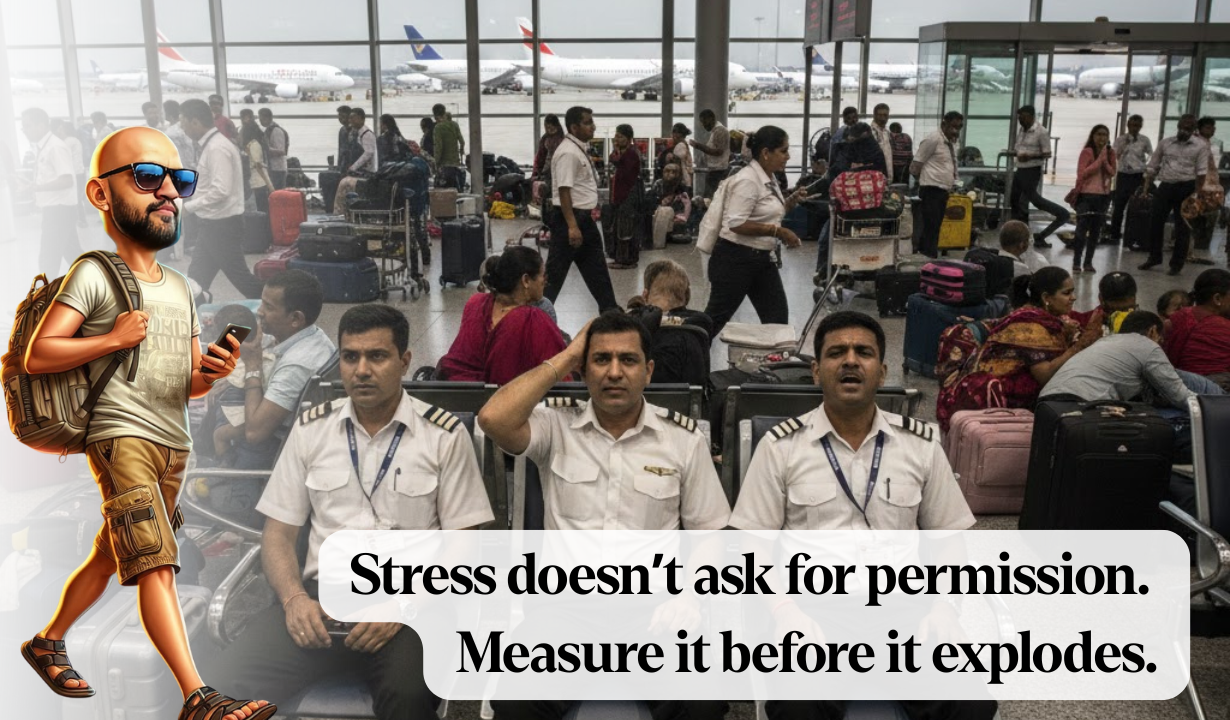
Pilots, cabin crew, ground staff, security, check-in teams — everyone operates under pressure, all the time.
The Delhi incident didn’t happen in the cockpit.
It happened in a queue.
That’s the point.
Stress doesn’t explode where it is created.
It explodes where the last thread snaps.
This Is Not Just Aviation. This Is Every Workplace.
We are seeing the same pattern everywhere:
- Managers snapping at teams
- Frontline staff lashing out at customers
- Healthcare workers burning out
- Teachers emotionally collapsing
- Delivery drivers showing road rage
- Corporate employees disengaging or imploding
These are not character failures.
These are system failures.
Workplaces are designed to extract output.
They are not designed to monitor human strain.
The Real Problem: Stress Is Invisible Until It Isn’t
Most organizations still rely on:
- Annual surveys
- HR check-ins
- Self-reporting
- After-the-fact counseling
By then, the damage is already done — to people, safety, culture, and reputation.
What if stress could be measured early?
What if organizations could see risk building up before it turns into incidents, attrition, or public embarrassment?
This question sits at the heart of the shift toward AI-powered stress management tools – not as surveillance, but as early-warning infrastructure for human systems under load.
Why Stress Monitoring Is No Longer Optional
Stress monitoring is not about surveillance.
It is about prevention.
With tools like Streffie, Stress can monitored and measured before it becomes a hurdle along the way.
For airlines:
- Identify high-risk crew fatigue and stress
- Improve scheduling and recovery cycles
- Reduce safety, conduct, and reputational risks
For airports and passengers:
- Detect stress hotspots like security, boarding, immigration
- Reduce aggression, conflict, and chaos
- Improve overall passenger experience
For workplaces:
- Spot burnout before it becomes breakdown
- Intervene early
- Build emotionally safer organizations
Conclusion
The Delhi airport incident is a warning, not an anomaly.
Stress today is a workplace hazard, just like fatigue, safety lapses, or compliance failures.
Ignore it, and it will surface — publicly, painfully, and unpredictably.
Measure it early, and you change outcomes.