VIP Syndrome: The Most Expensive Mental Health Crisis In India

There are two Indias on the road.
One India waits at traffic lights.
The other India arrives with sirens.
And if the sirens are loud enough, suddenly traffic laws, civic equality, taxpayer dignity, and common sense all become “adjustable.”
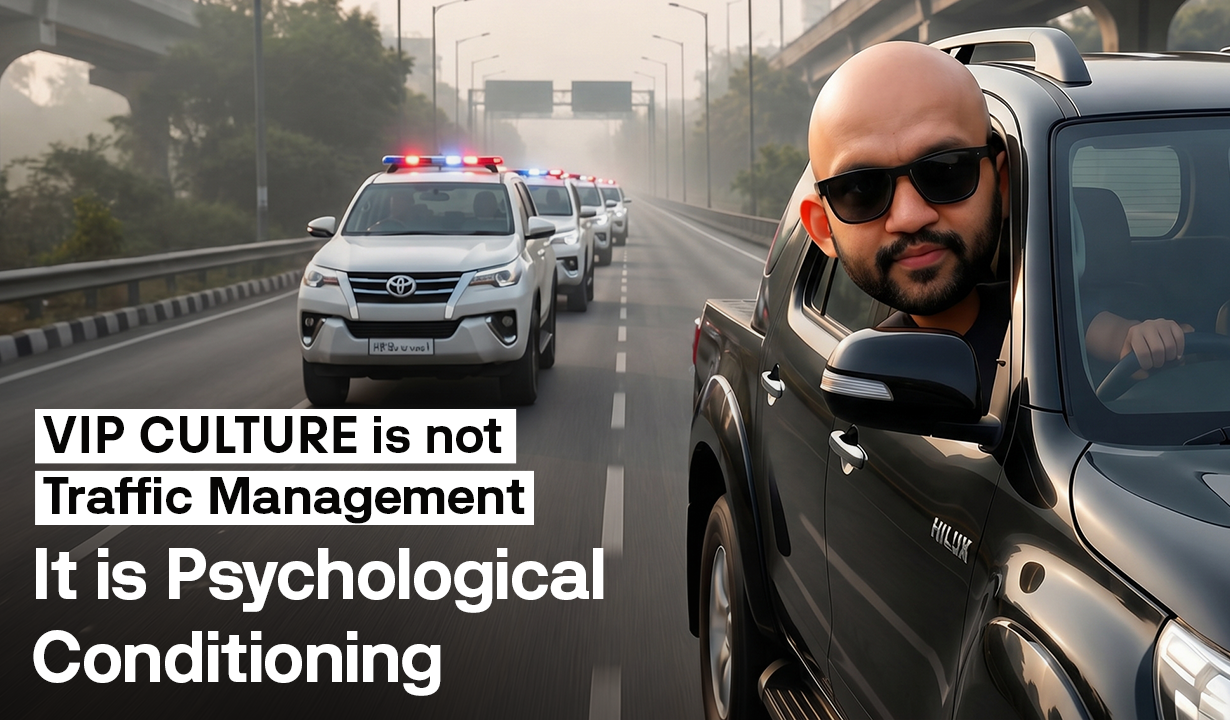
Yesterday, I accidentally offended the Indian establishment in the most dangerous way possible: I drove faster than a VIP convoy.
Not cut them off. Not blocked them. Not abused them. Not endangered them.
I simply did not disappear quickly enough from their line of sight.
That was enough.
Somewhere between Shanti Van and ISBT, the machinery activated.
Phone calls. Police alerts. Traffic coordination. Vehicle tracking. Instructions flowing through wireless sets as if Delhi Police had finally located an international cartel boss instead of a guy trying to go home.
At Majnu Ka Tila traffic light, I was stopped.
Very politely. Very professionally. Very unnecessarily.
Over the next hour:
• Traffic Police arrived.
• Delhi Police arrived.
• Senior officers arrived.
• Calls were made.
• Discussions happened.
• Threats floated casually.
• “Impounding.”
• “Section 184.”
• “Prison.”
All because somewhere, someone’s ego had developed national security concerns.
And here’s the funny part: the cops themselves knew it was absurd.
The ASI was laughing. The inspector was confused. The head constable looked like a man trying to solve a math equation nobody taught him.
Nobody actually knew:
• what law was broken,
• what danger was caused,
• or what exactly I had done.
But nobody had the authority to say:
“Sir, this is nonsense. Let him go.”
That is the real story.
Not corruption. Not one political party. Not one convoy.
The real story is institutional helplessness.
India has inherited a colonial governance mindset where power must constantly be seen, felt, feared, and theatrically respected. That is the foundation of modern VIP culture in India.
The British left in 1947.
The psychology never did.
Somewhere deep in the bureaucratic DNA of the subcontinent still exists the belief that:
• the powerful move first,
• the citizen moves aside,
• and the State must demonstrate its superiority regularly.
Not through service. Through intimidation.
We no longer have Viceroys.
We simply replaced the hats.
And before anyone turns this into BJP vs Congress vs AAP vs whoever: stop.
This disease predates all of them.
Every government talks about empowering citizens. Every government eventually develops a section that enjoys managing them.
This was not about the Chief Minister (yeah, the convoy was Rekha Gupta). In fact, I highly doubt the CM even knew or cared.
This was about the ecosystem around power.
The orbit.
The unofficial culture of: “Do you know who is passing?”
India’s favorite constitutional amendment.
And here’s what privileged people often fail to understand:
I got lucky.
Because I knew how to remain calm. Because I spoke respectfully. Because I could joke with the cops. Because they Googled me. Because they saw my media work. Because I had enough social signaling to not look “dangerous.”
Now imagine the same situation involving:
• a delivery driver,
• a student,
• a migrant worker,
• someone angry,
• someone scared,
• someone without English,
• someone without social capital.
That one-hour inconvenience could easily become:
• humiliation,
• detention,
• violence,
• extortion,
• trauma.
The average Indian has learned something psychologically dangerous:
Being innocent does not guarantee peace.
And then we wonder: why are Indians so stressed?
Everyone talks about workplace stress. Academic pressure. Relationships.
But nobody talks enough about ambient national anxiety and the psychological stress in India created by arbitrary systems.
The stress of unpredictability.
The feeling that:
• any official,
• any checkpoint,
• any local strongman,
• any random system, can suddenly consume hours, money, dignity, or peace from your life without accountability.
This uncertainty exhausts people psychologically. It creates a form of bureaucratic anxiety that millions quietly carry every day.
People do not only fear criminals in India.
They fear processes.
They fear:
• police encounters,
• government offices,
• traffic stops,
• taxation notices,
• municipal systems,
• airport officials,
• local authority figures.
Because the average Indian has quietly learned that systems do not always distinguish clearly between inconvenience and guilt.
And that realization damages millions of nervous systems every single day.
Mental health is not only therapy apps and meditation podcasts.
Mental health is also civic dignity.
It is the ability to move through your own country without feeling permanently vulnerable to authority.
Countries become emotionally healthier when citizens stop feeling smaller than systems.
And to be fair: many policemen themselves are trapped in this machinery.
Most officers I met that day were courteous. Professional. Even embarrassed.
But they too operate inside a chain where refusing absurdity can itself become risky.
That is the tragedy.
Not evil individuals.
But normalized overreach.
India does not need fewer VIPs.
India needs fewer people who think being near a VIP temporarily upgrades them above citizens. That mindset is what keeps VIP culture in India emotionally exhausting for ordinary people.
Because the real test of democracy is not elections.
It is whether an ordinary person can live one ordinary day without unnecessary fear from power.
Right now, too many Indians cannot.
And everyone knows it.
Even the people laughing about it at the traffic signal.
Add-On Section: India’s Biggest Unofficial Tax
India does not only tax income.
It taxes emotional certainty.
Every Indian subconsciously carries invisible psychological overhead:
• “What if police stop me?”
• “What if some official gets offended?”
• “What if paperwork becomes a weapon?”
• “What if someone influential notices me?”
This low-grade anxiety becomes permanent background noise in people’s lives.
And eventually people normalize it.
That normalization is the tragedy.
Because citizens in healthy democracies should fear breaking the law. Not accidentally inconveniencing power.
In India, systems often do not ask: “Did you commit a crime?”
They first ask: “Did you inconvenience someone important?”
That is the hidden mental health crisis in India nobody fully measures, but millions experience daily.
FAQ
What is VIP culture in India?
VIP culture in India refers to the visible and invisible systems of privilege surrounding political power, bureaucracy, and authority. It often includes special treatment, convoy systems, preferential access, and the expectation that ordinary citizens must adjust around power.
How does VIP culture affect mental health?
VIP culture contributes to ambient anxiety, civic stress, and psychological exhaustion by making ordinary citizens feel vulnerable to arbitrary authority, unpredictable systems, and public humiliation.
Why do Indians fear systems and authority?
Many Indians grow up experiencing bureaucratic unpredictability, aggressive processes, and uneven enforcement of rules. Over time, this creates low-grade psychological stress and distrust toward institutions.
What is ambient national anxiety?
Ambient national anxiety is the constant background stress people experience when they feel systems, officials, or authority figures can disrupt their lives unpredictably without accountability.
Is mental health connected to civic dignity?
Yes. Mental health is not only personal or clinical. It is also social and civic. People feel psychologically safer when institutions are predictable, fair, and respectful toward ordinary citizens.
Why do people criticize VIP convoys in India?
Criticism usually comes from the perception that VIP convoys symbolize unequal treatment, disruption of public life, and a culture where power expects visible public deference.