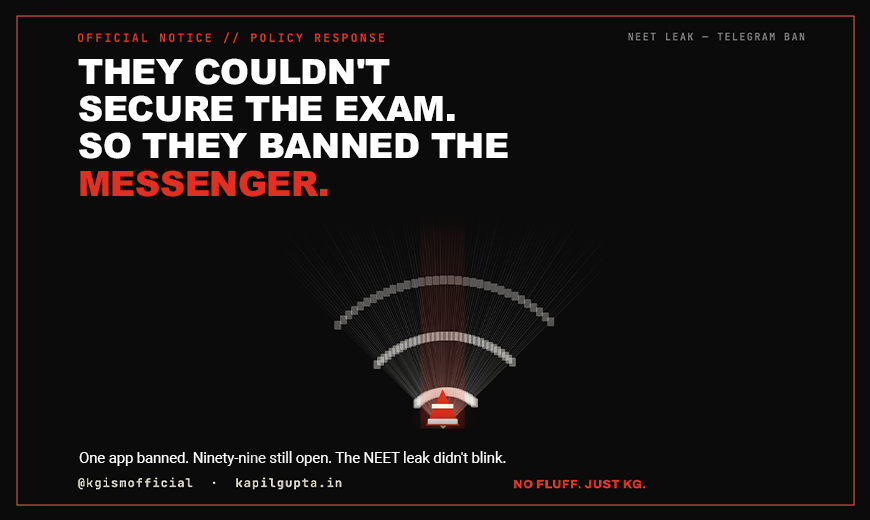
THEY COULDN’T SECURE THE EXAM. SO THEY BANNED THE MESSENGER.

A paper meant to pick the country’s next doctors leaked. The government’s big counter-move? Switch off one app. Let me walk you through exactly how stupid that is.
Let’s start with the part nobody in power wants said out loud.
The NEET paper – the single exam that decides who gets to become a doctor in this country – leaked. Again. The NEET paper leak is now one of the biggest education controversies in India. It travelled, it sold, it circulated, and lakhs of honest kids who studied for two years got to compete against a few who simply bought the answers. That is the scandal. That is the failure. That is the thing a serious state would be on its knees fixing.
And the headline response we got? Ban Telegram.
I build campaigns for a living. I’ve watched brands panic and do dumb things to look busy. But this one belongs in a museum. This is a government that couldn’t lock its own front door, getting caught, and then loudly announcing it has banned… one brand of crowbar. As if the burglar can’t walk to the next hardware shop. As if there’s only one.
THE THING THEY ACTUALLY CAN’T DO
Strip away the press conference and here is the naked truth: the state cannot secure its own exam. That’s the whole story. Everything else is theatre.
A paper leak is not a Telegram problem. The NEET exam leak did not begin on a messaging platform. A paper leak happens long before anything touches an app – in a printing press, a transport van, a question-bank vault, a district co-ordinator’s phone, a tuition mafia’s WhatsApp group, an examiner who got greedy. By the time a PDF is moving on a chat platform, the breach already happened. The app is the delivery van, not the heist.
Banning the delivery van does not un-rob the bank. It just tells the country you found the van and gave up on the bank. We’ve seen this pattern before – banning platforms instead of fixing the problem.
THE MATH THAT MAKES THE BAN A JOKE
Here’s the part that should end the conversation around the Telegram ban and the NEET paper leak. Telegram is not special. It is one of over a hundred ways to move a file from one phone to another. Take the app off every phone in India tonight and the leak economy doesn’t even blink. Because the next morning it just opens one of these:
WhatsApp. Signal. Discord. WeChat. Viber. Snapchat. Instagram DMs. Facebook Messenger. iMessage. Google Chat. Microsoft Teams. Slack. Session. Threema. Element / Matrix. Briar. Wickr. Wire. Skype. Line. KakaoTalk. Botim. ToTok. Hike’s descendants. Every dating app with a chat box. Every gaming voice channel.
And that’s just the messengers. Now add the rails that don’t even need an account: email. A shared Google Drive link. Dropbox. A pastebin. A Reddit thread. A Telegram-shaped clone that springs up by Friday. A QR code printed on paper. A pen drive in a pocket. AirDrop across a room. A screenshot. A photo of a screen taken by a second phone – the one channel no ban on earth can ever close.
So you’ve banned 1 of 100+. You’ve closed one lane on a highway with a hundred lanes and stood there proud of the traffic cone. The leaker doesn’t need to be clever. He needs to be alive and own a second app. He has ninety-nine.
WHO ACTUALLY GETS PUNISHED
Now the part that makes it worse than useless – it’s actively harmful to the wrong people.
Telegram in India isn’t a leak app. Yet the Telegram ban after the NEET leak affects millions of legitimate users. It’s a workplace. Small businesses run their entire customer support on it. Crypto and trading desks live on its channels. Coaching institutes – the legitimate ones – deliver classes and doubt-solving through it. Resellers, community admins, news distributors, indie creators, customer broadcast lists, delivery fleets co-ordinating drops – millions of ordinary people who did nothing wrong wake up to find a tool they built their livelihood on has been switched off because a state couldn’t guard a question paper.
Think about that trade. To not even stop the leak – because it migrates in one tap – you have knee-capped lakhs of honest businesses. You imposed a 100% cost on the innocent for a 0% gain against the guilty. If a marketing intern proposed that funnel I’d walk them to the door.
WHAT A BAN IS REALLY ADMITTING
Here’s the uncomfortable bit for the people who ordered it. The government response to the NEET leak raises more questions than answers. A ban isn’t a show of strength. It’s a confession.
When you ban the messenger, you are publicly announcing: “We could not protect the paper. We could not catch the people inside our own system who sold it. We could not secure the press, the vault, the transport, the coordinators. So we’re going to point at an app made in another country and hope you look there instead of at us.”
It’s misdirection dressed as action. It is the digital equivalent of a school that responds to a stabbing by banning a brand of pencil. Everyone can see the knife is still in the building. Banning the pencil just tells the country you’ve decided to manage the optics instead of the problem.
AND REMEMBER WHAT EXAM THIS IS
If this were a state quiz competition, the stupidity would still annoy me. But this is NEET – India’s most important medical entrance exam.
This is the gate to medicine. The leak doesn’t just rob a topper of a rank. It quietly swaps people. Somewhere, a brilliant kid from a town with no coaching budget loses a seat. And somewhere else, someone who bought a paper inches into a medical college. Fast-forward a decade and that’s not an abstraction – that’s the person reading your mother’s scan. That’s the hand on the scalpel.
An exam leak in medicine is not an administrative hiccup. It is a slow corruption of the people we will one day trust with our lives. A government that can’t secure that exam has failed at something close to sacred. And instead of fixing it, it banned an app. Let that sit.
WHAT FIXING IT ACTUALLY LOOKS LIKE
I’m not here to only throw rocks. So here’s the unglamorous truth about what actually closes a leak – none of which involves an app store.
If policymakers are serious about exam security in India, these are the reforms that matter:
- Move the paper less. Every printed copy, every van, every human in the chain is a leak point. Encrypted, time-locked digital delivery to the centre minutes before the exam beats a fortnight of transport.
- Make leaking personally catastrophic. Fast, named, jailed convictions of the insiders – the press operator, the coordinator, the examiner. Leaks happen because the people inside calculate the odds are in their favour. Change the odds.
- Multiple paper sets, randomised. A leak of one version is worthless when the kid next to you has a different one.
- Watermark every copy. If a leaked PDF can be traced to the exact phone it came from, you don’t need to ban anything – you need to make an arrest.
- Own the failure. Re-test cleanly, compensate the honest, and stop performing competence you don’t have.
Notice what’s on that list and what isn’t. Securing an exam is hard, boring, accountable work. Banning an app is a tweet. Guess which one looks like governing and which one is just easier.
THE LINE THAT SHOULD STICK
You don’t fix a leak by banning the bucket. You fix the pipe. Banning Telegram for the NEET paper leak is a state that lost control of its own exam, getting caught, and switching off a light in someone else’s house so we won’t notice the fire is in theirs.
The leak doesn’t live in an app. It lives in a system that can’t protect the one exam that decides who gets to heal us. As we’ve seen repeatedly, system failures don’t disappear when you hide the symptom.
Don’t watch the app they banned. Watch the paper they couldn’t protect.
No Fluff. Just KG.
⚠ Honesty footer (because I don’t pretend). I’m writing this as commentary on the policy reflex, not a court filing. Exact loss figures, the precise scope of any ban, and which platforms get named will keep shifting as this story moves – I’m not going to pretend a tidy final number exists. But the logic doesn’t move with the details: the NEET paper leak is a system breach, not an app feature, and a hundred-plus channels make a single-app ban theatre. If the government proves me wrong by actually securing the next paper, I’ll be the first to write that blog. I’m not holding my breath.
FAQs
1. What is the NEET paper leak controversy?
The NEET paper leak controversy refers to allegations that the NEET question paper was accessed and circulated before the examination, giving some candidates an unfair advantage and raising concerns about the integrity of India’s medical entrance exam system.
2. Why was Telegram linked to the NEET paper leak?
Telegram was reportedly used as one of several platforms where leaked exam-related material was allegedly shared. However, critics argue that the leak itself originated from weaknesses within the exam administration system rather than the messaging platform.
3. Can banning Telegram prevent future exam paper leaks?
Many experts believe that banning a single messaging platform is unlikely to stop paper leaks because leaked content can be shared through numerous other channels, including email, cloud storage services, social media platforms, and messaging apps.
4. How do exam paper leaks typically happen?
Exam paper leaks usually occur due to breaches within the examination process, such as unauthorized access at printing facilities, transportation stages, storage locations, examination centers, or through insiders with privileged access to exam materials.
5. What measures can help prevent NEET paper leaks in the future?
Potential solutions include encrypted digital paper delivery, multiple randomized question sets, forensic watermarking of exam papers, stronger monitoring of exam logistics, and strict legal action against individuals involved in leaking examination materials.