The Kids Won. Now Comes the Hard Part.

A NO-FLUFF NOTE FROM KG
The Kids Won. Now Comes the Hard Part.
Let me begin with an admission, because this piece is only worth writing if it’s honest: I did not support the NEET student protest 2026 when it started. And I’ll be precise – I still hold that original reservation. So read this as the words of a convert, not a cheerleader.
WHY I STAYED ON THE FENCE
Here’s what I saw at the beginning, and why I didn’t march. The NEET paper leaked – genuinely, seriously. But then the system actually did its job: the exam was cancelled, a fresh one was conducted, and the next academic session was protected so that no student lost a year of their life. Yes, there was a leak. But it was also caught and corrected. That is not nothing, and I refuse to pretend it is. So when the earliest calls went out to burn the whole house down, I wasn’t in that crowd.
What I was clear about, from the very first week, is accountability. A failure that large happens on a minister’s watch, and Dharmendra Pradhan should have owned it and resigned long before it ever came to this. Fixing the exam repairs the paper; it does not answer for the rot that let it leak. And I’d bet a great many Indians were standing exactly where I stood – sympathetic but not marching, wanting accountability without wanting anarchy. Reasonable fence-sitters. There were more of us than the noise suggested.
THE DAY THE FENCE DISAPPEARED
And then came July 20. The lathi-charge. The tear gas rolling over a district full of teenagers who had broken nothing. That was the day the fence vanished under my feet. I stopped being a sceptic and became a supporter – not of the CJP, not of the theatre around it, but of one simple principle: you do not do that to your own children for holding up placards. The Delhi Police lathi-charge on students achieved what the cause alone never could. It turned a country of quiet doubters into a country of loud witnesses. I was one of them.
TO THE STUDENTS: CONGRATULATIONS
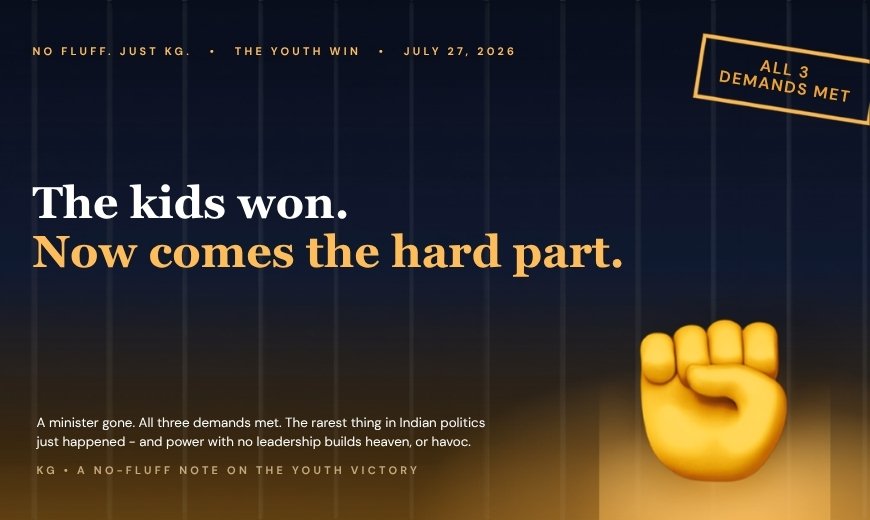
So let me say the sentence I truly did not expect to write: the youth of India came out, stayed out, took a beating – and won. On July 25, Pradhan resigned; President Murmu accepted it; Pralhad Joshi took charge. And it wasn’t a face-saving half-measure – the government conceded all three demands: his exit, no action against the July 20 protesters, and one crore rupees to the families of every child lost to suicide in this saga. A day earlier, Sonam Wangchuk broke a twenty-six-day fast; Modi promised an anti-paper-leak law and fast-track courts. A month of stalemate collapsed in seven days.
To the students, and to the young people of this country: congratulations. Genuinely, and without an asterisk. You did the thing this republic almost never manages – you made the state stop, listen, and move. The NEET protest victory belongs to you.
We are a nation that has perfected the ignored protest: you march, you trend for a day, the file goes back in the drawer. The last time the young poured out at this scale was the Mandal churn of the early nineties, and even that didn’t end with a minister clearing his desk. What made this student movement in India special is that it stopped being a Delhi story and became a national feeling – Kota to Kerala to Bihar – with no high command dialing it. That synchronisation cannot be manufactured. Be proud of it. You earned every bit of it.
WITH GREAT POWER…
Now let me get earnest, because a win this big deserves honesty more than applause. With great power comes great responsibility – and right now this movement has all of the power and almost none of the scaffolding for the responsibility. The uncomfortable truth is that the NEET student protest 2026 succeeded in spite of the CJP, not because of it. No leadership worthy of the name, no plan on the day of the march, no institution underneath it to hold what’s been won. Dipke himself is already warning of “political infiltration” – a polite way of saying every party in India is circling this energy with a net.
The youth now hold real power. The only question that matters is where the responsibility will come from – because power without responsibility doesn’t sit quietly. It either builds heaven, or it makes havoc.
WHAT WE ACTUALLY NEED NOW
Here is my hope, said plainly. We need a larger, genuinely non-political youth movement in India – and I mean non-political. Not another outfit hatched in the underbelly of existing politicians. Not a party youth-wing wearing fresh colours and an old master’s instructions. Something independent. Something that pulls in the vast, currently-disengaged middle-class and upper-middle-class young – the educated, capable ones who have never marched because they assumed nothing would ever change. July just proved them wrong. If that cohort organises – cleanly, independently, with real structure and real accountability of its own – this stops being a NEET campaign and becomes the thing that reforms how the country is actually run.
Because don’t let this shrink back into being about one exam. NEET was the doorway, not the house. Behind it sits an un-riggable examination system, real jobs, an accountable police, a politics that respects the young instead of gassing them. Examination system reform in India is now part of a much bigger demand for accountability. Getting beaten took courage; building something that outlasts a news cycle takes patience – the one thing a viral moment is worst at. That is the harder, quieter, more important work, and it starts now.
This is an inflection point – perhaps the inflection point – for where this country goes next. The kids proved they can win. Now they have to prove they can build, and the rest of us – especially those who sat on the fence until the tear gas cleared our heads – owe it to them to help. Heaven or havoc isn’t the government’s call anymore. It’s ours. Let’s choose well.
– KG
FREQUENTLY ASKED QUESTIONS
What was the NEET student protest 2026 about?
The NEET student protest 2026 began after the NEET paper leak and concerns over the integrity of India’s examination system. Students demanded accountability, protection for protesters, support for affected families and reforms to prevent future paper leaks.
What did the NEET protest achieve?
The protest resulted in Dharmendra Pradhan’s resignation, assurances that no action would be taken against the July 20 protesters, compensation for affected families, and commitments toward an anti-paper-leak law, fast-track courts and examination reforms.
Why did Dharmendra Pradhan resign?
Dharmendra Pradhan resigned following sustained nationwide student protests demanding ministerial accountability for the NEET paper leak and failures within the examination system.
What happened during the July 20 student protest in Delhi?
Students protesting in Delhi faced a police crackdown involving a lathi-charge and tear gas. The incident brought wider public attention to the movement and persuaded many previously neutral observers to support the students’ demand for accountability.
Who organised the NEET student protest?
The movement was associated with the Cockroach Janta Party, or CJP, and Abhijeet Dipke. However, it expanded beyond one organisation and developed into a wider youth-led movement across different parts of India.
What reforms are needed after the NEET paper leak?
India needs a secure and transparent examination system, stronger safeguards against paper leaks, independent investigations, clear institutional accountability and fast-track action against those responsible for examination fraud.
Can the NEET protest become a larger youth movement in India?
It can-but only if the movement develops independent leadership, transparent structures and accountability of its own. Its long-term impact will depend on whether it can move beyond one examination and address wider concerns such as education, employment, policing and government accountability.