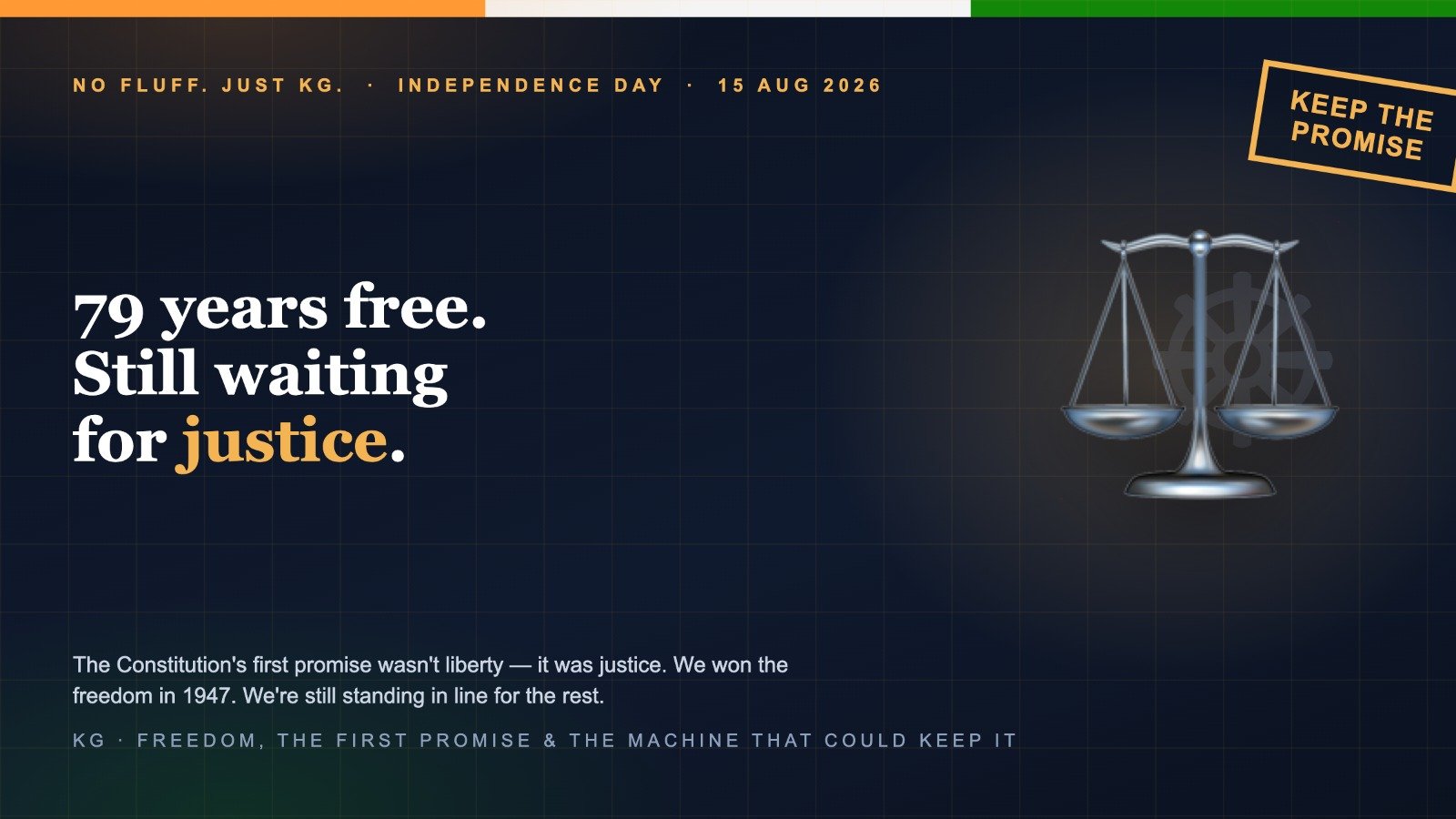
Seventy-Nine Years Free. Still Waiting for Justice.

At the stroke of the midnight hour, seventy-nine years ago, a nation woke to freedom. Nehru called it a tryst with destiny – the moment we redeemed our pledge, he said, “not wholly or in full measure, but very substantially.” Read that line again on this Independence Day. Not wholly. Not in full measure. Even drunk on the joy of that first free morning, we admitted out loud that the pledge was only half kept.
Here is the half we still haven’t kept.
Open the Constitution we then wrote for ourselves. Before liberty, before equality, before fraternity, the very first thing “We, the People” promised one another was a single word: JUSTICE. It sits at the head of the Preamble on purpose. The framers understood something we have since let ourselves forget – that a nation can be free and still be unjust. We won the freedom in 1947. Seventy-nine years on, we are still standing in line for justice.
So today, while we wave the flag, I want to ask the more uncomfortable question. Not “are we free?” We are. The harder one: are we just? And I want to make a case that will sound strange on Independence Day – that the most patriotic thing we could do for the republic’s first promise is hand it the most powerful reasoning tool humanity has ever built.
I don’t say this from the cheap seats. I’ve spent years up close with the Indian judiciary – not as a spectator, but as a campaigner. I run the Forum for All India Judiciary Services, pushing for a transparent, merit-based, national way to choose the people we hand near-godlike power over other human beings’ lives. The deeper I’ve gone, the clearer one thing has become: if you want to understand both why justice is sacred and how brutally we mangle it in practice, get close to a courtroom.
What I’ve seen from the inside is exactly what convinced me that AI in the Indian judiciary belongs at the centre of the conversation – more than AI in any inbox, ad account or slide deck we keep pointing it at.
Your first instinct – mine too, once – is to recoil. A machine deciding who goes to jail? No thanks. But that instinct answers a question I’m not asking. I don’t want a robot banging the gavel. I want something narrower, and far more interesting.
If justice is fundamentally about applying established law to established facts while minimising personal bias – then there is no better arena on earth to responsibly deploy AI.
The promise we wrote down
Freedom was the means. Justice was the point. The men and women who signed off on that Preamble had just watched an empire rule by law that was orderly and efficient and utterly unjust – so they knew that mere order is not the same as justice, and that a free India would be judged not by whether it held elections but by whether the poorest litigant could walk into a court and be heard as fairly as the richest.
That was the destiny in the tryst. Not a flag. A promise rooted in the importance of the Indian Constitution – that in this republic, the law would finally belong to everyone equally.
Measure us against our own words. That is all I’m doing here.
The impossible job
Think about what we actually ask of a judge. We hand one human being the power to take your liberty, your property, your livelihood, your reputation, your children, in some places your life – and then we ask that human to make the call with total detachment.
But the judge is a person. Who slept badly. Who has a worldview, a childhood, a caste, a class, a politics. Who has read the morning’s headlines and is on their fortieth case of the week. Who – consciously or not – finds one lawyer more polished, one accent more trustworthy, one defendant more sympathetic.
We demand something almost cruel of them:
Be completely objective while being completely human.
That is the paradox at the centre of all of this. Humans invented the idea of objective justice. Humans are congenitally subjective. We built a temple we are biologically unequipped to enter.
So the honest question isn’t whether machines are wise. It’s whether artificial intelligence in the judiciary can help us get closer to an ideal we designed, wrote into the first line of our Constitution, and keep failing.
What a judge is actually supposed to do
Strip away the robes and the ritual and the job is startlingly definable. A judge examines the Constitution and the applicable law, the statutes, the binding precedents, the past judgments, the evidence, the testimony, the documents, both sides’ arguments, the burden and standard of proof, the rules of procedure and natural justice – and arrives at a reasoned decision.
Notice what is not on that list.
Not who the judge likes. Not who cried more convincingly. Not politics, status, wealth, religion, caste, gender, celebrity, the mob outside or the headline that morning.
In theory, justice is reasoned, evidence-based and legally constrained. Read that back and tell me it doesn’t sound like an unusually well-specified problem.
Because it is.
And well-specified problems are exactly where machines get interesting.
That, to me, is the real role of AI in the judiciary: not replacing judgment, but strengthening the reasoning that must come before it.
It starts long before the verdict – with who gets to be the judge
Here’s what years in this fight taught me: the rot doesn’t begin in the courtroom. It begins in how we choose the person sitting at the front of it.
In India, judges appoint judges. The Supreme Court collegium – the Chief Justice and a handful of the senior-most judges – decides who is elevated to the High Courts and the Supreme Court.
Behind closed doors.
No published criteria. No written examination. No public reasoning.
We are simply not told why one name rose and another didn’t. It is the most consequential hiring process in the republic, and it runs like a private members’ club.
Everyone inside knows the vocabulary – “uncle judges,” the recurring surnames, the dynasties. Merit is in the room. So is proximity. And proximity wins far too often.
Sit with that on Independence Day.
We threw off a colonial ruling class precisely so that no Indian’s station in life would be decided by whose child they were. And then, at the very apex of the branch that guards our rights, we quietly rebuilt a lineage.
That is exactly why I run the campaign for an All India Judicial Service – a transparent, competitive, merit-based national exam to recruit judges, the way we recruit our civil servants.
Fill the empty benches on proven merit rather than connection. Break the opacity at its source.
For anyone talking seriously about judicial reforms in India, the collegium system in India cannot be treated as a footnote. It sits at the beginning of the problem.
Now hold that up against the AI question, because it is the same disease.
We select judges opaquely – and then we let them reason opaquely.
Two sealed boxes stacked on top of each other, guarding the most life-altering decisions a state can make.
My campaign attacks the first box.
This essay attacks the second.
It is one war: transparency and merit against opacity and access.
And once you see it that way, refusing to use the most powerful reasoning tool humanity has ever built to make judicial reasoning visible stops looking like caution.
It starts looking like protecting the club.
The case for AI in the Indian judiciary
Here is what AI is genuinely, unarguably good at – and what the courtroom is drowning in.
Volume. One serious matter can bury a judge under thousands of pages: files, prior judgments, statutes, contracts, statements, expert reports. No human reads all of it with equal attention at 6pm on a Friday. A machine reads all of it, every time, without tiring.
Precedent. AI can sweep the entire corpus of judgments and surface the similar cases, the binding authorities, the conflicting rulings, the later judgment that quietly overturned the reasoning everyone still cites.
How many verdicts have turned on a precedent nobody in the room happened to remember?
Contradiction. It can lay the police report beside the medical report beside the first testimony beside the cross-examination, and flag – cleanly, without ego – where they don’t line up.
An evidence map. This matters most. AI can separate what is established from what is disputed from what is merely alleged from what has actually been proven.
That distinction is the whole of justice – and it is precisely what emotion, eloquence and exhaustion blur.
And then the irony I can’t shake.
AI could flag reasoning patterns that betray bias – gender, caste, religion, class, confirmation, the same court treating two like cases unlike.
Sit with that.
A machine may be better positioned than a human to detect human bias.
This is where AI in Indian courts becomes interesting. Not because the machine knows justice better than the judge, but because it may be capable of showing the judge what the human mind failed to notice.
But don’t let me sell you a lie
Here’s where the AI evangelists lose me, and where this piece has to be honest or it’s worthless.
AI is not objective. And as we’ve already seen with the risks of artificial intelligence in areas like impersonation and deepfake fraud, powerful technology without adequate safeguards can scale a human problem frighteningly fast.
It learns from data made by humans. And judicial precedent – the very corpus we’d train it on – is the accumulated output of biased humans across decades.
If the history is prejudiced, an AI trained on that history doesn’t cleanse the prejudice.
It launders it.
It gives old bias a new, confident, machine-shaped voice.
AI does not magically remove bias. It can make bias invisible at scale.
That sentence should frighten you more than the robot-judge fantasy ever did.
A biased judge is one biased human. A biased model deployed across a nation is that bias industrialised, wearing the costume of neutrality.
Anyone who tells you “just use AI, it’ll be fair” is naive or selling something.
So the real question was never “can AI be unbiased?”
Nothing is.
It’s sharper than that:
Can we build judicial AI that is more transparent, more auditable and more consistently constrained than the human decision-making we already tolerate?
That is the question at the centre of AI bias in the judiciary, AI ethics in the judiciary, and any serious debate about AI and judicial decision-making.
Because the bar isn’t perfection.
The bar is a collegium behind a closed door and 5 crore cases gathering dust – while the Constitution’s first word waits.
What the machine should actually produce
If we do this, the single most important design rule is that the AI must never output a verdict.
Not “Guilty.”
Not “Dismissed.”
A black box that says “the algorithm finds him guilty” is a nightmare, and should be illegal.
What the machine produces instead is a reasoning framework – its work, shown, sourced and challengeable:
- The law – every relevant constitutional provision, statute, rule and principle in play.
- The precedent – binding and persuasive authorities, and why each applies or doesn’t.
- The facts – undisputed, disputed, alleged and evidence-supported, kept ruthlessly apart.
- The evidence – every material claim mapped against what actually backs it:
| Claim | Evidence | Contradiction | Reliability |
| … | … | … | … |
- The witnesses – contradictions, changed testimony, corroboration, gaps – flagged. But the hard limit stands: the machine does not get to brand a witness a liar because it spotted an inconsistency. That remains a human call.
- Both sides – and this is the part I love most. Before it concludes anything, the system must build the strongest possible case for each side. The best argument for the petitioner and the best for the respondent.
An engine forced to steel-man both parties.
Machine cross-examination.
- The bias audit – before any recommendation, one test: would the reasoning change if the identities of the parties were hidden?
Strip the name, gender, religion, caste, wealth, political colour, fame – and watch whether the answer moves.
That is “equal before the law” turned from a slogan into a check you can actually run.
- The reasoning – only now, a proposed conclusion, with every source visible.
Not “the algorithm says guilty,” but “here are the facts, the law, the precedent, the evidence, the contradictions, the reasoning, the conclusion – and exactly where each came from.”
If AI for justice is going to mean anything, it has to mean this kind of transparency – not replacing one black box with another.
Judge plus machine – not judge versus machine
So picture the courtroom of the near future not as one without judges, but as one where the judge finally holds what no judge in history ever has:
Every relevant law, precedent, document and contradiction in view at once.
The judge stays accountable.
The AI becomes the most powerful judicial research assistant ever built.
And the judge can ask it things no clerk could ever fully answer:
Show me every Supreme Court judgment interpreting this provision.
Show me cases with materially similar facts.
Show me where the prosecution’s argument conflicts with settled precedent.
Where does the testimony contradict itself?
What evidence supports this finding – and what cuts against it?
What is the strongest argument against the conclusion I’m leaning toward?
And – would my conclusion change if I removed the defendant’s identity from the facts?
That last question might be the most quietly radical sentence in this whole essay.
It is also the oldest promise we ever made ourselves, finally made testable.
This is the version of artificial intelligence in the Indian judiciary worth building: judge plus machine, not judge versus machine.
Why India – and why this day
Bring it home, because in India this stops being philosophy and becomes arithmetic.
Our courts sit on more than 5 crore pending cases. The Supreme Court alone carries over 94,000; some 10,000 have waited more than a decade. Certain High Court matters have been pending over thirty years – a case older than the lawyer arguing it, some nearly as old as a third of our independence itself.
And who’s meant to clear this mountain?
Around 21,000 judges – with 312 High Court seats lying vacant and nearly 4,900 posts empty in the district courts.
Vacancies the collegium and the government have failed, for years, to fill.
We’ve poured close to ₹9,800 crore into judicial infrastructure and digitisation since 2011, and the backlog still grows.
The scale of pending cases in Indian courts makes this more than an argument about technology. It is an argument about whether the Indian justice system has the capacity to deliver the justice it promises.
“Justice delayed is justice denied” isn’t a proverb here.
It’s an operating condition.
When a case takes twenty years, the acquittal lands after the accused has already lost two decades, or the compensation arrives after the wronged party is dead.
That is the republic failing at its founding promise, at scale, every single day.
A citizen technically free but denied a hearing for thirty years is free the way a locked man is free to imagine the sky.
Fix selection – my campaign – and you fix vacancies.
Fix vacancies and add machine leverage, and you finally start draining the swamp of delay – and start paying down a debt we’ve owed since midnight, 1947.
The part we prefer to whisper
And I’ll say what people would rather murmur.
The judiciary is also one of the most opaque and manipulable branches of the state.
We all know how the game is really played.
Litigants don’t just hire a lawyer for skill – they hire the one with the right prior relationships, sometimes specifically so a particular judge is forced to recuse and the matter drifts to a friendlier bench.
Forum shopping.
Bench hunting.
The strategic adjournment that bleeds an opponent’s money and patience dry.
These aren’t conspiracy theories; they’re Tuesday.
Cases turn on who is in the room as much as on what is true.
When outcomes bend to access, wealth and connection, “equal before the law” becomes a poster, not a practice – and the equality we sang about at midnight becomes something money can still buy.
Opacity is not a bug in this system.
For some, it’s the whole point – which is exactly why it’s defended so fiercely.
The objections – and they’re good ones
“AI has no empathy.”
True. But should empathy decide whether someone is legally guilty?
Compassion belongs in sentencing, in constitutional interpretation, in mercy. The cold factual question – did the evidence prove this to the required standard – is exactly where feelings should have the least vote.
“AI hallucinates.”
Yes – disqualifying, for a chatbot.
Judicial AI cannot be a chatbot.
It must be source-constrained, citation-based, auditable, version-controlled, legally verified and explicit about its own uncertainty.
If it can’t cite it, it can’t assert it.
“AI inherits historical bias.”
It does – the real danger.
Which is why the training corpus, the method and the outputs must themselves be audited, continuously and publicly, by people whose job is to attack it.
“Who is accountable when it’s wrong?”
The biggest one, and the answer is non-negotiable: never the machine.
There must always be a named, accountable human judicial authority who owns the decision.
AI advises.
A human answers for it.
Lose that, and you don’t deploy.
“Can AI understand justice?”
Maybe not.
But the question the sceptics skip is more uncomfortable: do humans?
Judges disagree constantly. Higher courts overturn lower ones. Two judges read the identical statute and reach opposite ends – and we call it normal.
If disagreement is baked into the human system, AI’s gift isn’t perfect truth.
It’s a reasoning process transparent and consistent enough to actually be argued with.
We are asking too little
Which is what actually bothers me.
We have spent years marvelling at AI writing marketing copy, spinning up slide decks, drafting our emails.
Useful.
Trivial.
We are asking a civilisational tool to do party tricks.
The question worth the technology is whether AI can help human beings make better decisions when the stakes are enormous.
And few stakes rival these:
Who is guilty.
Who is innocent.
Who keeps their freedom.
Who loses it.
Who gets justice.
And who is quietly denied it for thirty years while the file gathers dust.
On the one day we celebrate a nation built on a promise, that is a strange thing to keep asking a machine to skip.
Perhaps the real future of AI in the justice system begins when we stop asking what AI can write – and start asking what it can help us reason through.
Where I land – on Independence Day
Perhaps the future of justice isn’t a courtroom without judges.
It’s a courtroom where the judge finally sees every relevant law, every precedent, every piece of evidence and every contradiction, all at once.
AI should not replace the judge.
It should challenge the judge.
Question the judge.
Show the judge what the judge missed.
Because if the whole point of a judicial system is to minimise human error in the pursuit of justice, then refusing to use the most powerful reasoning tool we’ve ever built – purely because we’ve always done it by hand – quietly becomes its own form of bias.
I already fight for transparency in how we pick our judges.
I am now certain we need it in how they decide.
Seeing the Indian system from the inside – the collegium’s closed door, the empty benches, the manipulation, the thirty-year files – is exactly what convinced me judicial reasoning is the most important use case AI has.
So this August 15, by all means wave the flag.
Salute the freedom fighters who bought us the freedom half of the pledge.
But the freedom we won at midnight was never the finish line.
It was the down payment on a bigger promise – the one written in the very first word of the Constitution we gave ourselves.
We are free. We have been free for seventy-nine years. The question this Independence Day isn’t whether we’re free. It’s whether we’re just – and whether we’re finally honest enough to admit we’re not, and brave enough to use the best tool we’ve ever built to keep the promise we made ourselves at midnight.
So – what exactly are we protecting by refusing?
Happy Independence Day.
Now let’s go win the other half.
– KG
Frequently Asked Questions
What is the role of AI in the Indian judiciary?
The most useful role of AI in the Indian judiciary is not to replace judges or independently decide verdicts. It is to assist judges with judicial research, analyse large volumes of documents, identify relevant laws and precedents, map evidence, flag contradictions and present the strongest arguments from both sides. The final decision must remain with an accountable human judge.
Can AI replace judges in India?
It shouldn’t. AI can support judicial reasoning, but questions of accountability, interpretation, compassion and constitutional judgment cannot simply be outsourced to an algorithm. A responsible model is judge plus machine, not judge versus machine.
How can AI help reduce pending cases in Indian courts?
AI can help judges and court staff process large volumes of legal material faster, identify relevant precedents, organise evidence, detect contradictions and accelerate judicial research. It cannot solve India’s court backlog on its own, but combined with filling judicial vacancies and broader judicial reforms in India, it could improve the capacity of courts to handle cases more efficiently.
Can artificial intelligence reduce bias in judicial decisions?
AI may help detect patterns of human bias by comparing similar cases, analysing reasoning and testing whether conclusions change when irrelevant identity characteristics are removed. But AI can also inherit bias from historical judgments and training data. Therefore, AI bias in the judiciary must be addressed through transparent models, auditable outputs, carefully governed datasets and continuous human oversight.
What are the risks of using AI in Indian courts?
Major risks include hallucinated legal information, biased training data, opaque algorithms, over-reliance on machine recommendations and uncertainty over accountability. Any AI used in Indian courts should therefore be source-constrained, citation-based, auditable, legally verified and transparent about uncertainty.
What is the All India Judicial Service?
The All India Judicial Service (AIJS) is a proposed national-level system for recruiting judges through a transparent and merit-based process. The idea is to create a more consistent pathway for judicial recruitment and address concerns around vacancies, access, merit and transparency in India’s judicial system.
What is the collegium system in India?
The collegium system in India is the mechanism through which judges of the Supreme Court and High Courts play the central role in recommending appointments and elevations to the higher judiciary. Critics argue that the process lacks sufficiently public criteria and transparency, which is why reform of judicial appointments remains an important part of the broader debate over India’s judiciary.
How can AI improve judicial transparency?
AI can make judicial reasoning more transparent by showing the relevant law, precedent, facts, evidence, contradictions and reasoning behind a proposed conclusion. Instead of producing an unexplained answer, a well-designed judicial AI system should show its sources and reasoning so that judges, lawyers and parties can challenge them.
What is AI for justice?
AI for justice refers to the responsible use of artificial intelligence to improve access to justice, judicial research, case analysis, transparency and the efficiency of legal systems. It should not mean handing judicial authority to an algorithm. The purpose should be to strengthen human decision-making while preserving human accountability.
What should judicial AI produce instead of a verdict?
Judicial AI should produce a transparent reasoning framework: the applicable law, relevant precedent, established and disputed facts, supporting evidence, contradictions, competing arguments, potential bias indicators and a fully sourced reasoning trail. The judge should remain responsible for the final decision.