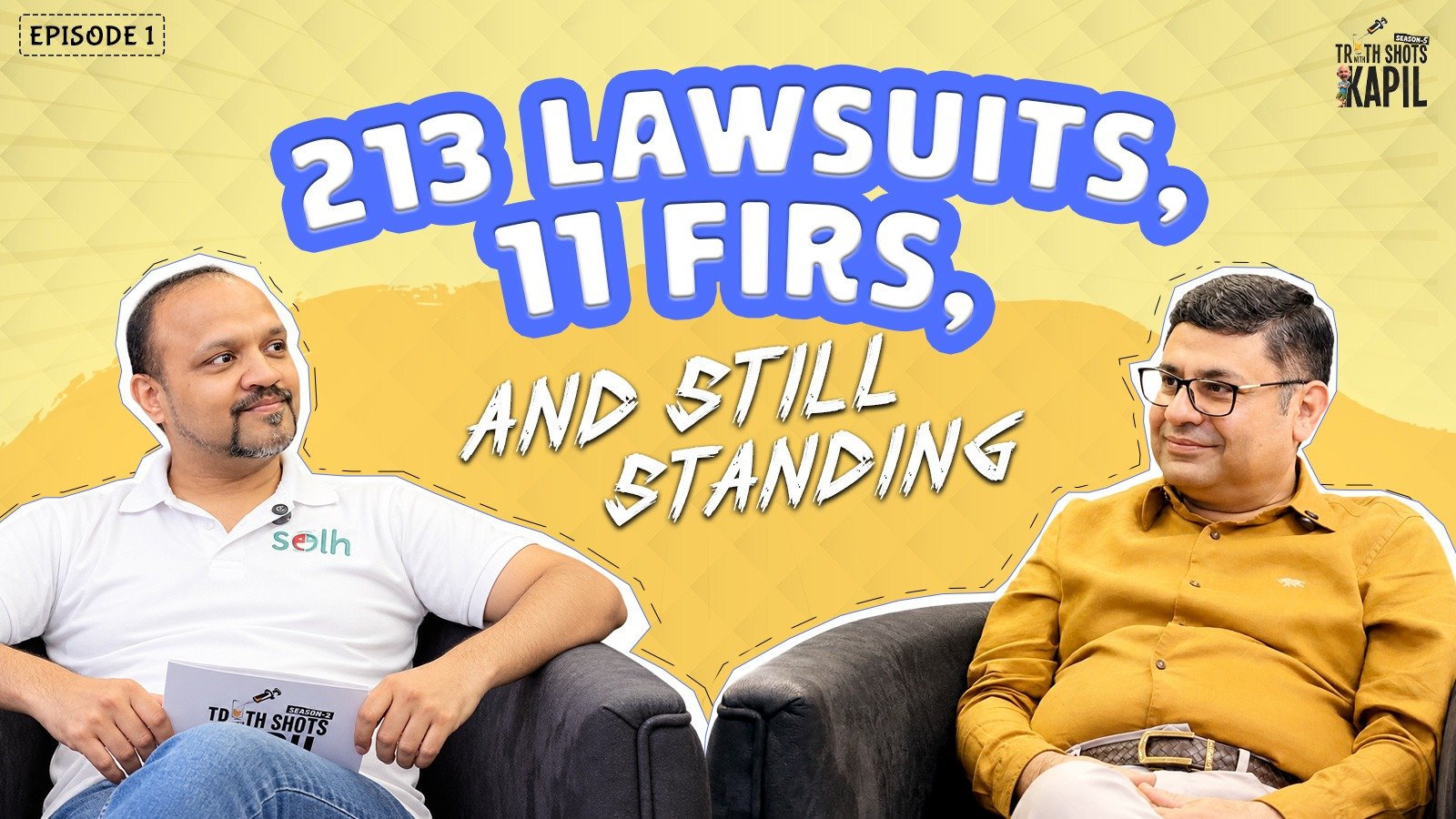
Truth Shots with Kapil – Season 5, Episode 1: What 213 Lawsuits Can Teach Every Founder

Most founders prepare for growth.
Very few prepare for a crisis—or think seriously about crisis management for founders.
We obsess over funding, hiring, scaling, sales, marketing and valuation. We proudly discuss market share and expansion plans. Yet, almost nobody sits in a boardroom and asks, “What happens if tomorrow we receive a legal notice? What if our accounts get hacked? What if our biggest client walks away? What if regulators come knocking?”
We behave as if crises are reserved for other businesses.
Until they aren’t.
That was the most fascinating part of my conversation with Vineet Relia on the first episode of Truth Shots with Kapil – Season 5.
Vineet isn’t just someone who has built businesses. He’s someone who has survived what most entrepreneurs hope they never have to face—213 lawsuits, 11 FIRs, ED investigations, regulatory scrutiny, public accusations, and years of legal battles.
His experience offers lessons not only in legal risk management for businesses, but also in resilience, judgement and leadership during a business crisis.
Most people would write a legal diary.
He wrote a book.
That tells you everything you need to know about perspective.
The first crisis doesn’t happen in court. It happens in your head.
One of the first things Vineet spoke about was something every entrepreneur experiences but very few admit.
Fear.
Not the fear of losing money.
The fear of not knowing what happens next.
The moment a notice arrives, your imagination becomes more dangerous than reality.
“Will the police come home?”
“Will I be arrested?”
“Will immigration stop me?”
“Should I tell everyone I have a case?”
Notice something.
Almost none of these questions are based on facts.
They’re based on assumptions.
And assumptions have an incredible ability to multiply during uncertainty.
Before you’ve spoken to the right expert, you’ve already imagined the worst possible ending.
That is exactly why Vineet’s advice on how founders should handle a crisis was surprisingly simple.
Relax.
Not because the problem isn’t serious.
Because panic has never solved one.
During a crisis, everyone suddenly becomes an expert.
This is perhaps my favourite observation.
The moment people hear words like FIR, court, cybercrime, ED, or legal notice, advice starts flowing faster than facts.
Friends have opinions.
Relatives know someone.
WhatsApp has solutions.
LinkedIn has experts.
Half the advice comes from people who have never experienced what they’re advising you about.
The problem is that fear makes bad advice sound convincing.
When you’re scared, certainty becomes attractive.
Unfortunately, certainty is also what many consultants sell.
Sometimes the consultant becomes the crisis.
I asked Vineet a question I’ve been thinking about for years.
I’ve seen businesses, families and founders hire advisors who somehow make an already difficult situation even worse.
Is it by design?
Or is it simply how the ecosystem works?
His answer wasn’t about blaming an entire profession.
It was about understanding incentives.
Some advisors reduce complexity.
Others increase dependency.
Some explain the process.
Others explain the disaster.
A good consultant leaves you more informed than frightened.
A bad one leaves you convinced that only they can save you.
That’s an expensive difference—and one of the most overlooked aspects of business crisis management.
Most legal fear comes from myths.
One story Vineet shared made me smile.
People often assume that once an FIR exists, the police immediately begin chasing them.
That’s not how the system works.
Law enforcement has priorities.
Commercial disputes don’t suddenly become national emergencies.
Yet fear creates a completely different movie inside our heads.
The imagination is often far more dramatic than reality.
Understanding the process doesn’t eliminate legal risk.
It eliminates unnecessary panic.
For founders dealing with lawsuits, FIRs or regulatory scrutiny, that distinction matters.
The system doesn’t always know how to deal with modern problems.
During our conversation, I shared one of my own experiences.
As I have written before while reflecting on leadership when systems fail, one of our Google Ads accounts was hacked.
Nearly ₹18 crore worth of advertising spend became part of a nightmare that involved cybercrime authorities, Google and multiple systems.
The responses were fascinating.
Cybercrime authorities explained that it wasn’t identity theft.
It also wasn’t financial fraud because money hadn’t been withdrawn directly from our bank account.
Google acknowledged the issue but couldn’t provide details because the campaigns sat outside our advertising hierarchy.
Everyone had a process.
Nobody had a solution.
That’s when you realise something important.
Systems are designed around categories.
Reality rarely fits inside them.
The more technology evolves, the more these gaps become visible.
As AI-powered fraud and impersonation become increasingly convincing, cybercrime risk for businesses is no longer a technical issue alone. It is also a leadership, legal and crisis-management issue.
Success quietly creates overconfidence.
One observation Vineet made deserves to be framed on every founder’s office wall.
Businesses often don’t ignore compliance because they’re careless.
They ignore it because they’re successful.
Growth creates confidence.
Confidence slowly becomes invincibility.
“We’ll handle it later.”
“It’s a small issue.”
“Nothing will happen.”
Until something does.
Many businesses don’t collapse because of competition.
They collapse because they underestimated risk.
Compliance isn’t exciting.
Neither is documentation.
Neither are legal processes.
Neither is governance.
They’re also the reason many businesses survive when everything else falls apart.
Business compliance for founders is not simply about following rules. It is part of crisis preparedness and long-term business resilience.
Humour isn’t disrespect. Sometimes it’s survival.
One of the stories from Vineet’s book, Relax, It’s Only a Raid, perfectly captures this.
An investigating officer repeatedly insisted that Vineet must reveal where he had hidden ₹100 crore.
The irony?
At that point, his own property was already under auction because he didn’t have the money everyone believed he had.
Imagine living that contradiction.
You can either become bitter.
Or you can laugh.
Humour doesn’t make a crisis smaller.
It makes you bigger than the crisis.
Perhaps that’s why his book doesn’t read like a legal document.
It reads like someone who refused to let adversity write the final chapter.
The next crisis won’t ask for permission.
The world founders operate in today is fundamentally different from the one we knew a decade ago.
Cyberattacks.
Regulatory changes.
Geopolitical uncertainty.
Reputational damage.
Artificial intelligence.
Data breaches.
Financial fraud.
Compliance.
None of these wait for the “right time.”
Building a company today isn’t just about creating products.
It’s about building resilience.
Crisis preparedness for businesses can no longer be treated as something to discuss after the crisis arrives.
The businesses that survive the next decade won’t necessarily be the smartest.
They’ll be the ones that remain calm when everyone else is reacting.
Final Thought
Success stories are inspiring.
Survival stories are educational.
Every founder loves reading about unicorns, valuations and billion-dollar exits.
Far fewer want to read about lawsuits, investigations or compliance failures.
That’s a mistake.
Because businesses rarely fail on the days everything goes right.
They fail on the days leaders stop thinking clearly.
If there was one lesson I took away from my conversation with Vineet Relia, it wasn’t about the law.
It was about mindset.
A crisis doesn’t arrive to test your legal knowledge.
It arrives to test your judgement.
And in business, judgement is often the only asset that compounds with experience.
Frequently Asked Questions
1. What is crisis management for founders?
Crisis management for founders is the ability to prepare for, respond to and recover from unexpected business challenges. These may include lawsuits, legal notices, cyberattacks, regulatory investigations, financial fraud, reputational damage or the loss of a major client. The first step is to understand the facts and avoid making decisions based on panic.
2. How should a founder handle a business crisis?
A founder should remain calm, gather verified information and consult the right legal or subject-matter expert. Avoid reacting to assumptions or taking advice from people who do not understand the situation. Good business crisis management begins with clear thinking, proper documentation and informed decision-making.
3. Why is compliance important for founders and businesses?
Compliance helps a business prepare for legal, regulatory and operational risks. Proper documentation, corporate governance and clearly defined processes may appear unexciting during periods of growth, but they can become critical when a crisis arrives. Business compliance for founders is an essential part of long-term resilience.
4. How can businesses prepare for legal and cybercrime risks?
Businesses can strengthen crisis preparedness by reviewing their legal obligations, securing digital accounts, limiting access permissions, maintaining records and creating clear response plans. Founders should also know whom to contact if they receive a legal notice, face a data breach or discover suspicious activity.
5. What can founders learn from Vineet Relia’s 213 lawsuits?
Vineet Relia’s experience with 213 lawsuits and 11 FIRs shows that fear and assumptions can make a crisis feel worse than it is. His story highlights the importance of understanding the process, choosing advisors carefully, maintaining perspective and staying calm under pressure. The central lesson is that a crisis tests a founder’s judgement as much as their legal knowledge.