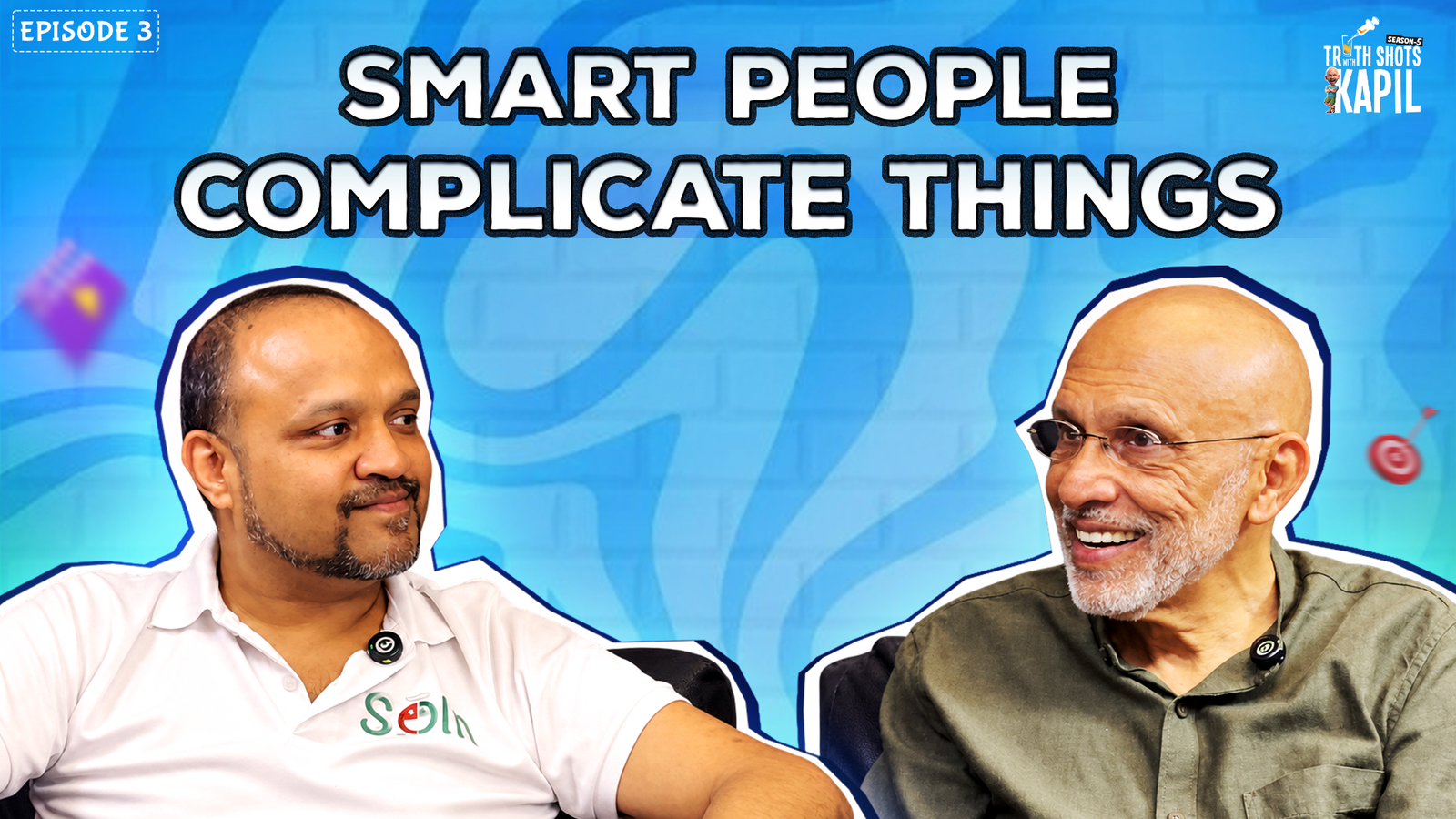
Why Smart People Complicate Simple Problems: The Power of Simple Thinking

We have Google.
We have ChatGPT.
We have YouTube.
We have courses teaching us how to use AI, and courses teaching us how to use those courses.
Basically, information is no longer the problem.
Too much information is.
That was one of the more interesting starting points in my conversation with Prof. Mukesh Sud in Episode 3 of Truth Shots with Kapil.
Mukesh has been an entrepreneur, gone back to academics in his 40s, completed a PhD at IIM Bangalore, taught at IIM Ahmedabad and universities abroad, and written a book called Simple Thinking.
And despite all those qualifications, his argument is surprisingly unacademic:
Most of us make problems more complicated than they need to be.
Which, if you think about it, is quite an achievement.
We finally got access to all the world’s information.
And used it to confuse ourselves.
What Is Simple Thinking?
Simple thinking is not about having simplistic answers.
It is about identifying the real problem, separating information from understanding, observing what others miss, and resisting the urge to make straightforward problems unnecessarily complicated.
That distinction becomes increasingly important in a world where search engines, social media, YouTube and AI can give us almost unlimited information.
The challenge is no longer simply finding an answer.
The challenge is knowing which answer matters.
More Information Hasn’t Made Us Smarter
There was a time when the internet solved a very different problem.
You searched because information was difficult to find.
Today, search engines are trying to solve the opposite problem.
There is too much.
You don’t want 14 million results.
You want the three that matter.
Mukesh makes an important distinction here.
Information is not knowledge.
Data is not understanding.
And a graph can look extremely intelligent while leading you to a completely ridiculous conclusion.
His example is simple.
If you plot men’s and women’s long-distance running records over time, both improve. Women’s timings historically improved at a faster rate.
Keep extending those lines blindly and eventually they intersect.
Congratulations.
Your spreadsheet has just predicted that women will inevitably outrun men.
The maths may be neat.
The conclusion may still be nonsense.
This is where Mukesh mentioned something I wish existed in every university.
A course at the University of Washington called Bullshit.
The first questions students are apparently encouraged to ask are essentially:
What bullshit do you see around you?
How much have you created yourself?
And how are you going to reduce it?
Probably more useful than several courses I have paid for.
There is an old argument that one of the purposes of higher education should be to help you identify bullshit and keep it out of your life.
In 2026, that may be less of a joke and more of a survival skill.
Simple Thinking in the Age of AI
AI has made this distinction even more important.
Tools such as ChatGPT can produce answers in seconds. And as AI becomes increasingly embedded in the way we work, the ability to question those answers becomes even more important.
But none of that automatically tells us whether the underlying question is the right one.
More information can improve decision-making only when we know how to evaluate it.
That is why critical thinking, observation and problem definition matter more—not less—in the age of AI.
Why Do We Trust Complicated Answers?
There is another strange thing humans do.
If somebody explains something complicated in very complicated language, we assume they are intelligent.
If they explain it simply, we suspect they don’t understand it properly.
We like jargon.
Frameworks.
Charts.
Three-letter acronyms.
Preferably several slides.
Because complexity feels expensive.
Simple answers sometimes feel suspiciously cheap.
Mukesh uses the example of a doctor.
If you visit a doctor and he tells you:
“Nothing serious. Give it a few days.”
A part of you feels cheated.
What exactly did I pay for?
Surely there should be three medicines, two investigations and at least one word I need Google to understand.
Sometimes we don’t want the correct answer.
We want an answer complicated enough to justify the fee.
And that tendency extends far beyond medicine.
We complicate business problems.
We complicate careers.
We complicate relationships.
We complicate decisions.
Sometimes because the problem is genuinely difficult.
And sometimes because admitting that the answer is simple would force us to actually act on it.
Three Rules for Simple Thinking
Mukesh’s framework is refreshingly free of unnecessary frameworks.
Three things.
1. Break the Problem Down
A large problem is usually several smaller problems standing on each other’s shoulders pretending to be one enormous problem.
“My business isn’t working.”
That’s not a problem.
That’s a headline.
Is sales the problem?
Product?
Pricing?
Retention?
People?
Cash flow?
Until you break the problem down, you are mostly fighting fog.
This is one of the most practical principles of simple problem solving:
Define the problem before trying to solve it.
Instead of asking:
“Why is everything going wrong?”
Ask:
“What specifically is not working?”
The quality of the answer often depends on the quality of that question.
2. Accept Paradoxes
Humans love certainty.
Pick one side.
Good or bad.
Right or wrong.
Growth or profit.
Happy or sad.
But real life doesn’t behave that neatly.
Mukesh talks about paradoxical thinking: the ability to accept that two apparently opposing things can both be true.
You inhale.
You exhale.
Opposites.
Both required.
A business may need discipline and experimentation.
An organisation may need control and freedom.
You can love something and still want to leave it.
The interesting solutions often arrive after you stop forcing reality into one side of an argument.
Simple thinking, therefore, does not necessarily mean choosing the simplest side.
Sometimes it means accepting that reality is more nuanced than the choices we have created for it.
3. Don’t Just See. Observe.
This one is very Sherlock Holmes.
Most people look at what is visible.
Observation includes asking what is missing.
What’s unusual?
What hasn’t happened?
What are everybody else’s assumptions preventing them from noticing?
Seeing gives you information.
Observation gives you clues.
That difference becomes increasingly important in a world where AI can give everybody information.
And once information becomes abundant, knowing what to do with it becomes even more important. The same shift is happening in search, where AI-first search is changing how information is discovered, understood and recommended.
When information becomes abundant, the ability to notice what matters becomes a competitive advantage.
Ten Balloons. Nine Hours. Almost No Technology.
One of my favourite stories from the conversation was a DARPA experiment.
Ten giant red balloons were placed across the United States.
Thousands of teams participated.
Find all ten.
The obvious approach?
Technology.
Mapping.
Software.
Complex systems.
The MIT team took a different route.
They created an incentive system.
Find a balloon and get rewarded.
If somebody you referred found one, you also benefited.
People spread the message themselves.
Nine hours later, the problem was solved.
Not by building the smartest technology.
By understanding human behaviour.
That is Simple Thinking.
The solution doesn’t always need to look as complicated as the problem.
And that is an important lesson for entrepreneurs, managers and anyone solving complex problems:
Before asking what technology can do, ask what people can do.
Entrepreneurship Is Not Freedom
Then we moved to one of my favourite pieces of fiction:
“I want to become an entrepreneur because I want freedom.”
Wonderful.
Take a job.
Seriously.
You will probably have a defined working day.
Become an entrepreneur and you work for customers.
Employees.
Vendors.
Banks.
Government.
Tax departments.
And whatever crisis arrives at 11:47 PM.
Mukesh describes entrepreneurship as running on a treadmill where the speed keeps increasing.
You run faster.
You become better.
Sometimes you make more money.
But occasionally you look around and realise you’re standing in exactly the same place.
He eventually realised entrepreneurship was not where he wanted to remain.
So he left.
Which brings us to another thing we unnecessarily complicate.
Starting Again at 40: Why Reinvention Matters
Mukesh went back to study and began his PhD in his 40s.
By that age, society normally expects you to have stopped asking what you want to become.
You’re supposed to know.
Career established.
Identity established.
LinkedIn headline properly formatted.
Mukesh didn’t agree.
His belief is that roughly every ten years, you should be willing to reinvent yourself.
Not because the previous version failed.
Because remaining relevant requires changing.
The entertaining part is what happened when an experienced entrepreneur arrived at IIM Bangalore and discovered he barely knew how to type.
Suddenly, people half his age were faster with technology.
Study groups met at one in the morning instead of one in the afternoon.
His previous status had no value.
He had to learn again.
There is something healthy about occasionally entering a room where nobody cares what you used to be good at.
Starting again is not necessarily failure.
Sometimes it is simply the next form of growth.
Failure Is Not What We Think It Is
Entrepreneurship is also constantly described as risk-taking.
Mukesh disagrees.
Good entrepreneurs don’t randomly take risks.
They try to understand risks better than everyone else.
And when businesses fail, we casually say:
“The entrepreneur failed.”
Not necessarily.
The company failed.
The entrepreneur may have gained experience, networks, knowledge and judgement that make the next attempt dramatically better.
His analogy was fantastic.
If I told you a Delhi-Bangalore flight had a 50% chance of crashing, would you board?
Of course not.
Yet startups routinely face terrible odds.
Why?
Because the entrepreneur isn’t necessarily betting everything on one company.
The venture can fail without permanently destroying the person building it.
That distinction changes the meaning of failure.
Failure can be an outcome.
It does not automatically have to become an identity.
Students Don’t Think. They Prompt.
Mukesh has another rule.
No technology on the table in his classroom.
Which in 2026 is roughly equivalent to asking students to surrender oxygen.
His logic is interesting.
If he removes the student’s phone and laptop, he places more pressure on himself.
Now he has to earn their attention.
He has to change pace.
Ask questions.
Create conversations.
Make the class worth looking up for.
The students push back too.
Fine, professor.
You took away our screens.
Now give us something better.
Fair bargain.
But this becomes even more interesting with AI.
Students increasingly don’t have to solve the problem.
They can prompt somebody—or something—to solve it.
Which raises a much larger question.
What will humans still do better than AI?
Mukesh’s answer was one word:
Empathy.
Naturally, I disagreed.
Because that’s what podcasts are for.
If empathy means actually feeling another person’s pain, AI may have a problem.
But if empathy means demonstrating to another person that you understand their pain?
Then things become uncomfortable.
Because demonstration is behaviour.
Behaviour can be learned.
Given enough data and processing capability, machines can increasingly reproduce behaviours we once thought were exclusively human.
We’ve already watched this happen with language.
Machine translation once produced robotic words.
Now AI can translate context, humour, tone and style.
So perhaps saying “AI can never do this” is a dangerous sentence.
History keeps humiliating it.
Ants Might Be Better Thinkers Than Us
Mukesh’s book also begins in an unusual place.
Not unicorn founders.
Not CEOs.
Ants.
An individual ant is not particularly intelligent.
Put millions together and something remarkable happens.
They build colonies.
Organise food.
Solve logistics.
Even create floating structures during floods by linking their bodies together and trapping air between them.
Nobody sent the ants to an MBA programme.
No leadership retreat.
No strategy deck.
Simple rules. Complex outcomes.
Maybe intelligence is not always about becoming individually smarter.
Sometimes it is about designing better systems.
This is another important idea behind simple thinking:
Complex outcomes do not always require complex rules.
Sometimes the better solution is to create the right conditions and let the system do the work.
Maybe We Don’t Need More Answers
At the end of the conversation, I asked Mukesh to make Simple Thinking practical.
Imagine everything feels broken.
Business.
Career.
Marriage.
Health.
Traffic.
Life.
What do you do first?
His answer wasn’t another framework.
Take a step back.
Observe.
Before designing the perfect diet, ask what you’re actually eating.
Before solving your career, identify which part isn’t working.
Before finding a complicated answer, make sure you have identified the actual problem.
We spend an extraordinary amount of time solving problems we haven’t properly defined.
And perhaps that’s the central truth behind Simple Thinking.
The world is complicated enough.
We don’t always need to help it.
There is a related lesson in Kapil’s writing about the difference between waiting and acting: The Two Worst Words in the English Language: Hoping and Trying.
What Is the Main Lesson of Simple Thinking?
The central lesson is simple:
Don’t confuse more information with better thinking.
Good thinking starts by identifying the real problem.
Then breaking it down.
Observing what others miss.
Accepting paradoxes.
Understanding human behaviour.
And knowing when a complicated solution is unnecessary.
In an age of AI, information overload and increasingly complex decision-making, simple thinking may not mean thinking less.
It may mean thinking better.
Watch Episode 3 of Truth Shots with Kapil featuring Prof. Mukesh Sud on YouTube @kgismofficial.
Frequently Asked Questions
What is simple thinking?
Simple thinking is the practice of identifying the real problem, breaking complex problems into smaller parts, observing carefully, and avoiding unnecessary complexity in decision-making.
Why do people complicate simple problems?
People often associate complexity with intelligence, expertise or value. Jargon, frameworks, charts and complicated explanations can make an answer feel more credible even when a simpler answer is more useful.
What are the three principles of simple thinking discussed by Mukesh Sud?
The three principles are:
- Break the problem down.
- Accept paradoxes.
- Don’t just see; observe.
Why is simple thinking important in the age of AI?
AI can provide enormous amounts of information and generate answers quickly. Simple thinking helps people determine which questions matter, evaluate information critically and identify the actual problem before asking AI or other tools to solve it.
What is paradoxical thinking?
Paradoxical thinking is the ability to recognise that two seemingly opposing ideas can both be true. For example, a business may need both discipline and experimentation, while an organisation may need both control and freedom.
Does failure mean an entrepreneur has failed?
Not necessarily. A business can fail while the entrepreneur gains experience, knowledge, networks and judgement that can improve future decisions and ventures.
Why did Mukesh Sud return to academics in his 40s?
Mukesh Sud returned to study and began his PhD at IIM Bangalore in his 40s, challenging the assumption that people must settle permanently into one career or identity.
What can humans do better than AI?
The conversation raises empathy as one possible area where humans may retain an advantage. However, the discussion also questions the assumption that AI can never reproduce behaviours associated with human capabilities.
What is the biggest lesson from Simple Thinking?
Before searching for a complicated answer, make sure you have identified the actual problem. Often, the first step toward solving a difficult problem is simply taking a step back and observing.