The Voice Was His. The Face Was His. The Person Wasn’t.

How AI is rewriting the rules of online fraud and impersonation in India-and the simple habits that can save your family.
It started the way most ordinary evenings do.
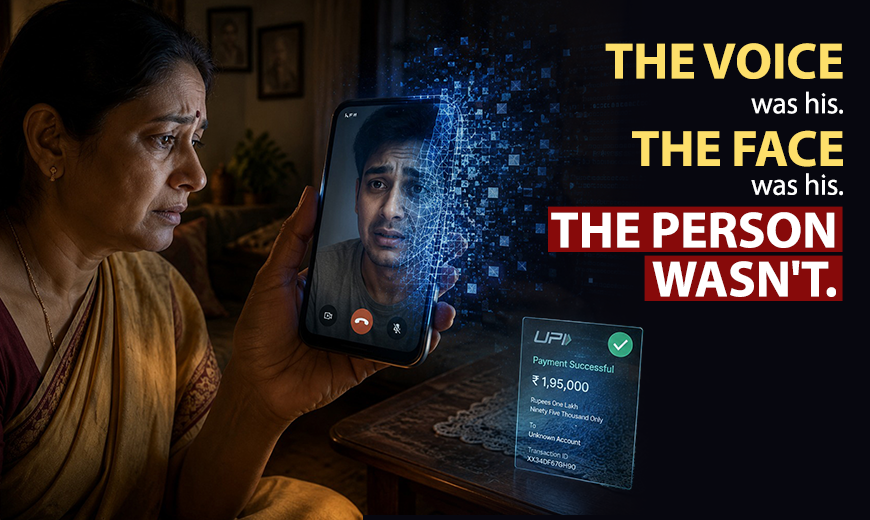
A mother in Pune is finishing dinner when her phone lights up. It’s a video call. Her son’s face fills the screen-the same eyes, the same nervous habit of running a hand through his hair. But something is wrong. He’s panicking. He’s been in a small accident, he says. His phone is damaged, he’s calling from a stranger’s number, and there’s a man-a “policeman,” an “official”-who needs a settlement paid right now or things will get serious. The voice cracks. “Maa, please, just send it. I’ll explain everything later.”
She doesn’t hesitate. Why would she? It’s her son. She can see him. She can hear him. Within four minutes, ₹50,000 has left her account over UPI.
It was not her son. It was never her son.
It was a few seconds of his voice-scraped from an Instagram reel-cloned by AI. It was his face, lifted from photos, animated in real time by a deepfake tool that costs a scammer almost nothing to run. The same technology powering creative breakthroughs is also raising serious concerns about misinformation and fraud. We explored this in our analysis of Google VEO 3 and the rise of deepfakes.
The “trouble,” the “policeman,” the urgency-all script. By the time she calls her son’s real number, the money is gone, routed through a chain of mule accounts, very likely already overseas.
This is not science fiction. This is 2026 in India. This is the AI voice cloning scam India is now confronting at scale, and one of the fastest-growing forms of deepfake scam India cybercrime units are warning about.
The Ground Has Shifted Under Us
For decades, fraud relied on a lie you could catch. The misspelt email. The unfamiliar number. The stilted English of a “bank official.” There were tells. We taught our parents the tells.
AI has erased the tells.
Today, a scammer needs as little as 10–15 seconds of someone’s voice to clone its tone, pitch, accent and emotion almost flawlessly. According to figures cited from India’s cyber cells, voice-cloning fraud cases jumped sharply through late 2025, part of a global surge in which voice phishing rose over 440% in a single year. Deepfake-enabled fraud crossed $200 million in losses worldwide in just the first quarter of 2025. Voice cloning fraud has become one of the clearest examples of AI-assisted cyber crime India is seeing move from novelty to mainstream criminal activity.
And it isn’t only the “son in trouble” call. India is now described by Bloomberg and others as a global hotspot for AI-assisted scams-supercharged by the very thing that makes us digitally world-leading: over a billion online identities, near-universal UPI, and a population that trusts the phone in its hand. The country’s challenge is no longer just online fraud awareness; it is AI fraud prevention at household scale.
The uncomfortable truth at the centre of all this: fraudsters are almost always ahead of the average person on technology. They adopt new tools first, because the tools pay for themselves in a single successful con. The boundary between what is real and what is synthetic is not blurring slowly-it has already blurred. The question is no longer “Can I spot a fake?” Increasingly, you can’t. The question is “What do I do when I can’t tell?” That is the real challenge of AI scam protection India must now solve.
The New Faces of Impersonation
The “distressed child” call is just the opening act. Here are the scenarios already playing out across India-and the ones heading our way:
1. The Digital Arrest
Perhaps the most devastating scam in the country right now. A video call from a fake CBI, ED, customs or “cyber police” officer-uniform, badge, official-looking backdrop, sometimes an entire fake police station rendered behind them. You’re told a parcel in your name contains drugs, or your Aadhaar is linked to money laundering. You are placed under “digital arrest”-kept on camera, forbidden from contacting anyone, and squeezed for “verification” transfers.
India’s Supreme Court has flagged cumulative losses from such scams running into tens of thousands of crores, calling it nothing short of robbery.
Remember this and nothing else about it:
No real police force in India ever arrests you over a video call.
“Digital arrest” does not legally exist.
If you search for digital arrest scam or deepfake video call scam, this is the pattern authorities are describing.
2. The Cloned Boss / CEO Fraud
An employee gets a WhatsApp video call or voice note from the “MD”-face, voice, mannerisms intact-instructing an urgent, confidential vendor payment before a deadline. Globally, one company lost over $25 million when a finance worker joined a video call in which every other participant was a deepfake.
Indian SMEs and finance teams are squarely in the crosshairs.
This is AI impersonation scam territory, not ordinary phishing.
3. The Romance & “Investment” Deepfake
A handsome stranger, a warm video chat to “prove they’re real,” weeks of affection-then a can’t-miss crypto or trading tip. The face on the call may be an AI puppet wrapped around a stolen photo. The trading app is fake. The losses are life-altering.
4. The Celebrity / Doctor Endorsement
Deepfaked videos of trusted public figures, doctors, and even RBI-style “officials” hawking miracle cures, guaranteed-return schemes or “government” lottery refunds-convincing enough to clear the only filter most people have: “but I saw them say it.”
These clips often spread as online fraud awareness lags behind the speed of AI-generated content.
5. The Grandparent UPI Trap
The voice of a grandchild, a niece, a nephew-“I lost my phone, this is my friend’s number, please send to this UPI ID.”
This is just one example of how modern payment systems can be exploited. Read our deep dive on UPI scams in India to understand the broader fraud ecosystem surrounding digital payments.
Elderly relatives, generous and trusting, are the softest targets of all.
Think of this as UPI scam prevention through verification, not through technology.
6. The Bank/KYC Video Verification
A polished “relationship manager” video-calls about a blocked card or expiring KYC, walks you through a screen-share or a link, and harvests OTPs and credentials in real time while you watch a friendly, smiling face.
7. What’s Coming Next
Real-time voice translation cloning (your relative “calling” in flawless local language from “abroad”), AI agents that hold full back-and-forth conversations, and hyper-personalised scams stitched from your own leaked data.
The tools only get cheaper and faster from here.
Deepfake fraud prevention will become less about spotting fakes and more about verification rituals.
So What Actually Protects You?
You cannot out-tech the scammers.
You don’t have to.
The defences that work are human, simple, and repeatable-habits, not gadgets.
This is the practical side of AI fraud prevention.
1. Set a Family Safe-Word. Today.
Agree on one secret word or phrase known only to your immediate family-for emergencies.
If someone calls in a panic asking for money, you ask for the word.
No word, no money.
Make it something no outsider could guess (not a pet’s name, not a birthday).
And the golden rule: decide it face-to-face. Never type it into WhatsApp, email, or any chat. Never store it digitally. It lives only between you.
A safe-word is the single most powerful, lowest-cost defence against voice and video impersonation-because AI can clone a face, but it cannot know a secret it was never told.
2. Hang Up. Call Back. Always.
Treat every urgent money request-no matter how real the voice or face-as unverified until you’ve confirmed it on a known, saved number.
Cut the call and dial your son, your boss, your bank yourself.
Scammers manufacture urgency precisely to stop you doing this.
The five minutes they don’t want you to take are the five minutes that save you.
3. Trust No One by Default. Re-check Everything-Especially Money.
Real urgency survives a verification step; only fraud collapses under it.
When money is involved, suspicion is not rudeness-it is self-respect.
Ask a question only the real person could answer.
Switch channels.
Confirm in a second medium.
4. Know the Lines That Don’t Exist.
No agency in India conducts “digital arrests.”
No bank, no police officer, no CBI/ED/TRAI/courier official will ever ask for OTPs, full card numbers, passwords, remote access to your phone, or payment to “prove your innocence.”
The moment a call demands secrecy + urgency + money, it is a scam. Full stop.
This single rule stops a large share of AI impersonation scam attempts.
5. Shrink Your Digital Footprint.
The raw material for cloning you is your public voice and face.
Lock down social media privacy.
Think twice before posting long voice notes, reels of your voice, or your children’s videos publicly.
Be wary of “your voice has won…” calls and random “can you hear me?” calls designed purely to record you saying “yes.”
The less public audio you provide, the less fuel there is for voice cloning fraud.
6. Insure Yourself-And Your Money Rails.
Cyber-fraud and online-fraud insurance covers now exist in India and are growing fast.
Review what your bank and insurer offer.
Enable transaction alerts, set sensible UPI/card limits, and use a separate low-balance account for daily online payments so a single breach can’t drain everything.
7. Stay Ahead-Make Awareness a Habit.
You don’t need to be a cyber expert; you need to be current.
Follow the right sources, talk about new scams at the dinner table, and forward warnings to the most vulnerable people in your family before-not after-they get the call.
The scammers do their research.
So should you.
Online fraud awareness is now a family hygiene issue, not just a cybersecurity topic.
If It Has Already Happened-Act in Minutes, Not Days
Speed decides whether money is recoverable.
The first hour is everything.
- Call 1930-the national cyber-crime helpline-immediately.
- Report at cybercrime.gov.in.
- Use Sanchar Saathi to report the fraudulent number and secure your account.
- Inform your bank immediately.
- Preserve everything-screenshots, call logs, UPI IDs and messages.
The Bottom Line
The face on the screen can be faked.
The voice in your ear can be faked.
The fear they trigger in you is the only thing that’s real-and that fear is exactly what they’re selling.
In the age of AI, love is the vulnerability they exploit, but it is also the defence they can’t replicate.
A secret word. A second phone call. A family that talks about this stuff out loud.
These are not high-tech defences.
They are human ones.
And against a machine pretending to be someone you love, human is the one thing it can never truly be.
Decide your safe-word tonight.
Make the call you’re putting off.
Forward this to the person in your family most likely to pick up that call.
Because the next “Maa, please, just send it” might come to your phone.
And the only thing standing between trust and theft will be a habit you either built-or didn’t.
Frequently Asked Questions (FAQs)
1. What is an AI voice cloning scam?
An AI voice cloning scam occurs when fraudsters use artificial intelligence to replicate someone’s voice using a short audio sample. They then impersonate a family member, friend, colleague, or authority figure to create urgency and trick victims into sending money or sharing sensitive information.
2. How can I tell if a video call or voice call is a deepfake scam?
It is becoming harder to identify deepfake scams through appearance or voice alone. Instead of relying on what you see or hear, verify the person’s identity through a known phone number, ask a question only they would know, or use a pre-agreed family safe-word.
3. What is a digital arrest scam?
A digital arrest scam is a fraud in which criminals impersonate police officers, cybercrime officials, customs officers, or government agencies through phone or video calls. Victims are falsely accused of crimes and pressured into transferring money for “verification” or “investigation” purposes.
4. What should I do if I become a victim of an AI scam or online fraud?
Act immediately. Call 1930, report the incident on the National Cyber Crime Reporting Portal, contact your bank to freeze suspicious transactions, and preserve all evidence such as call logs, screenshots, messages, and UPI transaction details.
5. How can families protect themselves from AI impersonation scams?
The most effective protection is verification. Create a family safe-word, confirm urgent requests through a known phone number, avoid sharing excessive personal information online, and discuss emerging scam tactics regularly with family members—especially elderly relatives.