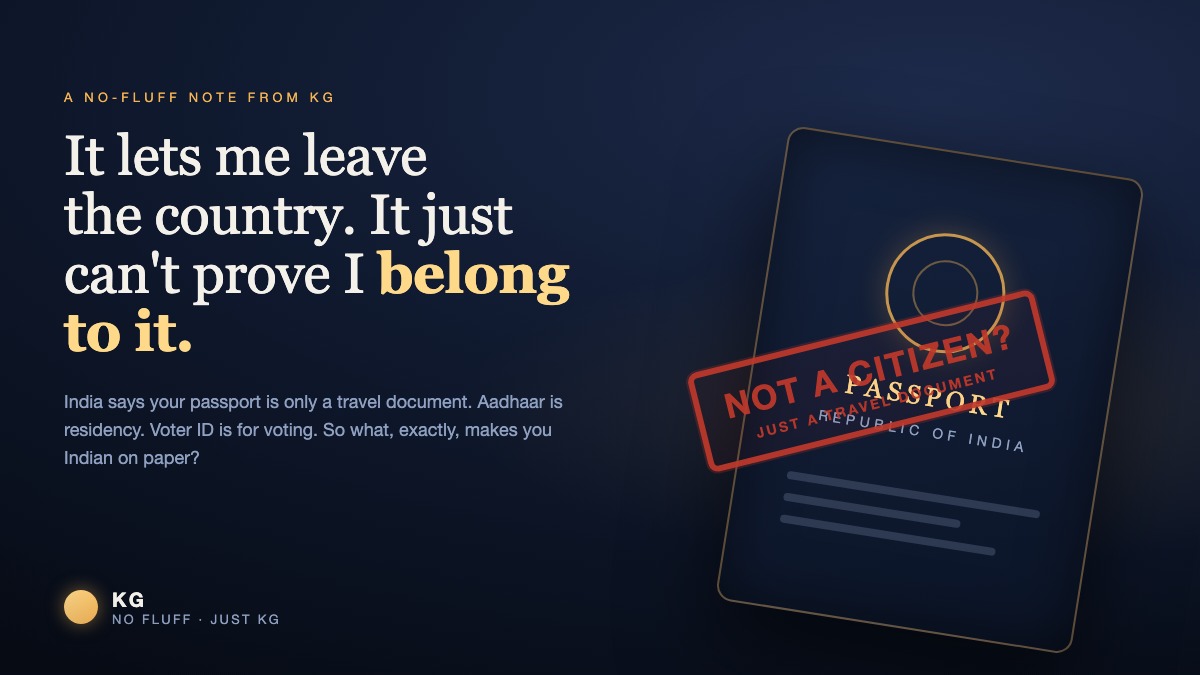
My Passport Can Take Me to 60 Countries. It Just Can’t Prove Which One I’m From.

Let me get the news out of the way, because you’ll think I’m making it up. On June 24, 2026, the Ministry of External Affairs of the Government of India clarified -calmly, in writing, like it was the weather -that your Indian passport is not proof of citizenship. It is a “travel document.” That’s it. A laminated permission slip to leave and return. The little gold emblem, the navy cover you queued three hours for, the thing you guard like a kidney when you travel -legally, it proves you can board a plane. Not that you’re Indian.
This entire debate sits inside a larger question of India citizenship proof documents, and most people don’t realize how fragmented that answer actually is.
And before you reach for your wallet thinking “fine, I’ll use my Aadhaar” -sit down. The Supreme Court already settled that one. Aadhaar isn’t proof of citizenship either. It’s proof of residency. Which, by design, is also available to people who are not Indian citizens. Voter ID? That proves you’re allowed to vote, not that you’re a citizen -and yes, those two things have somehow been decoupled in the world’s largest democracy.
So let me make sure I have this straight. The document that lets me cross international borders doesn’t prove I’m Indian. The document with my fingerprints, my iris, and my entire biometric soul on it doesn’t prove I’m Indian. The card that literally lets me choose the government doesn’t prove I’m Indian. We have built a country of 1.4 billion people and somehow not one of us is holding the receipt.
I’VE SEEN THIS MOVIE BEFORE -IN A CONFERENCE ROOM AT UIDAI
Here’s why this hit me harder than it should have. Years ago, I went to pitch at UIDAI. Bright-eyed, deck ready, the whole circus. And somewhere in that meeting, trying to make a point, I referred to Aadhaar as a kind of national identity -the obvious “you are Indian” card.
A very patient official stopped me. No, he said. Aadhaar is not proof of citizenship. It is proof of residency. It is available to people who live here who are not necessarily Indian citizens. I remember nodding slowly, the way you do when you’ve just been corrected by someone who is clearly right and slightly enjoying it.
And then he told me the part I built my whole mental model around for the next several years. “If you want proof of citizenship,” he said, “that’s your passport. And your voter ID.” Those, he assured me, were the real thing. The gold standard. The documents that actually said Indian.
I walked out of that building genuinely educated. For years I’d correct other people at dinner tables -“actually, Aadhaar isn’t citizenship, that’s residency, the passport is the real proof” -feeling like the smartest person in the room.
Reader, the room moved. In June 2026, the same government that sent me out of UIDAI clutching “passport and voter ID” as the truth has now informed me that the passport is just a travel document and the voter ID just lets me vote. Every single answer I was handed has since been recalled like a faulty airbag. I didn’t fail the citizenship exam. The syllabus got deleted while I was studying.
THE PART THAT IS ACTUALLY, GENUINELY ABSURD
Let me lay out the logic the way a five-year-old would, because that’s the only altitude at which it makes sense -and also where most conversations about what proves Indian citizenship eventually land.
- Passport: Issued only to Indian citizens (mostly). Says “Republic of India” on it. Has the national emblem. Not proof of citizenship.
- Aadhaar: The most-issued ID in human history. Biometric. Tied to your bank, your phone, your gas cylinder, your soul. Not proof of citizenship. This is where the confusion between Aadhaar citizenship proof India expectations and reality really begins.
- Voter ID: The card that lets you decide who runs the country. Not proof you belong to the country.
So what is proof? Officially: a combination. Your birth certificate, your parents’ citizenship documents, the date you were born stitched against a changing rulebook. In other words: there is no single card. There is a quest.
Citizenship in India is not a document you hold; it’s a folder you assemble, a small archaeological dig through your family’s paperwork. And if you’re asking about documents required for Indian citizenship proof, the answer is less a list and more a maze that shifts depending on context.
And my personal favourite legal detail, the cherry on this bureaucratic sundae: your passport -the thing you paid for, the thing with your face on it -remains the property of the Government of India. So to summarize: it’s not proof you’re Indian, and it’s not even yours.
You’re holding the government’s stationery, on loan, with your photo in it, for the privilege of being asked at the border to prove the one thing it refuses to prove.
INTERLUDE: THE NEPAL BORDER, WHERE I LOST A FIGHT TO A MAN WITH A PHONE
Picture it. The India–Nepal border. Beautiful day. I roll up, relaxed, because every Indian knows the one flex we have on this planet: we don’t need a visa for Nepal. Open border. Friendship treaty. Just walk in.
The officer asks for my visa.
“I don’t need a visa,” I say, smiling, holding all the cards. “I’m an Indian citizen.”
“Wonderful,” he says. “Prove it.”
So I produce the passport. The navy one. The gold emblem catching the Himalayan sun. The single most internationally respected sentence I own: Republic of India.
He doesn’t even take it. He just turns his phone around. On the screen is a news headline, dated yesterday: “Indian passport is not proof of citizenship -Government of India.” This is where citizenship verification India becomes less theoretical and more… awkward.
He raises an eyebrow. “Sir, this is a travel document. It tells me you can travel. Your own ministry says it does not tell me you are Indian.”
I scramble. I pull out the Aadhaar. Biometrics! Fingerprints! The most data any government has ever held on a human being!
He nods kindly. “Residency, sir. It proves you live in India. It does not prove you are India.”
Then, with the gentle cruelty of a man who has clearly read the news more recently than I have: “Do you have anything that actually proves you are an Indian citizen?”
And I stood there, at a border I was supposed to walk through on the strength of being Indian, holding three documents that confirmed I could travel, that I live somewhere, and that I’m allowed to vote -and not one that confirmed the only fact in question.
That moment captures the entire India identity vs citizenship documents contradiction in one uncomfortable exchange.
NOW LOOK AT HOW THE REST OF THE WORLD DOES IT
Here’s the part that turns absurdity into embarrassment.
In the United States, a valid U.S. passport unequivocally proves citizenship. Full stop. In Canada and Australia too, the logic is straightforward: passport equals nationality.
Across most of the developed world, the deal is simple and sane. The document issued for travel doubles as proof of citizenship.
In India, it’s more fragmented -a classic case of Aadhaar vs passport vs voter ID India confusion, where each document answers a different question but never the same one completely.
To be fair -even the UK complicates this. But the difference is tone. Some countries make citizenship a single locked answer. Others make it a set of partial clues.
WHY THIS ISN’T JUST FUNNY
I’ve kept it light because the alternative is to cry, but let me land the plane honestly.
This isn’t just about paperwork -it’s about how Indian documentation system citizenship logic actually operates in practice. When the state can ask “prove you’re a citizen,” and then disqualify every document it itself issues as proof, you don’t get clarity. You get dependency on layered verification.
And that becomes a problem when ordinary people are asked to produce citizenship verification India documents on demand -especially those without perfect records, stable archives, or legally preserved histories.
A citizenship test that no ordinary citizen can pass instantly is not a test. It’s a reconstruction project.
So here’s where I land. Issue one document. Make it mean what it says.
Let the passport that says “Republic of India” actually stand for being of the Republic of India.
Until then, I’ll keep my navy book -the government’s stationery, on loan, with my face in it -and I’ll keep my UIDAI memory, where a kind official taught me the truth that expired before I could use it.
I can travel anywhere. I just can’t prove where I’m from.
-KG
FAQS
- Is an Indian passport proof of citizenship?
No. An Indian passport is a travel document issued to citizens, but it is not considered conclusive proof of citizenship on its own. It allows international travel, not standalone verification of nationality in all legal contexts. - Is Aadhaar proof of Indian citizenship?
No. Aadhaar is proof of identity and residency. It is issued to residents of India, including non-citizens, and therefore cannot be used as Aadhaar citizenship proof India in legal terms. - What documents are accepted as proof of Indian citizenship?
There is no single universal document. Documents required for Indian citizenship proof typically include a combination of birth certificate, parent’s citizenship documents, school records, or government-issued records depending on the case and context. - Can voter ID be used as proof of citizenship in India?
Voter ID confirms eligibility to vote, but it is not absolute proof of citizenship. It is part of the broader system of India citizenship proof documents, but not a standalone guarantee of nationality. - Why is citizenship proof in India so complex?
Because citizenship in India is not tied to one single identity card. Instead, it relies on multiple overlapping records across different systems, leading to frequent confusion in citizenship verification India processes and documentation checks.