We Have More Degrees Than Ever. So Why Aren’t We Thinking Better?

We have managed to make education a very complicated business.
We have schools preparing children for colleges. Colleges preparing students for jobs. Universities competing for rankings. Parents competing over which university their children get into.
And students spending years collecting marks, certificates, internships and degrees.
Everyone seems to be preparing for something.
But I have a simple question.
When exactly do we teach people to think?
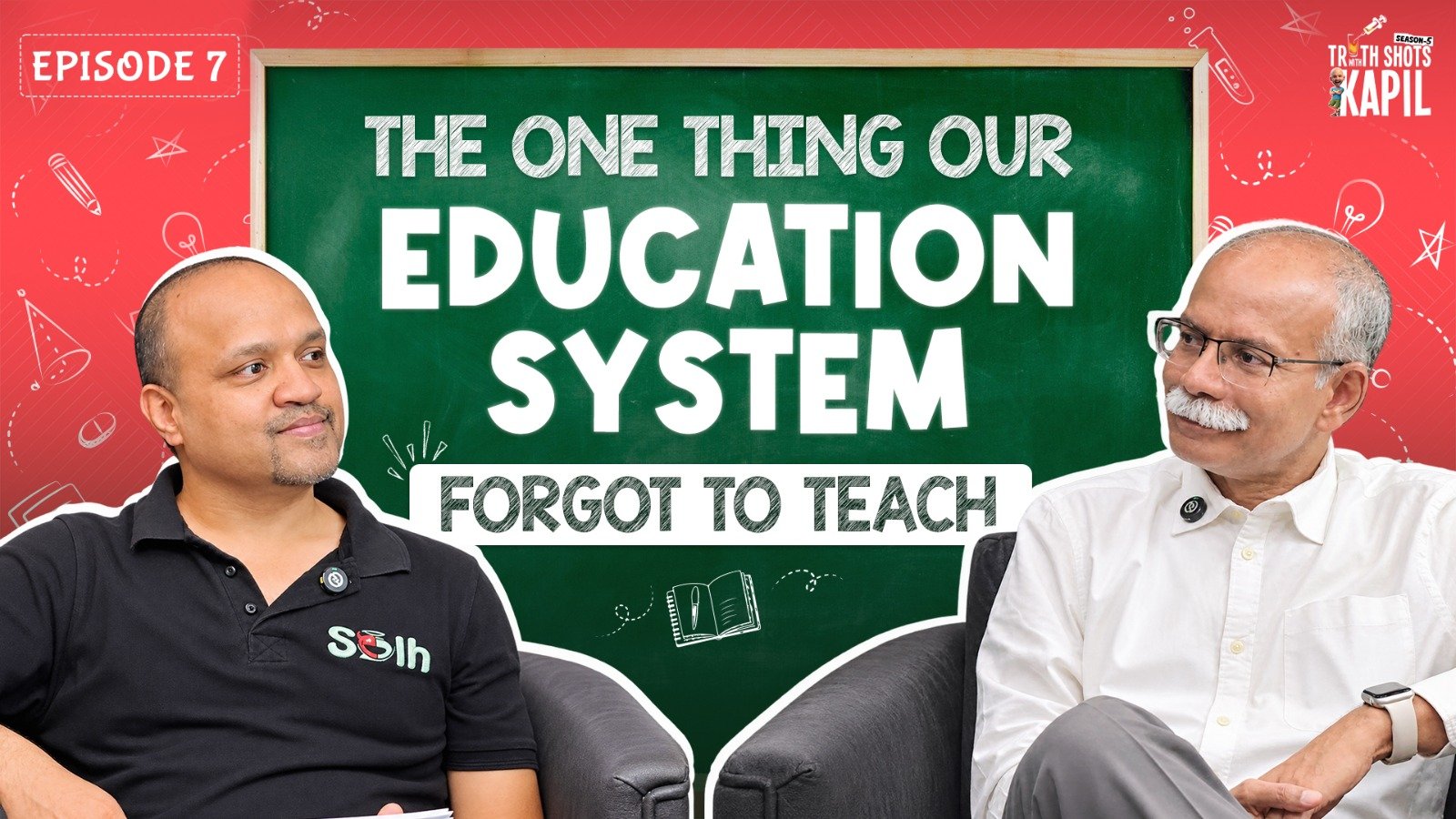
That question stayed with me through my conversation with Prof. Padmakumar Nair, Vice-Chancellor of Thapar Institute of Engineering & Technology, on the latest episode of Truth Shots with Kapil.
We spoke about education, universities, rankings, artificial intelligence and the future of learning.
But underneath all of it was a much bigger question.
Have we confused being qualified with being educated?
A Degree Is Not a Certificate of Thinking
Somewhere along the way, education became a checklist.
Finish school.
Get good marks.
Get into a good college.
Earn a respectable degree.
Find a good job.
Repeat the process with the next generation.
And there is nothing inherently wrong with any of these things.
The problem begins when we mistake the checklist for the purpose.
A degree can tell me what you studied.
It cannot necessarily tell me how you think.
Can you question an assumption?
Can you look at a problem from multiple perspectives?
Can you accept that something you believed yesterday might be wrong today?
Can you solve a problem that doesn’t have an answer at the back of the textbook?
These are not small questions.
In fact, they may be the most important questions education should answer.
Yet we spend remarkably little time asking them.
We Have Turned University Rankings Into a Competition
I find our obsession with rankings fascinating.
A university moves up five places, and it’s a celebration.
It moves down three, and suddenly everyone wants an explanation.
Parents compare rankings. Students compare rankings. Institutions build entire communication strategies around rankings.
But what exactly are we measuring?
And more importantly, are we measuring what matters?
Rankings can provide useful information. They can encourage accountability and help institutions benchmark performance.
But they cannot tell the entire story of an education.
A university is not simply a factory that takes students in and produces employable graduates.
It should be a place where young people learn to question, experiment, fail, collaborate and discover what they’re capable of.
How do you put a number on that?
And if everything that matters cannot be measured, should we really be allowing measurements to define everything that matters?
AI Has Made Answers Cheap. Thinking Is Still Expensive.
Now comes the most interesting part.
Artificial intelligence.
For generations, education was built around access to knowledge.
Teachers knew things students didn’t.
Books contained information that took time and effort to find.
Research required patience.
And then technology changed the equation.
Today, a student can ask AI almost anything and receive an answer within seconds.
Which is extraordinary.
But it creates a strange problem.
If the answer is always available, will we still bother understanding the question?
Think about it.
The difficult part of learning was never just finding the correct answer.
It was the process of getting there.
Being confused.
Trying something.
Getting it wrong.
Thinking again.
Making connections.
That struggle is not a defect in learning.
Very often, that struggle is learning.
AI has enormous potential to make education more accessible, personalised and effective.
But if we use it only to eliminate effort, we risk eliminating the very process that develops understanding.
The question is not whether students should use AI.
Of course they should.
The question is whether AI will help them think better or simply make it easier to avoid thinking.
I explored a related subject in another conversation about AI, technology and the future of human decision-making.
Maybe Education Should Be a Little Uncomfortable
We have become very good at making things convenient.
Faster access.
Simpler explanations.
Instant summaries.
Ready-made answers.
And while convenience is wonderful, I wonder whether we are trying to make learning too comfortable.
Real learning often challenges what you already believe.
It forces you to confront things you don’t understand.
Sometimes it makes you realise you were completely wrong.
And that is a good thing.
An education that never challenges you may leave you well-informed.
But it may not leave you intellectually independent.
We shouldn’t be teaching students merely to agree with what they’re told.
We should be teaching them how to evaluate it.
Including when the person telling them something is a teacher, a university, an expert or an AI system.
The World Has Changed. Has the Classroom?
The world our students are entering is very different from the one most of our education systems were designed for.
Technology is changing industries.
Jobs are evolving.
Entire categories of work are being redefined.
And skills that seemed valuable a decade ago may look very different a decade from now.
So what should universities prepare students for?
A particular job?
A particular industry?
A particular set of technical skills?
Those things matter.
But perhaps the more important responsibility is to prepare students for change itself.
To learn new things.
To unlearn old things.
To work with people who think differently.
To make decisions when the answer isn’t obvious.
And to remain curious long after the examinations are over.
Because the greatest failure of education would be producing people who stop learning the moment they graduate.
The One Thing We Forgot
There is a wonderful irony in modern education.
We have more information available than any generation in history.
And we are increasingly worried about whether people know how to think.
We have built systems to test memory, reward performance, compare institutions and certify qualifications.
All useful things.
But somewhere in the process, we may have forgotten that education is supposed to create something much more valuable than a degree holder.
An independent thinker.
Someone who doesn’t need to be told what to believe.
Someone who can ask uncomfortable questions.
Someone who understands that knowledge is not the same as wisdom.
And someone who knows that learning doesn’t end when a university hands over a certificate.
My conversation with Prof. Padmakumar Nair reminded me that the future of education isn’t simply about bringing more AI into classrooms, improving rankings or creating better curricula.
It’s about remembering why we built educational institutions in the first place.
To help people understand the world.
And perhaps, occasionally, to challenge it.
We have spent decades teaching students how to find the right answers.
Maybe it’s time we taught them how to ask the right questions.
Watch my full conversation with Prof. Padmakumar Nair, Vice-Chancellor of Thapar Institute of Engineering & Technology, on the latest episode of Truth Shots with Kapil, available on YouTube @kgismofficial.
Explore more conversations on the Truth Shots with Kapil podcast.
Frequently Asked Questions
1. Why is critical thinking important in education?
Critical thinking helps students question assumptions, analyse information, evaluate evidence and develop independent opinions instead of simply memorising information.
2. How is artificial intelligence changing the future of education?
Artificial intelligence is making learning more accessible and personalised. However, students must also learn to evaluate AI-generated information and use technology to strengthen their thinking rather than replace it.
3. Are university rankings a reliable measure of educational quality?
University rankings provide useful benchmarks, but they cannot measure every aspect of education, including creativity, intellectual curiosity, independent thinking and personal development.
4. What skills should students develop in the age of AI?
Students should develop critical thinking, problem-solving, creativity, adaptability, communication and the ability to make independent decisions.
5. What is the real purpose of higher education?
Higher education should go beyond degrees and employability. It should help students become independent thinkers, solve unfamiliar problems, question ideas and continue learning throughout their lives.