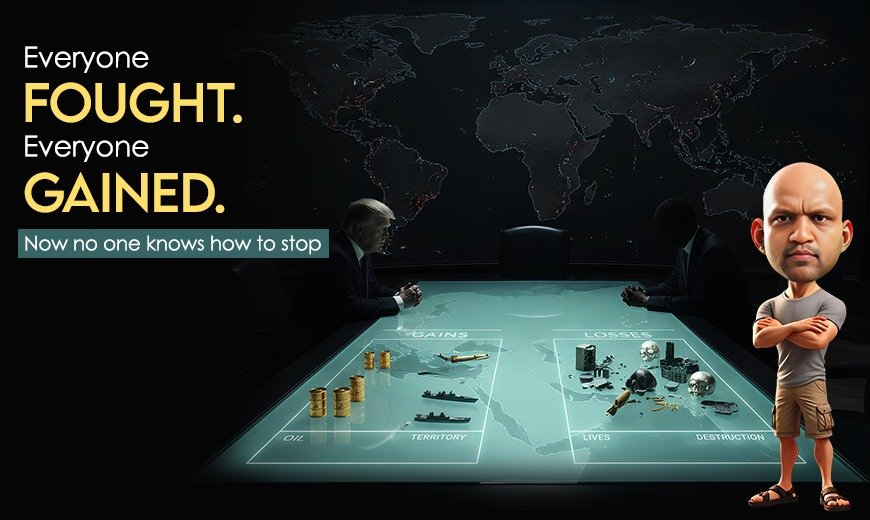
Iran War Winners and Losers Analysis: War Isn’t Chaos. It’s Accounting. Wins & Losses Defined

Strip away the noise and Iran war analysis becomes simple:
Everyone enters a war knowing what they want.
And how much they’re willing to lose to get it.
Now comes the twist.
Donald Trump is suddenly looking for a deal in the broader US-Iran conflict strategy and power dynamics.Israel is still figuring out what its end statement should be.
Iran is publicly saying no.
And the rest of the world?
Quiet.
Not peaceful quiet. Strategic quiet.
Because in this Iran war winners and losers analysis, everyone already got what they came for.
The Endgame Nobody Says Out Loud
There’s a familiar template in Middle East conflict analysis:
Libya
Syria
Iraq
Afghanistan
Destabilize. Fragment. Neutralize.
That’s one possible outcome for Iran.
But this time, it’s not that clean.
Iran isn’t isolated.
It’s embedded.
And it sits on the Strait of Hormuz crisis point.
Which means this isn’t just war.
It’s leverage.
This is where the global impact of Iran war becomes bigger than the battlefield.
Iran War Winners and Losers Analysis: Global Impact & Power Shift
| Country / Bloc | Wins | Losses |
| United States | – Reinforces power narrative – Instills fear globally – Pushes dollar dominance | – Credibility risk without clear win – Weakening Middle East alliances |
| Iran | – Expands proxy influence – Strategic leverage via Hormuz | – Economic damage – Risk of destabilization |
| Russia | – Sanction pressure diluted – Focus shifts from Russia-Ukraine War | – Long-term geopolitical strain |
| China | – Economic expansion – Energy leverage – Taiwan distraction advantage | – Supply chain risks |
| India | – Neutral global positioning – Strategic partnerships across blocs | – Energy shocks – Regional instability |
| Saudi Arabia | – Oil price upside – Strategic leverage | – Security risks – Stability concerns |
| United Arab Emirates | – Early capital inflows | – Loss of safe-haven perception – Real estate hit |
| European Union | – Strategic independence leverage | – Energy crisis – Economic pressure |
| Israel | – Tactical military gains | – Strategic ambiguity – Escalation risks |
| Global Markets | – Gains for energy exporters | – Volatility – Inflation |
This table reflects the broader Iran war global impact and shifting geopolitical power dynamics.
Final Thought
Everyone got something.
Now comes the awkward part:
Ending it.
Because starting wars is strategy.
Ending them is compromise.
And right now:
- One side wants a deal
• One side refuses
• One side is unsure what to say
Which is usually how you know…
The real game in this Iran conflict geopolitical analysis has already been played.
FAQs: Iran War Winners and Losers Analysis
1. Who are the winners and losers in the Iran war?
In any Iran war winners and losers analysis, outcomes are not absolute. Countries like the United States and China may gain strategic or economic advantages, while regions like the European Union face energy and economic pressure. The results depend on how geopolitical leverage evolves over time.
2. What is the global impact of the Iran war?
The global impact of Iran war extends beyond the battlefield. It affects oil prices, global trade routes, inflation, and geopolitical alliances—especially due to the strategic importance of the Strait of Hormuz.
3. Why is the Strait of Hormuz important in the Iran conflict?
The Strait of Hormuz crisis is central to the conflict because a significant portion of the world’s oil supply passes through it. Any disruption here directly impacts global energy markets and economic stability.
4. How does the Iran war affect India’s economy?
The impact of Iran war on India is mainly seen through rising oil prices and regional instability. However, India also maintains a neutral geopolitical stance, allowing it to balance relationships with multiple global powers.
5. Is the Iran war more about strategy than conflict?
Yes, most Iran conflict geopolitical analysis suggests that modern wars are not just about military action but also about strategic positioning, economic leverage, and long-term influence across regions.