Decoding New Age Indian Workplaces. Hidden lessons from TCS Nashik

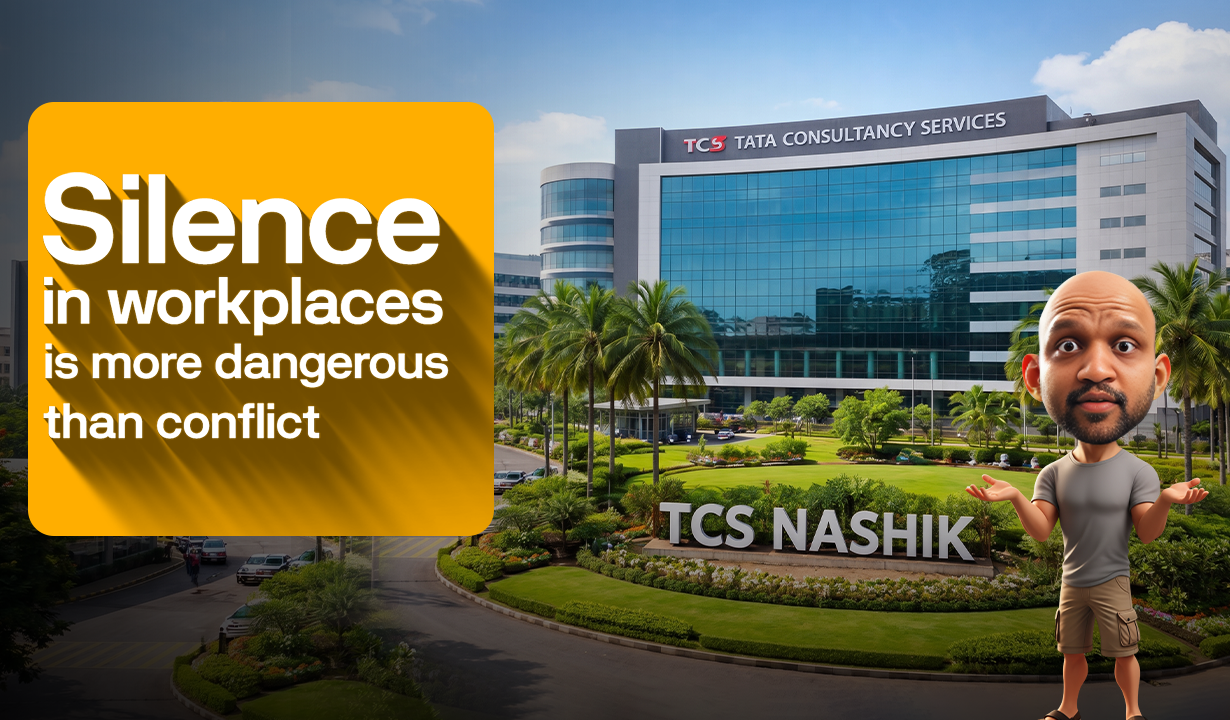
The TCS Nashik Incident Is Not an Exception. It’s a Mirror of Workplace Culture in India.
Everyone is busy debating:
· sexual harassment
· religion
· intent
· outrage
And like always, we’ll miss the point.
This is not about one incident.
This is about a reality we’ve been avoiding in workplace culture in India:
There is not one India. There are multiple India.
And for the first time in history,
they are being forced to sit in the same office.
Two India. Same Desk.
Let’s not pretend we don’t see this every day.
- One youngster works for ambition.
The other works because the family’s survival depends on it. - One lives off parental wealth.
The other is the family’s wealth. - One walks in with:
o confidence
o exposure
o freedom - The other walks in with:
o pressure
o restraint
o inherited beliefs - One believes:
“My life. My rules.” - The other believes:
“My life. My responsibilities.” - One doesn’t care about caste, religion, labels.
· The other is deeply shaped by them. - One wants equality.
· The other sees gender through tradition, roles, boundaries.
And now you expect these two India to “collaborate” inside modern organizations.
The Workplace Is Now a Collision Zone
This is not:
· metro vs small town
· rich vs poor
This is: mindset vs mindset — the core of workplace conflict in India.
And the most uncomfortable truth?
Both think they are right.
And that’s the problem.
Because everyone thinks they’re right. No one is accountable.
The TCS Nashik Case Is a Symptom of Indian Workplace Culture Challenges
What happened there is tragic.
But also predictable.
Because when:
· entitlement meets insecurity
· freedom meets conditioning
· equality meets hierarchy
friction is guaranteed in any Indian workplace culture that lacks clarity.
The Problem Is Deeper Than Safety or Religion
Let’s be clear.
This is not just:
· a woman safety issue
· a religious issue
That’s the surface.
Underneath is:
· entitlement
· power dynamics
· hierarchy
· lack of clear cultural rules
This is where workplace harassment in India and silent discomfort often begin.
Indian Workplaces Are Not Ready for This Reality
We imported:
· global office structures
· modern HR frameworks
· western ideas of equality
But we forgot one thing:
The workforce is still deeply Indian.
Complex. Layered. Contradictory.
That’s the real gap in diversity and inclusion in the workplace in India.
And HR Alone Cannot Fix This
This is where companies hide. Behind HR. Behind policy. Behind process.
They think:
“Let HR handle it.”
No.
This is not policy.
This is culture.
And culture is not built in handbooks or HR policies vs culture debates.
Leadership Has to Own This. Fully.
In my companies, I’ve learnt this the hard way.
We are:
· irreverent
· open
· brutally honest
We joke. We push boundaries. Sometimes uncomfortably.
But:
👉 Zero tolerance for bullshit.
Not sometimes. Not selectively. Not politically.
Always.
What does that actually mean in practice?
Not posters. Not policies. Not workshops.
👉 Real, uncomfortable clarity.
- Define non-negotiables
(No jokes on identity. No “casual” sexism. No grey areas.) - Train managers to handle value clashes, not just performance reviews
(Because most conflicts are not about work. They’re about belief systems.) - Create escalation channels that are actually safe
(Anonymous is useless if nothing happens after—critical for employee safety at workplace.) - Reward people who speak up early
(Not just those who deliver results quietly while problems grow.)
Because culture doesn’t fail in big moments.
👉 It fails in what you ignore daily.
Just like how top talent quietly starts disengaging long before they actually leave.
A Personal Lesson
There was a time someone in my company suffered silently.
Why?
Because she thought:
“He’s close to Kapil. Nothing will happen.”
And this where she was wrong.
Yes, I knew the person.
But once the complaint came in:
👉 He didn’t even get to go back to his seat.
That’s the line.
Not friendship.
Not hierarchy.
Not performance.
👉 Nothing overrides safety and dignity in any ethical workplace culture in India.
This Is the Real Leadership Test
Not growth.
Not valuation.
Not revenue.
👉 Culture under stress — the real test of leadership accountability in the workplace.
- Do people feel safe speaking up?
· Are signals ignored?
· Is silence rewarded?
If yes, you’ve already failed.
The Real Challenge Ahead for Workplace Culture in India
This will become one of India’s biggest growth challenges.
Because:
👉 You cannot scale organizations
if your people cannot coexist
And this problem is growing faster than most leaders are willing to admit.
The Hard Truth
Equality is not simple.
Fairness is not universal.
Culture is not uniform.
Every organization will need to define:
· its boundaries
· its tolerance levels
· its red lines
To avoid a toxic workplace culture in India, clarity is not optional.
And This Goes Beyond Workplaces
Let’s not kid ourselves.
The same conflict exists in households.
That’s a bigger, messier conversation.
One we’ve barely even started.
Final Thought
The Indian workplace is not evolving.
It is colliding.
And unless we:
· acknowledge the multiple Indias
· define clear rules
· enforce them without bias
We will keep reacting to incidents…
because we don’t have the courage to define culture in Indian workplaces.
And behind every “incident” we debate publicly…
there is someone who stopped feeling safe privately
long before anything actually happened.
when the signals were already there, just not taken seriously.
FAQs
1. What are the biggest challenges in workplace culture in India?
Workplace culture in India is shaped by diverse mindsets, social backgrounds, and belief systems. The biggest challenges include clashing values, unclear cultural boundaries, power hierarchies, and lack of leadership accountability, which often lead to conflict and confusion in teams.
2. Why is workplace conflict increasing in Indian organizations?
Workplace conflict in India is rising because employees from different socio-economic, cultural, and ideological backgrounds are working together. When organizations lack clearly defined behavioral norms, these differences turn into friction.
3. How do leadership and management impact workplace culture?
Leadership plays a critical role in shaping workplace culture. Clear communication, consistent enforcement of rules, and zero tolerance for misconduct determine whether employees feel safe and respected—or ignored and hesitant to speak up.
4. What does the TCS Nashik incident reveal about workplace culture in India?
The TCS Nashik incident highlights deeper issues within workplace culture in India, including clashing mindsets, power dynamics, and lack of clearly enforced behavioral boundaries. It shows that many workplace conflicts are not isolated events but symptoms of broader cultural gaps.
5. Is the TCS Nashik case an isolated incident or part of a larger workplace issue?
The TCS Nashik case is not an isolated incident. It reflects a larger pattern of workplace conflict, employee safety concerns, and cultural misalignment seen across many Indian organizations, where policies exist but consistent enforcement and leadership accountability are often missing.