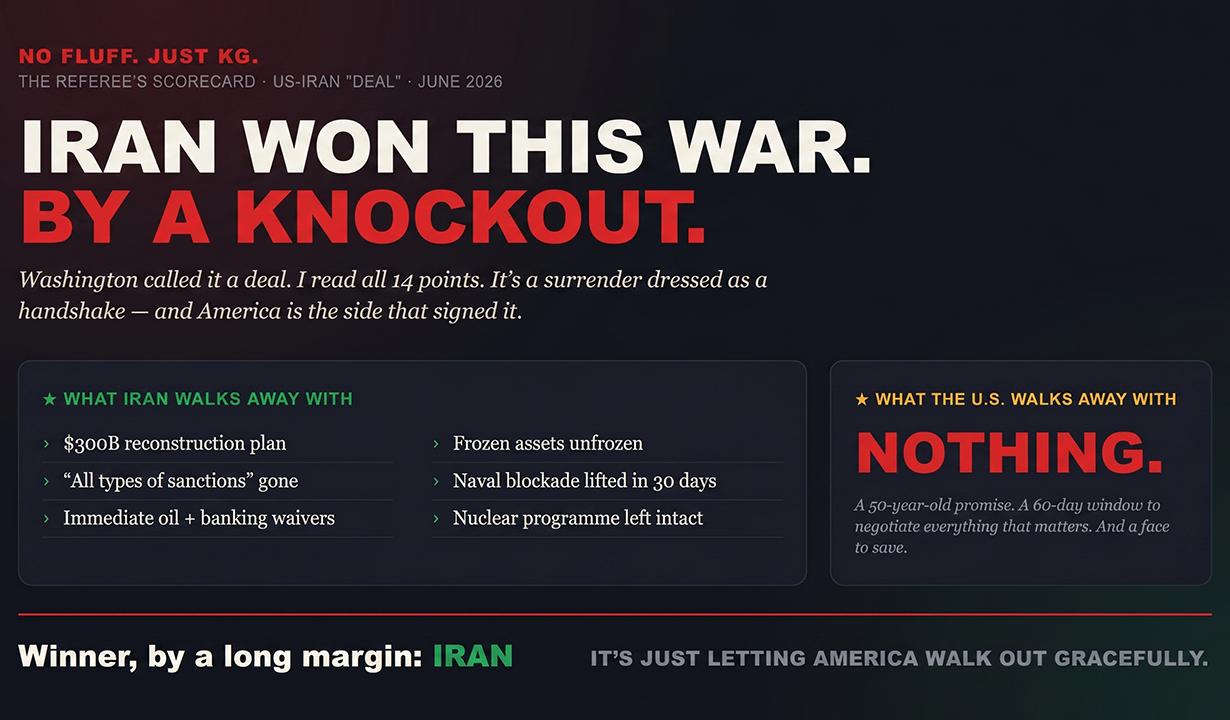
IRAN WON THIS WAR. BY A KNOCKOUT. | US Iran Agreement 2026 Analysis

A referee’s scorecard · June 18, 2026
Washington called it a deal. I read all 14 points. It’s a surrender dressed as a handshake – and America is the side that signed it.
I don’t score a fight by who threw the last punch. I score it by who walks away richer. That’s the only honest way to call a winner – and it’s the one nobody in Washington wants used right now.
So let me do the thing the press conferences won’t. Let me read you the card.
On June 17, the United States and Iran signed the Islamabad Memorandum of Understanding, a 14-point framework that many are calling the US Iran Agreement 2026 – about 800 words, digitally signed, and sold to the world as the deal that ended the war. I read all 14. Slowly. Twice. And I’m going to tell you what I actually saw, including the parts the headlines skipped.
What I saw was not a peace deal. It was an exit. America needed a door to walk out of, and Iran – graciously, expensively – held one open for it.
First: what a win actually looks like
Before you score anything, you agree on what scores. A real win in a conflict like this has three measurable parts. Did you remove the threat? Did you change the other side’s behaviour? Did you walk away owed something, or owing something?
Any serious Iran US Deal Analysis starts with a simple question: who actually improved their position when the signatures dried?
Hold the 14-point memo against those three questions and the card fills itself in. One column overflows. The other is blank. Let me show you.
Column one: everything Iran walks away with
- A permanent ceasefire on every front – the regime survives, intact.
- At least USD 300 billion in a US-backed reconstruction plan. Three hundred billion. To rebuild what the war broke.
- Termination of “all types of sanctions” – UN resolutions and unilateral measures both.
- Immediate US Treasury waivers for Iranian crude, petroleum and the banking and insurance around it. The oil flows on day one.
- Its frozen assets unfrozen, with “full usability” for the Central Bank.
- The US naval blockade gone within 30 days.
- Its nuclear programme “status quo” preserved – in the memo’s own logic, Iran keeps what it has while talks drag.
That is not a column. That is a shopping list, and every line got approved.
Column two: everything the United States walks away with
Ready?
Nothing.
I want to be precise, because precision is the whole point of this piece. Not “not much.” Not “less than hoped.” Nothing you can bank. The US gets a signed promise that Iran won’t build a weapon – a promise Tehran has made, in one form or another, for fifty years. It gets a 60-day window to negotiate everything that actually matters. And it gets the one thing this whole document was really written to deliver: a face to save.
The “60 days” is the con, and it’s hiding in plain sight
Read the memo for the word “within” and watch what happens. The hard things – the nuclear methodology, the sanctions schedule, the asset-release procedure, the reconstruction mechanism, the future of the Strait, and broader Iran Nuclear Negotiations – are all pushed into a 60-day negotiation that hasn’t started and has no detail attached.
There is no detailing for how any of it gets done. None. Point 3 literally writes in its own escape hatch: “maximum 60 days, extendable with mutual consent.” Translation: this can be extended forever, by either side, for any reason. The substance isn’t agreed. The substance is scheduled. And in diplomacy, “we’ll agree later” is what you sign when there’s nothing you could agree on today.
Meanwhile the things that ARE immediate – sanctions waivers, oil, unfrozen cash, lifted blockade – all run one direction. Toward Tehran. Iran banks the certainties now and trades only in IOUs later. That’s not a negotiator’s draw. That’s a negotiator’s mugging.
There is no agreement on nuclear weapons. There is an agreement to keep talking about them.
This is the part dressed up most carefully, so look hardest here. The memo gives you confident-sounding language – “down-blending on site under IAEA supervision,” a “minimum methodology.” It sounds like a plan. It is the opposite of one.
There is no meaningful agreement on nuclear weapons in this version of the Iran Nuclear Deal 2026.
“Minimum methodology.” “On site.” “By mutual agreement.” There is no clarity – none – on how that highly enriched material is actually accessed, who controls the timeline, or what “minimum” even means. The most dangerous stockpile on the table is handled by a phrase, not a procedure. Iran keeps the material, keeps it on its own soil, and keeps the right to argue about the method for the full 60 days and beyond. That isn’t neutralisation. That’s a backdoor with a polite label on it.
Iran kept two backdoors wide open. Both on purpose.
A real settlement closes the exits. This one builds two new ones and hands Tehran the keys.
Backdoor one – Lebanon. The memo declares a permanent end to operations “on all fronts, including in Lebanon.” Beautiful sentence. Except Israel has not stopped, and Iran’s leverage there was never a front it controlled on paper – it was a proxy it controls in practice. A ceasefire that one of the real combatants isn’t honouring isn’t a ceasefire. It’s a pressure valve Iran can open whenever it wants something in the 60-day talks.
Backdoor two – the nuclear material itself. Covered above, but it belongs on this list, because it is the bigger one. As long as the material sits on Iranian soil under an undefined “methodology,” the threat never actually left the room. It just got a chair in the negotiation.
And the Strait of Hormuz? That was already open.
And the Strait of Hormuz Agreement everyone is celebrating? That was already open.
This is the concession everyone is clapping for, so let me ruin it for you. Iran “agreed” to guarantee safe passage through the Strait of Hormuz with no charge for 60 days. Sounds like a gift. It’s a refund on something that was never really yours to take.
The Strait was open before the war. Commercial traffic ran through it for years. Iran closing it was the threat; Iran “opening” it is just Iran agreeing to stop doing the thing that the war was partly about. You don’t get credit for returning what you grabbed during the fight. In a fair scorecard, reopening Hormuz isn’t a point for the deal. It’s zero – the restoration of the status quo, billed as generosity.
So here’s my call. As the referee.
So here’s my call. As the referee conducting an Iran War Ceasefire Analysis.
I’m not a diplomat and I’m not on a team. I read documents for a living and I score what’s actually on the page, not what’s in the press release. On the page, this is one of the most lopsided cards I’ve ever read.
Iran walks away with money, sanctions relief, oil, unfrozen assets, a surviving programme, and both backdoors intact – and gives up a promise it’s made for five decades and a Strait that was already open. The United States walks away with a signature and its dignity.
Winner of this war, by a long margin: Iran. For readers who want a broader scorecard of who gained, who lost, and who merely survived the conflict, see my companion analysis, Iran War Winners and Losers.
If you’re asking who won the Iran US conflict, the scorecard points overwhelmingly in one direction.
It isn’t close. And the most telling detail of all is the kindness in it – Iran is letting America walk out gracefully. That’s not what victors do for equals. That’s what a winner does when it can afford to be generous.
Can this framework grow into a good deal for the US in 60 days? I don’t see it. You don’t negotiate your way back to strength after you’ve already handed over every card you were holding for the leverage you needed at the table. The concessions went out the front door this week. The “talks” are just the paperwork.
A deal that solves nothing, details nothing, and secures nothing for the side that signed it isn’t the end of a war. It’s the polite announcement of who lost it.
No Fluff. Just KG.
Honesty footer (because I don’t pretend)
I’m writing on June 18, the day after the text was released. The 14-point Islamabad Memorandum of Understanding, often referred to as the US Iran Ceasefire Agreement in early reporting, is the US account; Iranian officials had not confirmed the US version of the text at the time of writing, and the document is a framework, not a final agreement – which is exactly my point.
Figures (USD 300bn reconstruction, the 60-day window, the 30-day blockade and Strait timelines, the down-blending “minimum methodology”) are drawn from the released text and contemporaneous reporting. If the final deal in 60 days proves me wrong, I’ll come back and score it again.
Deal’s a deal.
Frequently Asked Questions (FAQs)
1. What is the US Iran Agreement 2026?
The US Iran Agreement 2026, formally presented as the Islamabad Memorandum of Understanding, is a 14-point framework announced on June 17, 2026, to halt hostilities between the United States and Iran. The agreement includes provisions related to sanctions relief, reconstruction funding, nuclear negotiations, asset releases, maritime security, and a broader ceasefire process. However, many of the most important details remain subject to future negotiations.
2. Why does this analysis argue that Iran won the conflict?
This analysis concludes that Iran emerged in a stronger position because it appears to receive immediate benefits, including sanctions relief, access to frozen assets, oil-related waivers, reconstruction commitments, and preservation of its existing nuclear programme status. In contrast, the United States primarily receives commitments that require future negotiations, leading the author to argue that the balance of concessions favours Tehran.
3. Does the US Iran ceasefire agreement resolve the nuclear issue?
Not fully. The framework outlines a process for future Iran nuclear negotiations, but many critical details remain undefined. Questions regarding enriched uranium, verification procedures, implementation timelines, and enforcement mechanisms are expected to be addressed during subsequent negotiations. As a result, the agreement is better understood as a framework for talks rather than a final nuclear settlement.
4. What role does the Strait of Hormuz agreement play in the deal?
The agreement includes provisions for maintaining safe passage through the Strait of Hormuz, one of the world’s most strategically important shipping routes. Supporters view this as an important de-escalation measure for global energy markets. Critics argue that keeping the Strait open largely restores pre-conflict conditions rather than creating a new concession, making its significance a matter of interpretation.