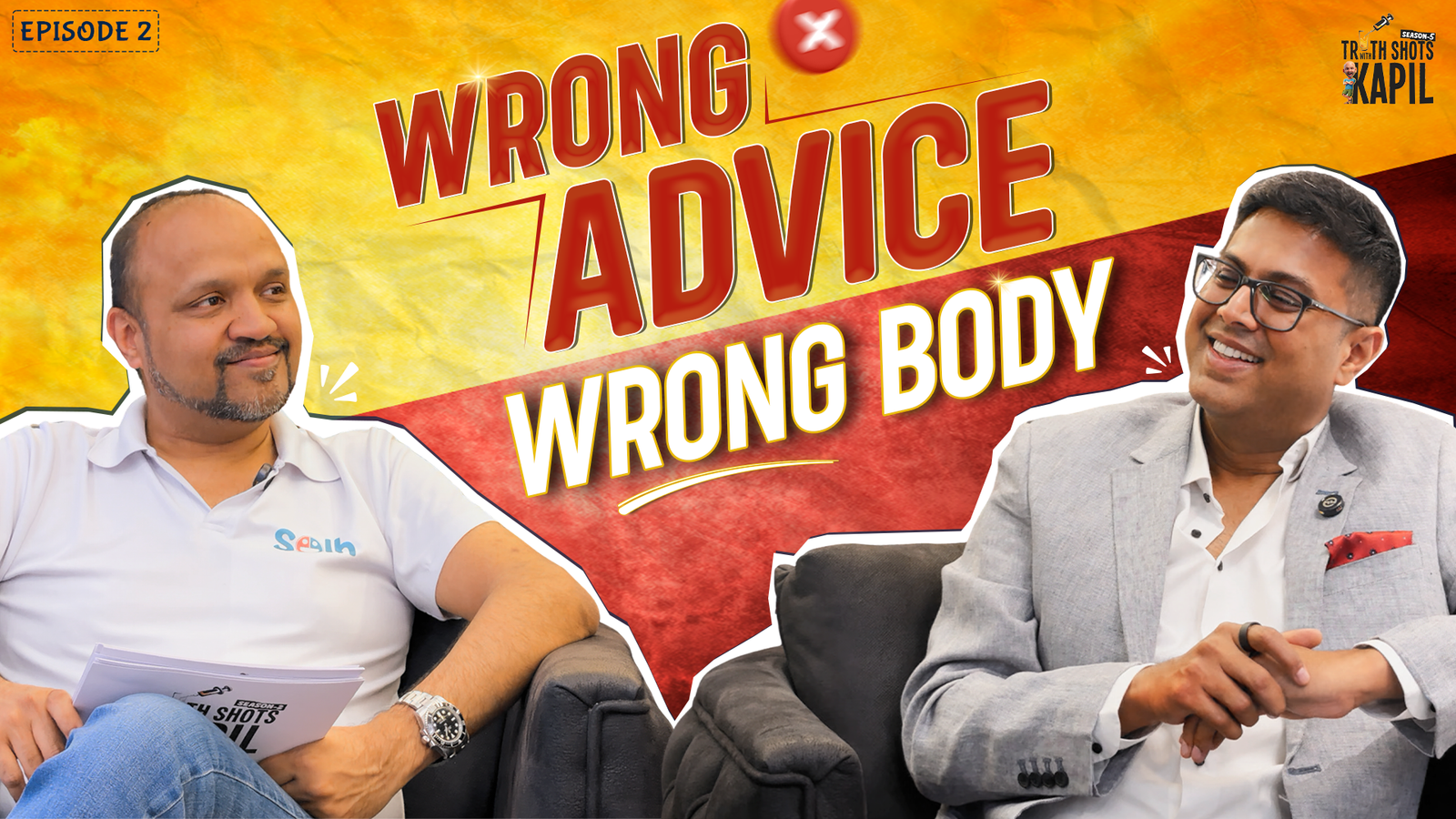
The Health Advice Indians Follow Was Never Written for Indians

We Indians love imported things.
Cars.
Phones.
Management jargon.
And apparently, health advice.
10,000 steps.
BMI.
Intermittent fasting.
Protein targets.
Cold plunges.
Longevity hacks.
All very scientific.
There is just one small problem.
Our bodies may not behave like the bodies those recommendations were originally built around.
That was the starting point of my conversation with Dr. Navin Gnanasekaran in Episode 2 of Truth Shots with Kapil.
And the more we spoke, the more obvious the contradiction became.
Indians are living longer. But we are not necessarily ageing better.
That is where the Indian longevity paradox begins.
Living Longer Is Not the Same as Living Better
Life expectancy has improved.
Wonderful.
But if diabetes starts in your forties, blood pressure follows, muscle disappears, sleep collapses and the last twenty years of your life are spent moving between hospitals…
did we really win?
Dr. Navin calls this the Indian longevity paradox.
We may be extending lifespan while quietly destroying healthspan.
That distinction matters.
Because longevity has become another fashionable word.
Everyone wants to live to 100.
Very few people ask what they want to be capable of doing at 80.
That is probably the more useful question.
Lifespan tells us how long we live. Healthspan asks how well we live those years.
And for Indians thinking about healthy ageing in India, that distinction could change the way we think about longevity altogether.
Looking Healthy Means Very Little
One of the more dangerous ideas in health is:
“I look fine, so I must be fine.”
You can be thin.
You can have a normal BMI.
You can even exercise.
And still have poor metabolic health.
For Indians, this becomes even more relevant because body weight alone does not tell the entire story.
Visceral fat, muscle mass, insulin resistance, inflammation and metabolic markers may tell you far more than the number on a weighing scale.
So perhaps the question is not:
“Am I overweight?”
It is:
“What is actually happening inside my body?”
Less comforting.
Much more useful.
This is why conversations around metabolic health for Indians need to go beyond weight loss and BMI.
Ghar Ka Khana Is Not a Medical Certificate
This one will probably annoy a few mothers.
We have treated “home food” as a synonym for healthy food.
It isn’t.
Something can be homemade and still be badly balanced.
A meal heavy on carbohydrates and low on protein does not suddenly become metabolically perfect because your mother cooked it.
Dal, roti, rice, sabzi.
Nothing wrong with them.
But composition matters.
Quantity matters.
Protein matters.
Muscle matters.
Context matters.
Tradition should not become immunity from questioning.
And when we talk about Indian diet and longevity, the conversation cannot simply stop at whether food is homemade. What matters is the overall nutritional composition, protein intake, portion sizes and how the diet fits into an individual’s lifestyle and metabolic health.
Stress Is Not Just in Your Head
Stress is another word we have managed to make meaningless.
Everyone says they are stressed.
Nobody asks what prolonged stress is doing biologically.
Sleep starts deteriorating.
Blood sugar regulation suffers.
Inflammation rises.
Recovery reduces.
Eating changes.
Movement reduces.
And eventually the body starts paying for a problem that began somewhere else.
We treat stress as an emotional inconvenience.
The body treats it as input.
That difference is important.
The relationship between stress and metabolic health is therefore not something we should dismiss as simply a mental or emotional issue.Stress can also be understood as a biological signal, not merely a feeling.
The Biohacking Circus
Longevity has also created a new industry.
Supplements.
Wearables.
Cold plunges.
Continuous glucose monitors.
Red-light therapy.
Optimisation has become expensive.
Some of it is useful.
Some of it is science.
And some of it is simply very good marketing aimed at people who have not fixed the basics.
There is little point measuring every biological signal if you sleep badly, barely move, have little muscle and live under constant stress.
We keep looking for advanced answers because basic answers are boring.
Unfortunately, the body does not care whether the solution is Instagram-worthy.
Longevity does not necessarily require more hacks. It may require better fundamentals.
Healthspan Is the Real Goal
This was probably my biggest takeaway from the conversation.
The goal should not simply be to avoid dying.
That is an extremely low bar.
The better goal is to remain capable.
To walk.
Think clearly.
Travel.
Work if you want to.
Play with your grandchildren.
Live independently.
Basically, remain alive in every sense of the word.
That is healthspan.
And perhaps that is where Indians need to change the conversation.
Health should ultimately be about more than simply surviving. It should be about preserving dignity, capability and quality of life.
Not:
“How do I live to 100?”
But:
“How much of those 100 years will actually feel like living?”
That is a very different health plan.
And probably a much better one.
For anyone thinking about how to improve healthspan, the answer may not begin with another longevity hack. It may begin with paying attention to metabolic health, muscle, movement, nutrition, sleep and stress.
Because the real goal of longevity for Indians should not simply be a longer life.
It should be a life that remains worth living for longer.
Watch Episode 2 of Truth Shots with Kapil on YouTube @kgismofficial.