The Problem Isn’t Screen Time. It’s What We Do With It.

There is something slightly ironic about the way we talk about children and screens.
We tell them to put the phone down.
Usually while holding ours.
We tell them not to watch too much YouTube.
Then spend two hours scrolling reels because we had a “stressful day.”
We worry that children are addicted to screens.
And when we need twenty minutes of peace, what do we hand them?
A screen.
So maybe the conversation around screen time needs to change.
Maybe the problem was never just the screen.
Maybe the problem is what we do with it.
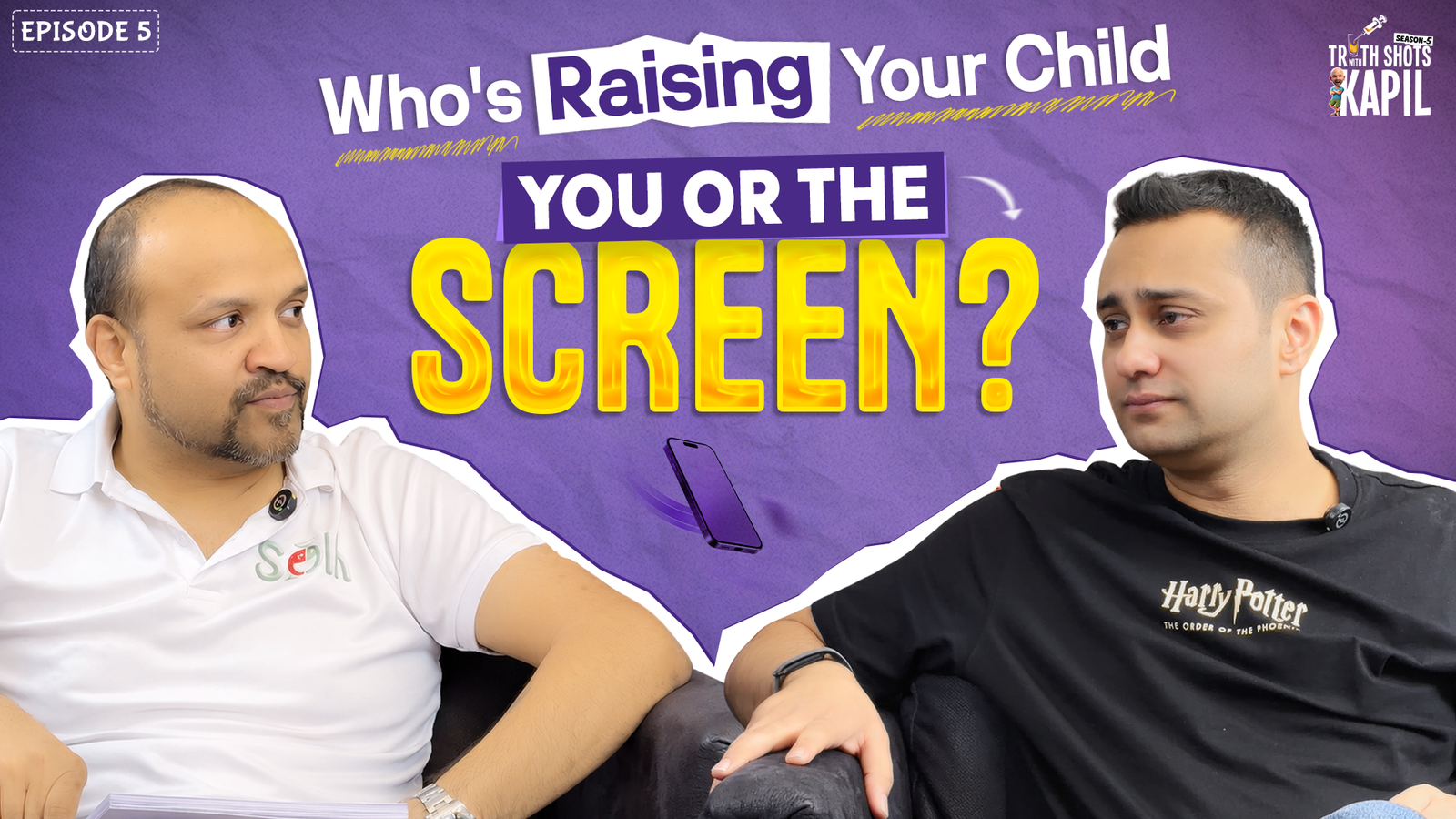
In Episode 5 of Truth Shots with Kapil, I sat down with Kushal Dev Kashyap—or KD, as I have known him for almost two decades—to talk about children, parenting, content, attention, algorithms and eventually, AI.
And somewhere through the conversation, I realised that we spend a lot of time asking:
How much screen time should a child have?
Maybe we should spend a little more time asking:
What is the child doing with that screen?
Screen Time Is an Easy Villain
I understand why parents hate screens.
If given a choice, most of us would probably want our children to spend less time on them.
But there is one small problem.
Screens aren’t going anywhere.
Schools use them.
Children learn through them.
They discover things through them.
Information increasingly reaches them through them.
And tomorrow, with AI and technology, that relationship is only going to become deeper.
So saying “no screens” may make us feel like responsible parents.
It doesn’t necessarily make it practical parenting.
KD put it simply:
The problem is never the screen. The problem is what you do with the screen.
Think about food.
Eating outside isn’t automatically unhealthy.
What matters is what you’re eating.
A burger, fries and Coke every day is one thing.
Making a better choice is another.
The screen is simply the medium.
The question is what we put through it.
Forty-Five Minutes Can Still Be Forty-Five Bad Minutes
KD spoke about allowing his son around 45 minutes of screen time.
But then he noticed something.
Children naturally gravitate towards content designed to hold them.
Fast movement.
Fighting.
Action.
Bright visuals.
Constant stimulation.
And over time, he felt some of that content was making his son slightly more aggressive.
So the question changed.
Instead of only asking:
“How do I reduce those 45 minutes?”
He started asking:
“If those 45 minutes are going to exist anyway, what can they give him?”
Maybe one lesson.
Maybe one idea.
Maybe even the same lesson repeated twenty times until it becomes part of how the child thinks.
That, to me, is a much more useful conversation than simply counting minutes.
Because thirty minutes of garbage doesn’t automatically become healthy because it falls within your screen-time limit.
Are We Designing Content for Children—or for Algorithms?
This is where things get uncomfortable.
Children’s content used to come from parents, grandparents and communities.
Someone sang something to a child.
Someone created a rhyme.
Someone told a story.
It survived because children enjoyed it and parents kept passing it down.
Then children’s attention became a business.
And once attention becomes a business, the incentive changes.
You don’t just ask:
What should this child learn?
You also start asking:
What will keep this child watching?
What gets another view?
What improves retention?
What gets picked up by the algorithm?
What creates fifteen more minutes of watch time?
And eventually:
What makes more money?
KD made an important point during our conversation.
One of the biggest mistakes people making children’s content can make is chasing short-term gains.
Because when the objective becomes keeping a child on the platform for three hours, the content naturally begins changing.
Faster graphics.
More stimulation.
More clickbait.
More things designed not necessarily to teach the child—but to stop the child from leaving.
And that’s a very different objective.
Your Child Is Learning. The Question Is What.
Children learn from repetition.
But they also learn from consequences.
This took our conversation into parenting itself.
I have a theory that I often tell young parents.
There are two ways to parent:
Either you teach, or you learn.
And sometimes, without realising it, parents become excellent students.
A child throws a tantrum.
The parent says no.
The tantrum gets louder.
Still no.
The child cries for another ten minutes.
The parent gets embarrassed.
And finally says yes.
What did the child learn?
Not that tantrums don’t work.
The child learned:
Ten minutes wasn’t enough. Next time, try twenty.
KD connected this beautifully to machine learning.
A child is constantly classifying actions and outcomes.
I did X.
Y happened.
So if I want Y again, I should repeat X.
We think we are stopping the tantrum.
The child may simply be training us.
Sometimes the Phone Is Solving the Parent’s Problem
There was another uncomfortable point in the conversation.
Sometimes we give children screens because children need them.
Sometimes we give children screens because we need them to have one.
You want to shop.
The child is bored.
You want to finish dinner.
The child wants attention.
You want to sit peacefully.
The child wants to play.
So the phone appears.
And suddenly everybody is happy.
Until we later complain that the child always wants the phone.
The screen didn’t create that arrangement alone.
We participated in creating it.
Which is why parenting around technology cannot only be about controlling the child’s behaviour.
It has to involve examining ours.
“Don’t Use Your Phone.”
One of my favourite moments came towards the end.
I asked KD:
What is one thing parents say about children’s screen time but don’t practise themselves?
His answer was basically:
Don’t have screen time.
Parents will tell children:
Don’t use your phone while eating.
Don’t keep watching videos.
Go outside.
Do something else.
Then after five meetings and a stressful day, the parent lies in bed and scrolls for two hours because:
“I need some me time.”
Children notice.
If a grandfather gets up after dinner every day and goes for a walk, the child sees that too.
If every adult in the house finishes dinner and immediately picks up a phone, the child sees that.
Children don’t only learn from what we tell them.
They learn from what adulthood looks like around them.
Don’t Give Children All Your Baggage
Another part of the conversation I found interesting had nothing to do with screens.
It was about beliefs.
Every adult arrives at parenting with baggage.
Religion.
Food.
Politics.
Social beliefs.
Things our parents taught us.
Things we rejected.
Things we discovered.
Things we became convinced were right.
And then there is a temptation to package all of that and hand it to the child.
KD’s point was simple.
Maybe don’t.
Give children a framework.
Give them guardrails.
Protect them from being pushed towards extremes.
But leave enough space for them to eventually make some choices themselves.
Parenting cannot mean creating a smaller version of yourself.
Stop Turning Every Behaviour Into a Label
We also got into something that has become increasingly common.
Parents diagnosing children through the internet.
A child cannot sit still.
“Maybe ADHD.”
A child gets distracted.
“Definitely ADHD.”
A reel appears.
Three symptoms match.
And suddenly the diagnosis is complete.
There is obviously a place for diagnosis.
There is a place for professional support.
And genuine conditions should absolutely not be ignored.
But casually giving a child a label can create another problem.
Because eventually the child starts hearing the label too.
And sometimes a description of a difficulty slowly becomes an identity.
“I can’t do this because I have this.”
There is a difference between understanding a problem and allowing the problem to define the person.
That distinction matters.
Especially for children.
Maybe Children Need More Responsibility, Not Less
The conversation then went somewhere I wasn’t expecting.
Responsibility.
We spend a lot of time trying to make childhood easier.
Perhaps sometimes too easy.
KD spoke about giving children responsibilities within the house.
Not as punishment.
As participation.
Take the garbage out.
Help with something.
Be responsible for someone other than yourself.
Because responsibility forces regulation.
If someone depends on you to be somewhere at eight, you have to organise yourself accordingly.
If something in the house is your responsibility, your actions suddenly affect other people.
There is a difference between:
“Do this because I told you to.”
and
“Do this because people are depending on you.”
One teaches obedience.
The other can teach responsibility.
And Then There Is AI
No conversation in 2026 ends without AI.
But with children, AI becomes particularly interesting.
Because the biggest promise may not simply be that AI gives children answers.
It may be that AI eventually understands how each child learns.
Imagine a classroom of fifty students.
Same teacher.
Same lesson.
Same hour.
But fifty different starting points.
Fifty different attention spans.
Fifty different gaps.
One child understands the physics but struggles because the mathematics underneath it is weak.
Another understands the mathematics but hasn’t understood the concept.
A teacher cannot always identify every individual gap in real time.
An AI companion potentially can.
KD believes that children growing up today may eventually have AI companions deeply attuned to their individual learning needs.
Not simply:
“Here is the answer.”
But:
“Here is where you went wrong.”
“Here is the concept you’re missing.”
“Go back and learn this first.”
And that could fundamentally change education.
Maybe Technology Isn’t the Enemy
We love making technology the villain.
Screens are bad.
Social media is bad.
AI is dangerous.
And yes, every one of them can create problems.
But technology can also make the world’s best education available to a child who would never otherwise have access to it.
It can personalise learning.
It can identify gaps.
It can bring expertise to places where expertise wasn’t previously available.
The same screen can show a child mindless content for three hours.
Or teach them something their school couldn’t.
Which brings us back to where we started.
Maybe the screen was never the whole problem.
The algorithm matters.
The content matters.
The creator’s intent matters.
The parent’s choices matter.
And perhaps most importantly:
The example we set matters.
We can tell children to put their phones down.
Or we can occasionally put ours down first.
Because children are always learning.
Even when we don’t realise we’re teaching them.
Frequently Asked Questions
How much screen time should a child have?
There is no single screen-time limit that works for every child. The more useful question is what the child is doing during that screen time. The content, purpose, quality of engagement and overall routine matter alongside the number of minutes.
Is screen time bad for children?
Screen time itself is not necessarily bad for children. Screens can be used for entertainment, learning, communication and discovery. What matters is the content children consume, how they use technology and the habits adults model around them.
What should parents do about children’s screen time?
Parents can focus not only on reducing screen time but also on improving what children do with screens. Choosing age-appropriate, meaningful content and setting healthy boundaries can make screen use more purposeful.
Do children learn from what their parents do?
Yes. Children learn not only from instructions but also from observing adults. If parents constantly use their phones, children may naturally see that behaviour as normal. Modelling healthy technology habits can therefore be an important part of digital parenting.
Can AI help children learn better?
AI has the potential to personalise learning by identifying individual learning gaps and adapting support to a child’s needs. Rather than simply providing answers, AI could potentially help children understand where they went wrong and what they need to learn next.
Should parents diagnose children’s behaviour through social media?
Parents should be cautious about interpreting social media content as a diagnosis. Behavioural difficulties can have many causes, and genuine concerns should be discussed with qualified professionals rather than relying on short online videos or symptom lists.
Why is the quality of screen time important?
Not all screen time serves the same purpose. A child can spend 45 minutes watching highly stimulating content or spend the same amount of time learning something useful. Looking at the quality and purpose of screen use gives parents a more meaningful way to think about technology.