Delhi Protest Crackdown: Why I Now Support This Protest

A No-Fluff Note from KG
Let me be honest about where I stand,all of it,because on a day like this, people want to sort you before they have even read you.
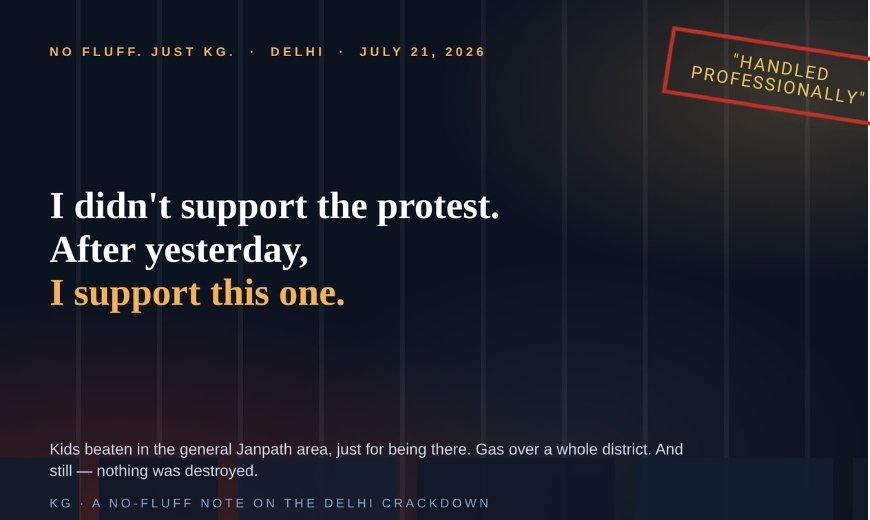
I did not support this protest.
I can be,and often am,a Modi supporter. I do not back the Cockroach Janta Party. I do not back Sonam Wangchuk’s fast or the theatre around it.
And with every bit of that on the table, I am telling you plainly:
What the state allegedly did in Delhi yesterday was horrific.
The protest it has now turned into,the one against the Delhi protest crackdown itself,is one I will stand for.
I am not writing this from behind a wide-angle lens either. Someone I love was on Janpath yesterday and came home with a firsthand account that rearranged how I read every headline.
I will leave it at that because who I happen to know is a footnote.
What was allegedly done,in the open, to peaceful people, in the middle of the national capital,is the story.
Here is the line I want to draw a box around and never let anyone smudge:
You do not have to support CJP.
You do not have to support Wangchuk.
You can even be a card-carrying Modi supporter.
And you can still question police action against peaceful protesters.
Those things are not in tension. Anyone who tells you they are is selling you a jersey you did not ask for.
What Happened During the Janpath Protest Crackdown?
The official account will likely be neat: a flashpoint at Jantar Mantar, a barricade broken and a measured response from the police.
That is not the version I heard.
According to the firsthand account shared with me, the beatings were not confined to Jantar Mantar. Children and young people were allegedly struck in the general Janpath area,away from the barricades, not pushing, not sloganeering and not doing anything except being present.
The tear gas, I was told, was not limited to one hot spot. It reportedly spread across a much wider stretch, affecting parts of Janpath, Sansad Marg and the Tolstoy Marg connector.
People did not have to be part of the flashpoint.
They only had to be in the area.
That was allegedly enough to get gassed. That was allegedly enough to get hit.
Reports surrounding the Delhi student protest also described a massive security presence, barricades, mobile internet restrictions and the closure of central Delhi metro stations. Videos and accounts circulating from the area reportedly showed injured young protesters and commuters struggling to exit closed stations.
I initially read those reports and thought, grimly, that it was happening somewhere “out there.”
Then someone I love walked through the door and told me what they had witnessed.
The Only Two Places Where a Child Felt Safe
Here is the detail that told me everything about the shape of that day.
By the account I trust most, there were two places where students felt safe.
The first was inside cafés.
And the cafés,credit where it is due,quietly dropped the usual rule. Nobody came around asking whether every person hiding inside had ordered something.
For one afternoon, a latte you did not buy was the price of not being beaten.
The cafés decided that was no price at all.
That is ordinary people offering the basic decency they felt the state had abandoned.
The second place was Bangla Sahib.
Children and students reportedly ran into the gurudwara because they believed the authorities would not send forces inside a religious institution.
Let that sink in.
In the middle of the national capital, a house of God became a sanctuary from the state.
When the one place where people believe they will not be gassed or beaten is a gurudwara, we are forced to confront an uncomfortable question:
Where do the real limits on power sit?
Because at that moment, they did not appear to sit in the Constitution.
What Made This Delhi Student Protest Different?
In all the years I have watched protests in this country, I cannot remember many large demonstrations where public property was not destroyed.
We know the usual images:
An overturned barricade.
A torched state-transport bus.
A smashed shopfront.
Stones flying across the road.
The images are so routine that we have stopped asking whether violence is inevitable.
But according to the available accounts of this protest, nothing burned.
Thousands of angry, frightened and allegedly tear-gassed people,including schoolchildren in uniform,were present, yet there were no widespread reports of buses being torched, shops being destroyed or organised stone-pelting.
The city’s property came home in better shape than the city’s children did.
That deserves to be stated plainly because it challenges the justification normally used for aggressive crowd control.
And yes, I can already hear the reply:
“But there are always some goons.”
Of course. In a crowd of thousands, you can find a few of anything.
But using the actions of two or three people to justify what was allegedly done to thousands is a con. It deliberately shifts attention away from the central issue.
The larger crowd reportedly remained disciplined.
The force sent to control it allegedly did not show the same restraint.
When protesters break nothing and the state breaks heads, “but the goons” is not an argument.
It is a distraction.
And I will not take the bait.
From a NEET Protest to a Protest Against the Crackdown
Here is the honest arc of it.
This started as a protest connected to NEET and Dharmendra Pradhan. I have already questioned the government’s response to the NEET paper leak and its tendency to address the messenger instead of fixing the system that failed students.
Thousands of people knew they had “come to protest,” but there seemed to be little clarity about the plan, the exact demand or the win condition. The stated objective appeared to shift by the hour.
I said that before, and I stand by it.As I explained in my earlier analysis of the Cockroach Janta Party protest, the movement appeared disorganised and lacked a clear plan, demand or win condition.
I did not support that protest.
But the nature of the protest has now changed.
After what allegedly happened, this is no longer only about an examination. It has become a protest against the response,against the alleged gassing of a wider area, the beating of bystanders and the closing of exits on citizens.
That is why I now stand against the Delhi protest crackdown.
Not because I have switched political jerseys. I have not.
I am the same person,lukewarm on CJP and broadly fine with Modi,that I was before this happened.
But the object of the protest has changed into something every citizen should be capable of agreeing on, regardless of politics:
The state does not get to use disproportionate force against peaceful people,especially children.
The right to peaceful protest in India cannot depend on whether those in power approve of the protesters’ politics.
If events had gone even slightly worse,a stampede at a locked metro gate or one panicked baton too many,we might be using much darker words to describe what happened.
We were closer to that possibility than anyone in power may want to admit.
The Silence from the Top
I will say this even as someone who can support Modi:
The response from the top was indefensible.
The Prime Minister opened the Monsoon Session speaking about economic growth while reports of children being gassed and beaten emerged from a short distance away.
He said nothing about it.
Being able to support a political leader does not require pretending that his silence is meaningless.
Silence is also a choice.
On that day, it may have been the loudest thing the government said.
The official engagement, when it eventually came, felt like a shrug in a suit,Health Minister J.P. Nadda meeting a small number of representatives, reportedly without making any clear commitments.
It came after the alleged Janpath lathi charge and the wider police response had already occurred.
The police claimed that the situation was handled professionally and disputed allegations of excessive force.
But citizens have videos. There are images of injured protesters. There are numerous eyewitness accounts.
At some point, an official statement stops being an explanation and starts sounding like a dare to disbelieve your own eyes.
Why Did the State Respond This Way?
I want to flag this clearly as a citizen’s speculation,not a charge sheet.
When a state appears to respond so aggressively to a disorganised, largely unarmed crowd that reportedly caused little damage, a gap emerges that the official explanation does not fully address.
Why was mobile internet restricted?
Why were exits closed?
Why was tear gas reportedly allowed to affect a wider area?
Why was such an extensive security response considered necessary for a march that did not result in widespread destruction of public property?
The official reasons do not appear to cover the size of the response.
Overreaction on this scale often appears to come from fear, not confidence.
A confident government can let people shout, make their demands and eventually return home. A fearful system treats even a disorganised gathering as an existential threat.
Whatever the real explanation may be, the questions deserve answers.
You Don’t Have to Support the Protesters
So here is where I land.
Not with the CJP.
Not against Modi.
Not with every demand made at the original protest.
I stand with one simple, non-negotiable idea:
A young person must be able to stand in a public square in a democracy,be wrong, be disorganised, be loud and be inconvenient,and still come home unbeaten.
That idea allegedly bled on Janpath.
You do not have to support the original protest to be disturbed by the Delhi protest crackdown.
You only have to imagine that it was your child breathing in that gas, standing near that locked gate or looking for somewhere safe to hide.
That is why I did not support the protest then.
And that is why I support this one now.
— KG
Editorial note: This article combines personal opinion, a firsthand account shared with the author and publicly reported claims. Specific figures, locations, injuries and official actions should be independently verified and linked to credible sources before publication.